
My Take Tuesday: The Hippopotamus
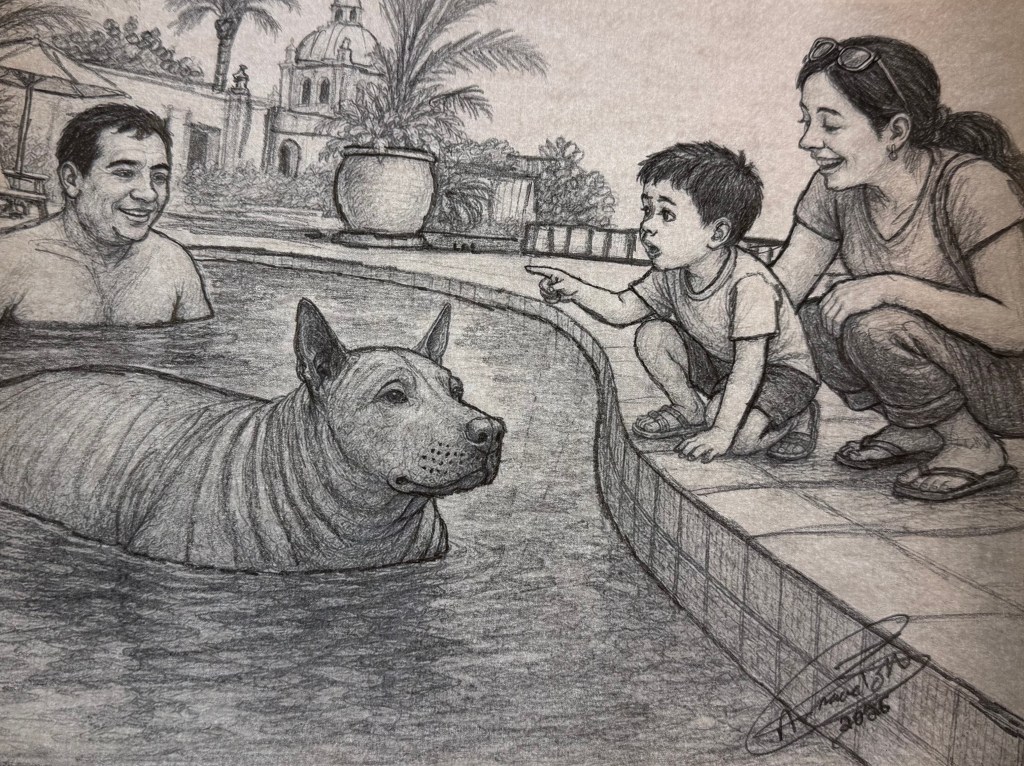
Years ago, I was swimming in Lima, Peru, when I saw one of my favorite breeds of dog paddling through the pool—a Peruvian Inca Orchid.
For those unfamiliar, the Peruvian Inca Orchid is a remarkable breed. Sleek. Ancient. Elegant. Completely hairless. They are native to Peru. Normally, they weigh around 40–50 pounds.
This one had apparently moved to a much larger neighborhood.
He was a magnificent specimen—round, buoyant, and glistening in the Peruvian sun like a well-fed river creature with excellent self-esteem. His owner was helping him swim, and he was doing his best, rolling through the water with all the grace of a canoe full of potatoes.
Just then, a small child walked to the edge of the pool. He stopped. He stared. His little brow wrinkled with the honest confusion only a child can get away with.
Then he looked up at his mother and asked, “Is that a hippopotamus?”
His mother laughed and said, “No, son. It’s just a large dog.”
And technically, she was right.
But I saw the boy’s point.
From his angle, that hairless, barrel-bodied dog drifting through the water looked less like a pet and more like something that ought to be featured on a nature documentary.
Children have a gift for saying the thing everyone else is trying not to say. Adults dress things up. We soften the edges. We say “big-boned,” “stout,” “well-conditioned,” or “food motivated.”
A child just looks at the pool and says, “hippopotamus.”
And sometimes, there is wisdom in that.
Veterinary medicine has taught me that beauty comes in many shapes. Some animals are graceful. Some are majestic. Some are aerodynamic.
But every one of them has a story, a personality, and someone who loves them.
That big Peruvian Inca Orchid may not have been built like a show dog, but he was loved enough to be swimming in a pool in Lima with his owner right beside him. And that says something.
Sometimes love looks like ribbons and perfect posture.
Sometimes it looks like a hairless dog doing laps while a child questions his taxonomic classification.
Either way, it made me smile.
And that oversized Peruvian Inca Orchid truly did look vaguely Hippopotamus amphibius.
And that is My Take.
N. Isaac Bott, DVM

