
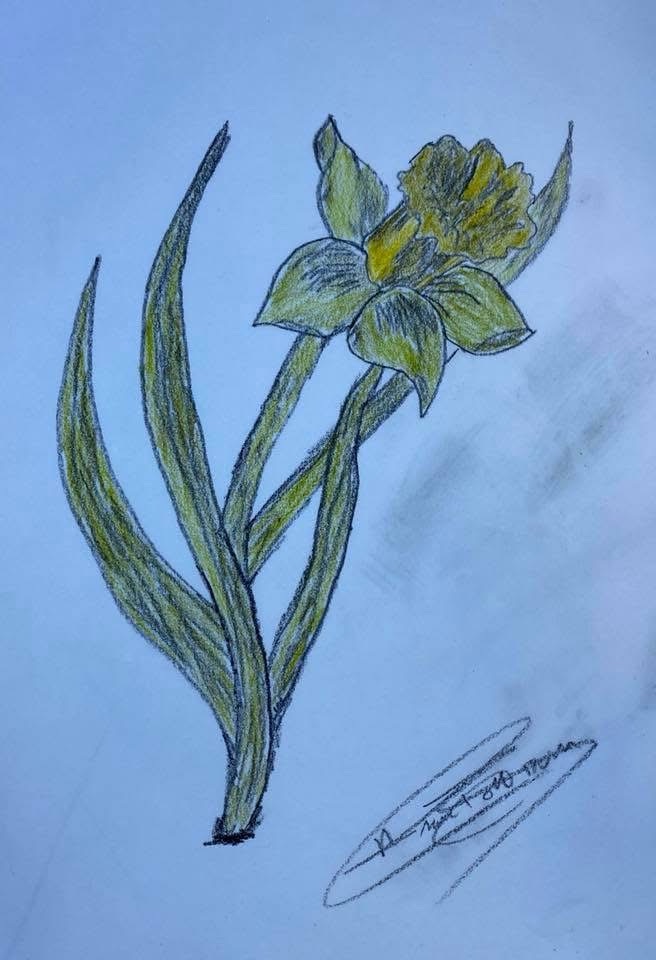
My Take Tuesday: Where the Daffodils Grow
On August 22, 1877, Brigham Young issued his final call for settlers to establish themselves in Castle Valley. Just seven days later, the “Great Colonizer” passed away, making this his last directive. If you’ve ever visited Emery County, you might leave with the feeling that the best was, indeed, saved for last.
Castle Valley is a land of extremes—where the towering Wasatch Mountains rise mystically to the west and the San Rafael Desert stretches endlessly to the east, a landscape of stark, breathtaking desolation. Yet, even among the sagebrush and junipers, there is a quiet, unyielding beauty waiting to be seen by those who look closely.
My great-great-grandfather, Boye Petersen, answered Brigham Young’s call and became one of Castle Dale’s original settlers. He homesteaded the West Farm, a 48-acre piece of land that remains in our family to this day. A straight road connects Castle Dale to Orangeville, running past that land—a road fittingly named Bott Lane.
Growing up in Castle Dale shaped me in ways that continue to define me. It instilled in me a strong work ethic, a vivid imagination, and a rare sense of self-awareness. This place is my home—not just in memory but in spirit. Emery County has a way of healing me. It is my sanctuary, my constant, the quiet refuge where I can reflect and recharge. Though I now live two hours north in Utah County, my heart remains tethered to the well-worn paths of my youth and the Blue Clay Hills just south of Castle Dale. Trail Mountain lightning runs through my veins, and Castle Valley thunder echoes in my chest.
Winters in Castle Valley can be relentless. The snow lingers, the ice thickens, and farm chores become grueling. Milking cows and hauling hay become battles against the elements. Manure piles freeze as hard as stone, and the ground around the water troughs turns to treacherous sheets of ice. In those long, frigid months, the yearning for spring is almost instinctive.
It was during one of those bitter winters that I first noticed them—small green shoots pressing through the frozen ground along the shaded path by my uncle Jerry’s house. Each morning and afternoon, as I crossed the street toward the corral, I would pass that same spot, watching as those brave little leaves pushed upward, undeterred by the frost. The sight was a quiet promise: winter’s grip was loosening, and spring was on its way.
The daffodils came quickly after that, rising with a certainty that felt almost miraculous. Their golden trumpets stood tall, a fanfare of yellow against the lingering gray of winter. They swayed in the breeze as if tomorrow was assured.
And then, just as suddenly as they arrived, they were gone—vanishing until the next year.
The Latin name for daffodil is Narcissus, a nod to the Greek myth of a river god’s son. Fleeting as their bloom may be, they remain a gift for those who pause long enough to notice them—soaking up the sunlight, drinking in yesterday’s rain, standing tall despite their transience.
Daffodils remind me of my uncle Jerry. He passed away in 2016, but his kindness, along with that of his twin brother Jeffry, remains unmatched. He was a gentle giant, steady and quiet, much like those golden blooms.
As winter fades, the robins and sparrows will return, heralding the change of seasons. The rivers and streams will swell with mountain runoff, and nature’s palette will once again color Castle Valley.
And, in Castle Dale, Utah, where the daffodils grow, spring will follow at last.
And that is my take.
N. Isaac Bott, DVM
 DocBott
❤️❤️
LikeLike