The Negative Review

My Take Tuesday: The Negative Review

When was the last time you heard of someone phone shopping for the price of their hysterectomy? Imagine being on the receiving end of such a phone call. As strange as it may sound, this is something that veterinary clinics deal with every single day.

Our policy at Mountain West Animal Hospital is not to give estimates for surgical procedures without first seeing a pet. Prices vary greatly with most medical care, especially surgery. Every animal is unique and individual. Prices vary on the need of each animal. Depending on health and condition some patients require different anesthesia, more care, different treatments to go home and so forth. There are myriads of variables that must be considered when providing an estimate for a surgical procedure and a thorough physical examination is required to provide such an estimate accurately.

Despite the misinformed general public perception, a “spay” is not a simple surgery. The ovaries are held in place, in close proximity to the kidneys, by a ligament. Arteries that branch from the aorta supply the blood to each ovary. Two additional arteries provide the blood supply to the uterus. Each of these 4 major arteries are ligated during a “routine” spay. This is a very invasive procedure. Despite this, the total cost to spay a 100 pound dog is still only around $300. In contrast, the total cost to perform an ovariohysterectomy (“spay”) on a 100 pound woman is about $40,000 – over one-hundred times as much!

As a veterinarian, I have always been interested in parallels between my profession and the human health care profession. While veterinarians, on some levels, seem to try to model what we do after “how it’s done in human medicine”, there are some things that I hope we will always do differently.

We have been able to keep our fees for most procedures relatively low compared to the same procedures in human medicine. The reasons for this difference are numerous, but in my opinion come down to mostly two things. The first is that we, as human patients, have become so dependent on insurance to cover our medical bills that we have removed competition from the equation.

Another major difference between veterinary medicine and human health care is the degree of specialization. Yes we do have a growing number of specialties in veterinary medicine, including surgeons, cardiologists, neurologists, dermatologists etc., etc., but for the most part, we as general practitioners, are still able to do what we feel we are capable and qualified to do. Therefore, we are able to treat most problems that arise in pets very efficiently and without having to refer our patients to a specialist for everything more severe than a laceration or an ear infection.

All to often in human medicine, many different specialty practitioners share in the care of a patient. As Dr. Bob Encinosa has observed, “One doctor takes care of Mary’s diabetes, while another takes care of her heart condition and yet another handles her dementia or her arthritis. It becomes very easy to overlook the question, “How is Mary?”

At Mountain West Animal Hospital, we provide individualized care. We strive to provide the best possible veterinary care for our patients by maintaining and utilizing state of the art facilities and equipment, and by employing and developing a well-trained competent and caring staff. We are dedicated to providing friendly, compassionate service to our clients in an atmosphere of professionalism, respect and concern. We advocate community and client responsibility in improving the welfare of animals. We seek to be a positive, contributing influence within the community we serve.

Unfortunately, occasional negative reviews are posted that reflect a lack of respect for our high standard of care and commitment to pets. If you appreciate our individualized care, I encourage you to provide a positive google review.

I feel that we have the best clients and patients out there. I consider myself blessed to work with such extraordinary people and to be able to help their beloved four-legged family members.

And that is my take!

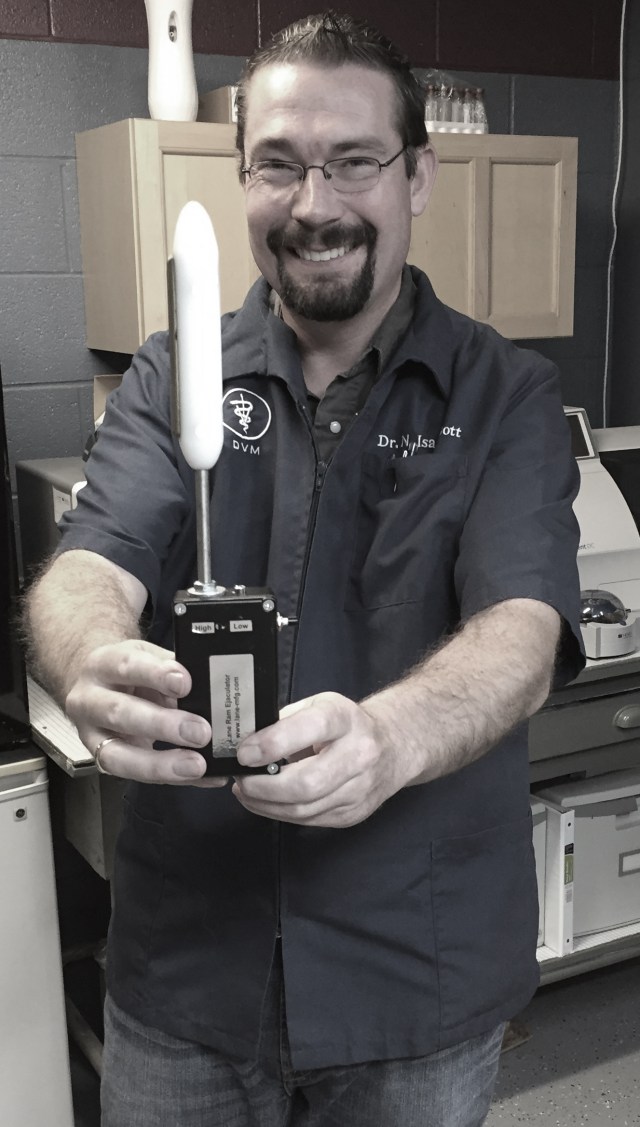
N. Isaac Bott, DVM
Frank The Turtle

My Take Tuesday: Frank The Turtle

Third grade seemed to be a particularly creative time during my childhood. I remember sitting quietly in Mrs. Wikersham’s class at Castle Dale Elementary. As part of our daily routine, we would recite a poem each day. Most of the poems were short and simple and easy to remember. I still remember most of them verbatim. One of my favorites was about a little turtle, and it went like this:

“There was a little turtle.

He lived in a box.

He swam in a puddle.

He climbed on the rocks.

He snapped at a mosquito.

He snapped at a flea.

He snapped at a minnow.

And he snapped at me.

He caught the mosquito.

He caught the flea.

He caught the minnow.

But he didn’t catch me!”

I remember Mrs. Wikersham’s facial expressions vividly as she would teach us hand actions that went along with this poem.

A snapping turtle? It was something I could only dream about as a sheltered kid  in a small town.

I recently thought about Mrs. Wikersham’s class after receiving an unusual call.

Frank the turtle needed an examination and a health certificate before flying to a warmer state. His owner called and explained that she could not find a veterinarian that would look at her turtle before her afternoon flight.

I really don’t know much about exotic pets, I somewhat reluctantly agreed to see her and provide the needed travel paperwork.

I entered the exam room to see the cutest little turtle imaginable. His innocent eyes peered up at me as I held him in my hands. I quickly looked him over and filled out the needed paperwork.

I handed the paperwork to the client and wished her safe travels. I then reached down to pat Frank on the top of his shell. Without warning, Frank snapped the tip of my right pointer finger.

Immediately, pain shot up my hand and continued all the way up my arm.

“Ouch!!!” I exclaimed, “That really hurts!”

Bewilderment filled my eyes. I didn’t see this coming. Frank, it turns out isn’t quite as sweet as he appears.

He might have snapped at that mosquito and caught that flea,

But in the end, Frank the turtle also caught me!

And that is my take!

N. Isaac Bott, DVMIMG_2247 2

The Christmas Cactus

A960082C-768C-4CCB-8979-6FBE1656ECB3

The Christmas Cactus: I never did get to meet my paternal grandmother. Her name was Caroline Westover Bott. She died several years before I was born. I wish I could have gotten to know her. I have heard stories about her humorous personality and just how kind and sweet she was.

Her favorite plant was called a Christmas cactus. This plant  is a long lived plant with flat, segmented stems. Most of the year its appearance is fairly unassuming. It seems to be just a regular potted green in the corner of the living room.

Around Christmas, however, something magical happens.

With care, this plain looking plant will blossom with beautiful pink flowers. Because of this festive seasonal bloom, the Christmas cactus is a tradition in many European and North American homes during the holidays.

After my grandmother died, her husband and children continued to take care of her Christmas cactus.

Caring for this plant is much more intense than other common house plants. Despite its name, the Christmas cactus is not a desert plant, but rather has its origins in the tropical rain forests of South America.

In fall, night temperatures around 50-55 degrees will trigger Christmas cactus to form flower buds. A carefully monitored balance of darkness and sunlight will give you beautiful blooms in time for the holidays. My uncle Jerry faithfully took care of this plant year after year until he died this past year.

One of my favorite Christmas memories is setting around this plant on Christmas morning and opening presents. I will forever treasure this family time and the pleasant memories that remain.

Another unique feature of this segmented plant is its ability to propagate. By transplanting a cutting of at least three stem segments into a small pot of soil (preferably taken from the pot of the parent plant). At least one segment is then buried. With care and time the plant will take root.

A couple of years before my uncle Jerry passed away, he gave me a small transplant from this Christmas cactus that belonged to my grandma. As it brilliantly bloomed during this holiday season, I longed to spend time with my loved ones that have passed away. I am so grateful for this tangible legacy that will continue to live on and be passed on to my children. It is my own little piece of a holiday tradition that lives on all year long. I cherish my Christmas cactus and the family ties it symbolizes.

And that is my take!

N. Isaac Bott, DVM
 

The Charismatic Chameleon

FullSizeRender 44

My Take Tuesday: The Charismatic Chameleon

It was a beautiful spring morning on the Palouse. The beautiful rolling hills and contrasting colors make this region of the country so unique. As I left my apartment, I took a moment to bask in bright sun of this gorgeous brisk spring morning, permeated with the scent of recent rain. Songbirds filled the air with music that would thrill the greatest maestros, and warblers and finches flashed their dazzling colors in the bushes outside my apartment.

I was an excited 4th year veterinary student just weeks from graduation. As I drove to the veterinary school, I reflected on the past 4 years. A flood of memories entered my mind as I smiled and felt a sense of accomplishment, these were some of the most difficult years of my life and the end was in sight.

This particular weekend, it was my turn to take the emergency call at the veterinary teaching hospital. I had spoken extensively with classmates about what exactly to expect to present throughout the weekend. Each indicated that many dogs and cats would likely present with a variety of ailments. I fully expected to see a variety of routine cases dealing with the perfidious parasites, bothersome bacteria and mysterious maladies that present daily in the life of a veterinarian.

I was not prepared for what was to follow.

Throughout the weekend, a variety of cases presented, none of which were dogs or cats, and none of which I would ever consider routine.

The first case was a hairless rat. This was followed by a parakeet with a broken and bleeding blood feather. A raptor presented with a wing injury and a duck with a fish hook stuck in its bill.

Still another anomaly followed as a boa constrictor presented with a prolapsed cloaca.

At this point in my education, I had virtually no experience with exotic animals. I am terrified of snakes and absolutely did not know the first thing to do with a prolapsed cloaca. I barely knew what a cloaca was!

Fortunately, an exotic animal clinician was a phone call away and she was able to talk me through each case. I learned a lot as I treated each animal and did my best to make each owner and pet comfortable.

Just when I thought I had everything under control, a young woman walked through the front doors of the hospital caring a white box. Small circular 1” holes were cut in each side of the cardboard box.

“I have a chameleon that is sick,” she nervously said with obvious fear and concern in her voice.

I placed my face against the box and peered through one of the small holes. A huge eyeball was all that I could see. Its unflinching stare was somewhat startling.

“He is huge!”, I exclaimed.

“No he isn’t,” she replied, with her voice raising, “He is actually smaller than most.”

“I am sorry,” I replied, “I haven’t ever seen a real chameleon.”

“Oh great, go figure, not only do I have to deal with a student, but I lucked out and got one that clearly doesn’t know what he is doing!” She was clearly upset at this point, as she sighed and shook her head.

Assertiveness has its place, but it is not always a virtue when you are on the receiving end.

“I am sorry,” I began, “Although I am inexperienced, I will call someone that is very competent with chameleons and we will take care of him. I promise I will do my best.”

She seemed to calm down somewhat after this and handed me the white box. I carried the box into the treatment area and immediately opened the lid and peered in. The chameleon stood perched on a branch, clinging with each of its 4 feet. It’s deep green color mimicked the leaves that were placed throughout the box.

I gently removed the little guy and placed him in the glass aquarium type pen used to hospitalize reptilian patients.

Almost immediately, his deep greed color began to fade as he miraculously turned brown, almost identical to the ambience of his new surroundings.

I reached for the phone and dialed the number of the on call exotic expert. I immediately rattled off the details of the case (age, sex, presenting complaint, clinical signs and examination findings). I then explained that I had ZERO experience with this species and that I needed detailed instructions.

Her first question took me off guard.

“Is he pale?” she inquired.

Immediately, I thought to myself, “You’ve got to be kidding me!”

“I am not sure,” I replied. “He was green in his box and then he turned brown when I moved him into the hospital. Now he is looking like a mix of brown and gray.”

“How in the hell can you tell if a chameleon is pale?,” I inquired.

Fortunately, this clinician sensed the frustration in my voice and laughed. She was very patient as she began to explain exactly what I needed to look for.

She talked me through how to administer fluids to a reptile. This is accomplished differently that with other species. Instead of finding a vein and administering the fluids intravenously, they are administered in the common body cavity called the coelomic cavity. I spent the entire night treating this unique patient and monitoring its progress.

Somehow, the chameleon survived. I learned a great deal throughout the remainder of the weekend. Not a single dog or cat ever presented, but I gained confidence and experience with each of the exotic animals that continued to present.

But still to this day, I still have no idea how to tell if a chameleon is pale.

And that is my take!

N. Isaac Bott, DVM

Sheep and Stoicism

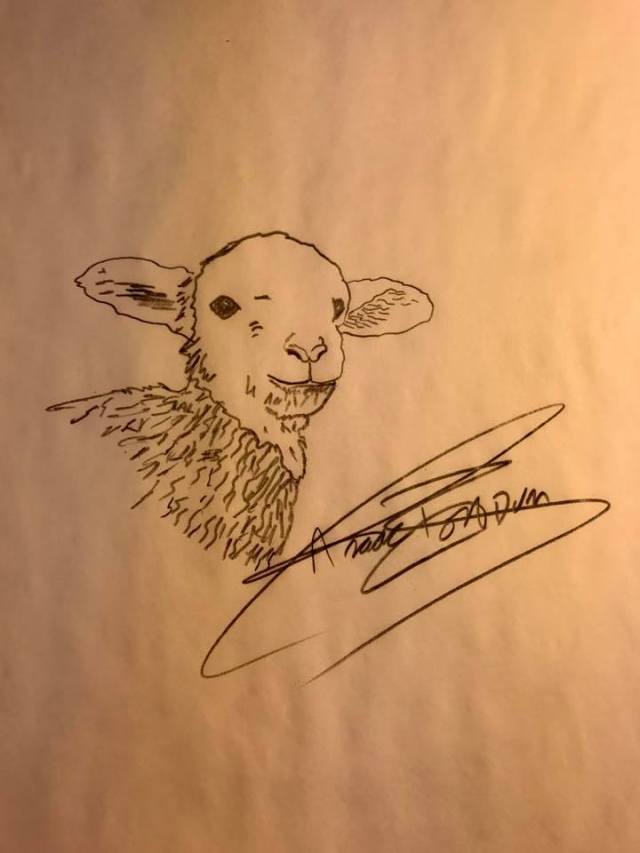
Sheep can be stubborn. I remember as a child trying to herd our small group of ewes to a nearby pasture. Although it was only about a hundred yards away, it didn’t go well. As I turned the sheep out, they all began running in every direction. There was pure chaos. I ended up covered in sheep snot, lying on my back looking up at the blue sky. The sheep were all over town. Not one of them ended up in the desired pasture.

Not long after this, my very wise great uncle, Boyd Bott, taught me an important lesson. The trick was simple: “You can’t herd sheep. You have to lead them.” It is a lesson I will never forget.

Taking a pail of grain and walking out in front of the sheep will yield an opposite response than that described above. The sheep will literally run after you and follow where ever you want them to go. Every time I had to move the sheep from this time forward, it was easy.

Sheep have a strong instinct to follow the sheep in front of them. When one sheep decides to go somewhere, the rest of the flock usually follows, even if it is not a good decision. Humans are the same way. In the bible, sheep are often compared to people. I find this comparison very accurate. We are stubborn. We resist when we are pushed. We follow when we are lead.

There is no better way to learn patience than having a small herd of sheep. They require much attention, protection and care.

Next time you find your patience running thin, think of exercising oversight instead of compulsion. It will most certainly yield a better result.

And that is my take.

N. Isaac Bott, DVM

This photo is of Dr. Bott holding a newborn lamb on his family farm in 1985.

Why Reindeer?

24302068_933964193434822_7595834599661973290_o

My Take Tuesday: Why Reindeer?

Curiosity is often sparked when clients learn about some of my work with reindeer and also when they see the massive antlers of our resident reindeer. This always begs the question… Why reindeer?

The day was March 28, 2010. I was driving on I-15 heading up to Cottonwood Heights. The next morning I was to begin a new job at an animal hospital in West Jordan. I was as nervous as I could be about the new change. As I was driving, I received a call from a concerned individual. The caller explained that his pet was thought to be pregnant and that confirmation was needed. It was then explained to me that the animal in question was a reindeer. Now, as a veterinarian, I deal with a lot of animals. However, I never anticipated working with reindeer. I had never even seen a live reindeer at this point in my life. But as I often do, I thought to myself, “Why not?” I told the caller I was just a few miles away and was happy to stop by.

I arrived just in time to witness the female reindeer, named Mischief, begin her labor. I was able to then help deliver a small female calf. The baby was so fragile! It was a solid jet black. I remember thinking that was such an unusual color when compared to her mother. The calf had difficulties initially. I had to administer medication to help with heart rate and for several days, the mother had to be milked and the calf had to be fed with a bottle. Mother also had difficulties after the birth. She had retained the placenta and required several days of medical intervention. Finally, after nearly a week, mother and baby began to thrive. We named the baby Disney.

Over the course of the next several weeks, I would often stop by after work to check on Mischief and Disney. The owner of the reindeer and I would often talk about how fascinating the experience had been for me. One night, he approached me about beginning an artificial insemination program for his reindeer herd. He had been searching for a veterinarian to attempt assisted reproduction in reindeer for over 10 years. He had not been able to find one. The idea excited me. I readily accepted the challenge.

I began researching the possibilities. I found that this had been studied and attempted dozens of times since 1973, without any appreciable success. In fact, The University of Alaska had received an $80,000 grant to begin a program. Their success rate was less than expected, and only one live reindeer calf was ever produced.

Our budget was small. We had only $2,000 to work with. We had to find out how to not only collect reindeer semen, but also how to freeze it in liquid nitrogen. We also had to learn how to heat synchronize the females and how to perform the insemination procedure. We had our work cut out.

After many failures and setbacks, in the spring of 2011 we were successful at producing the world’s first female reindeer calf by frozen/thawed artificial insemination. We named her Mira (short for miracle), a fitting name.

We have produced dozens of calves since then. Our program involves a novel semen collection and cryopreservation system, estrous synchronization of females and trans-cervical artificial insemination. Because of our high post thaw semen motility and artificial insemination pregnancy rates, our program is arguably the most successful program in the world.

It is fun to reflect back on that random phone call I received while driving down the road. Many opportunities have opened up for me since that day. I am glad I have had the chance to work with this truly unique species and for the scientific contributions I have been privileged to be a part of.

And that is my take!
N. Isaac Bott, DVM
 

Rudy The Reindeer

My Take Tuesday: Rudy the Reindeer

As a veterinarian, each case I see presents a challenge. Emotionally, each day is filled with both happiness and sadness. Clinical outcomes vary, some patients make it, others do not. Regardless, I give my best to each. I hold a special place in my heart for those pets that couldn’t be saved even with all the resources in the world.

I am fortunate to have the privilege of working on a variety of species. As this month’s Facebook entries focus on reindeer, I am reminded of a unique case with a reindeer named Rudolph.

Rudy, as he was affectionately called, was a unique bull. He did not display the extreme aggression typical of intact male reindeer. He was docile. He knew his name and would come when called. His favorite treat was a handful of rolled corn. During the seasonal displays, he was always popular, especially among the children. Meeting a reindeer named Rudolph is exciting, even for many adults.

Rudolph played a role in my success in reindeer artificial insemination. He was the first male that we were able to successfully collect and freeze. His offspring carry the same docility and unique tractable nature.

Rudy became ill one evening in April. I traveled to Sandy to see what could be done. I found Rudy in rough shape. He was in obvious distress and having difficulty breathing.

After hours of intense care and medical treatment, Rudy did not improve. The cause, a small winter glove that had lodged in his intestine. A careless individual likely left the black glove in his pen during the christmas display season. For whatever reason, it had stayed in the rumen (largest stomach compartment) for several months before entering the small intestine. Reindeer are non discriminate eaters and will literally eat anything that is placed in their pen.

Reindeer are very stoic. They often do not show clinical signs until they are gravely ill. This makes surgical intervention almost impossible. Despite our best efforts, this magnificent animal did not make it.

Often, such is the case in veterinary medicine. Whether it be a dog or cat, or a reindeer or sheep, each deserves to live a life free of pain and suffering. I give up a bit of the peace in my heart each time one does not make it. We all do this. Over time, we feel those missing pieces of peace more and more. Although Rudy did not belong to me, I still had tremendous difficulty saying goodbye.

There is also some good that came from this experience. We were able to freeze over 100 doses of Rudy’s semen. This is stored in liquid nitrogen and will be good indefinitely. Thankfully, Rudy will continue to produce reindeer calves for years to come.

He was truly one of a kind.

And that is my take.

N. Isaac Bott, DVM

White Lightning

White Lightning
Reindeer rarely have difficulty giving birth. Fortunately, nature has provided this species with amazing vitality. Young calves stand within minutes of being born. Predation is the primary cause of death in newborn calves. To minimize this, cows synchronize their birthing. If all of the calves are born at the same time, fewer are killed by predators. Gestation length can vary as much as 45 days to accomplish this. Such synchrony is fascinating, but provides considerable challenges with domesticated herds. Occasionally, calves are born premature and lung development is not complete. Sadly, many of these calves die.
As a veterinarian, I perform a considerable number of artificial inseminations on reindeer each year. The calves produced by this procedure are especially valuable. Intense care is given to newborns to ensure the best chances of survival.
A few years back, a young male calf was born during the summer. He had a unique white marking on his nose. This calf was a charmer. We all instantly fell in love with him.
On examination, the calf showed considerable effort in his breathing. His lungs were not working as they should. Research has shown that these calves lack a chemical called Surfactant. Surfactant reduces the surface tension of fluid in the lungs and helps make the small air sacs in the lungs (alveoli) more stable. This keeps them from collapsing when an individual exhales. In preparation for breathing air, fetuses begin making surfactant while still in the the uterus. With some reindeer calves, this production is incomplete when they are born.
Treatment consists of replacement surfactant therapy. This is often not feasible in veterinary medicine because of the high cost of synthetic surfactant. When is is available, it must be administered within 6 hours of birth to be effective.
The second treatment is placing the calf in an incubator (very similar to ones used with human neonates) and administering oxygen. Some calves will improve with this treatment. We placed him inside the oxygen chamber and waited. Feeding was required every 2-3 hours. The first few hours were touch and go, but little by little, improvement was noted. His tiny lungs slowly began to function properly.
Fortunately, such was the case with this beautiful calf. We named him White Lightning, reflecting the distinctive white stripe on his nose.
Miraculously, on this hot summer day, a life was saved. As you can see in the photos, we were all happy to pose with the calf, with the exception of my youngest son, KW. He fortunately has overcome his fear of reindeer. 🙂

N. Isaac Bott, DVM