The Parsimonious Pyometra

My Take Tuesday: The Parsimonious Pyometra

Apart from preventing unwanted pregnancy, routine spaying of female dogs has been historically recommended for two reasons: 1) Reduce the incidence of mammary cancer, and 2) Prevent the female from developing pyometra later in life. This is caused by a bacterial infection of the uterus resulting in a potentially fatal infection.

The word pyometra can be divided into two root words: Pyo meaning pus and Metra referring to the uterus. A pyometra starts after a dog goes through a heat cycle, usually within about 2 to 5 weeks. A pyometra develops due to repeated prolonged exposure of the estrogen-primed uterus to progesterone (estrogen increases the number of progesterone receptors in the endometrium). Female dogs are prone to uterine disease due to the unique nature of cycling in this species. As infection develops in the uterus, the uterus fills with pus. The most common bacteria isolated in these cases is E coli. The uterus with a pyometra can be huge! I have surgically removed an infected uterus weighing over 11 pounds from a 56 pound Golden Retriever.

The clinical signs associated with this disease are anorexia, depression, drinking and urinating more frequently, abdominal distention, and sometimes a vaginal discharge is noted. Vomiting and diarrhea may also be present, especially late in the course of the disease. If any of these clinical signs are noted in your pet – immediate veterinary consultation is imperative.

Females that develop pyometra have an underlying condition called cystic endometrial hyperplasia. Most intact females older than 5-6 years have some degree of this. The vast majority of cases are treated by removing the infected uterus and ovaries. This surgery is very difficult and much more expensive than a traditional spay. There are many more post-operative complications that may arise that are not associated with a routine spay.

These include:
1- Peritonitis – infection of the abdomen
2- Disseminated intravascular coagulation – a clotting disorder that is often fatal
3- Sepsis – occurs when chemicals released in the bloodstream to fight an infection trigger inflammation throughout the body. This can cause a cascade of changes that damage multiple organ systems, leading them to fail, sometimes even resulting in death.

It is simple to avoid this. Females not intended for breeding should be spayed at a young age. Females used for breeding should be closely monitored by both the owner and the veterinarian.

If you are hesitant to spay your pet because of the cost of the routine surgery, you must consider the cost of an emergency pyometra surgery also. Such a surgery is at least 3-5 times higher than what a routine spay would be.

At Mountain West Animal Hospital, we discuss both the benefits and detriments of routine spays and neuters and strive to help you make the best decision for the health and well-being of your individual pet. You can count on us as a trusted partner in the care of your four legged family member.

And that is my take. 

N. Isaac Bott, DVM

My Journey Through COVID-19

My Take Tuesday: My Journey Through COVID-19

As many of you know, I was diagnosed with COVID-19 on July 2nd. Fortunately, I have since recovered. Many of you have contacted me directly saying how happy you were that I was better. I cried many times as I read the messages, texts, cards and emails from all of you. I am humbled by your kindness and loyalty.

Many have asked what the course of the illness was like for me. Something that I have learned is that every case is different. The three individuals from my hospital that tested positive all experienced vastly different clinical signs. My first clinical sign was an itchy scalp. This was followed by a sore throat to which I attributed to seasonal allergies. I am allergic to grass, alfalfa, roses, dandelions and a myriad of other plants. June is always a miserable month for me. The symptom that distinguished an actual illness from seasonal allergies was a fever. I was immediately tested once it was apparent that I had symptoms consistent with COVID. The test came back positive. The clinic was closed for the following 12 days as we all recovered from this vicious virus.

As my disease progressed, my most significant symptoms were gastrointestinal. I had tremendous nausea and an unrelenting headache. I quickly lost 12 pounds during the following week. For several days, I experienced severe chest pain. My body’s response to this virus was very different from many of the cases I had read about. I never developed a cough and I did not lose my sense of smell or taste. I developed severe muscle and joint pain. It reminded me of over-doing it at the gym after a long period of not working out. The pain was similar, but 10 times more severe. Every inch of my legs and arms ached. In the beginning, it felt like my spirit just crawled in a hole somewhere and all joy in life temporarily seemed to disappear.

Little by little, day by day I improved. I went from lying in bed all day to sitting on the couch. My energy slowly returned. I feel blessed that I didn’t need to be hospitalized, that I didn’t need to be intubated, that I didn’t suffer any of the horrible complications, and I consider myself lucky that I’m out the other end alive and all in one piece. I realize that although my illness was horrible, it could’ve been much, much worse.

I returned to work two weeks after testing positive. I am still weak, work leaves me pretty wiped out, and I’m ready to be back on the couch at the end of the day. I anticipate it will take a couple of months to fully return to normal.

In the evening of one particular day, I felt strong enough to walk around the house and even felt strong enough to walk out to the back yard. As I stepped outside for the first time in over a week, I gazed towards the west. As I stood on my back porch in Springville, I gazed westward, across Utah Lake and West Mountain. Simultaneously, a fire swirled cinnamon sunset lit up the entire evening sky. A calmness overcame me as I took in the majesty of God’s creation.

Life is full of little moments of joy, so fleeting, that they are often unappreciated. In today’s extremely fast-paced world, our busy lives often keep us from enjoying the simplest of life’s pleasures.

Like you feel just good enough to appreciate a sunset, the smell of freshly cut grass, or the bright amber moon rising in the East above Hobble Creek Canyon.

As yesterdays are gone, and tomorrows are never promised, our challenge is to enjoy these joyful moments that are sprinkled along this journey of life and to hang on to every single one that comes along.

And that is my take!

N. Isaac Bott, DVM
The Capricious Caprine

My Take Tuesday: The Capricious Caprine

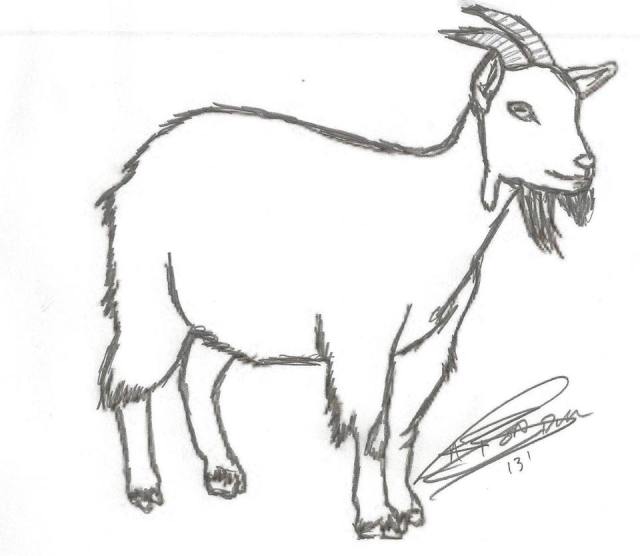
We are all familiar with the classic Norwegian folk tale of the “Three Billy Goats Gruff.” The captivating children’s story follows an “eat me when I am fatter” plot. The intelligent goats cleverly deceive the hungry troll to access the greener pastures on the other side of the bridge. This species is often overlooked, but its importance on world agriculture is tremendous.

Goats are one of the oldest domesticated species, and have been used for their milk, meat, hair, and skins over much of the world. Goats have an intensely inquisitive and intelligent nature; they will explore anything new or unfamiliar in their surroundings. They do so primarily with their prehensile upper lip and tongue. This is why they investigate items such as buttons, rope, or clothing (and nearly anything else!) by nibbling at them, occasionally even eating them.

Goats will test fences, either intentionally or simply because they are handy to climb. If any of the fencing can be spread, pushed over or down, or otherwise be overcome, the goats will escape. Due to their high intelligence, once they have discovered a weakness in the fence, they will exploit it repeatedly.

To help illustrate my point, I will share with you a lesson I learned as a teenager growing up in the small town of Castle Dale, Utah.

One summer I was entrusted with the care of a small herd of goats belonging to a disabled veteran. Each morning and afternoon, I would travel down Main Street to the small white house on the corner near the hardware store. The most vocal and dominant goat in the group I affectionately called “General Custer” because of a small unusual patch of hair extending forward from his beard.

General Custer could escape his pen without leaving any evidence as to where the weak spot in the fence was located. Several times a week I would find the devious billy goat in the yard of the house nibbling on the freshly bloomed flowers. Each time this event occurred, I would take him back to his pen, where he would remain, albeit temporarily, satisfied.

One morning I got in my car, a 1979 white Buick LeSabre, and started the one mile drive down Main Street. As I proceeded, I noticed a large group of people gathered outside the only tavern in the small town of 1,500 residents. I noticed several men laughing and looking down the sidewalk. As I approached, I noticed a goat standing next to the front door. The goat had a rope halter on and was tied to a power pole on the sidewalk in front of the building. I continued driving, not giving a second thought to what I had just witnessed; after all, I had seen similar things growing up in a small town.

As I arrived at the small house to feed the goats, I immediately noticed that the General was not in the pen. I began looking around the yard for the wayward caprine. He was nowhere to be found.

As I frantically began running through the possibilities in my mind, I remembered the goat that was tied up at the bar. I jumped back in the car and drove as quickly as possible back to where the goat was tied up previously. The crowd had entered the bar and General Custer stood calmly tethered to the pole, chewing his cud and very much unaware of his situation. I jumped out of the car and quickly untied the escapee. I did not have any way to haul General Custer and the 1/2 mile walk back to the house would be awful leading a goat. The large back seat of the Buick would have to do. I placed the general inside the car and headed back down Main Street with the billy goat bleating at every car and pedestrian we passed.

Naturally, the stench in the days following the incident with General Custer was such that the windows needed to remain down while traveling. It took months to rid the car of the goat eau de toilette that so effectively had permeated the back seat.

I was proud of myself. The General had escaped and wandered several blocks down a busy road and still came away unscathed. I had no concern for the inebriated witnesses at the bar; after all, it would be hard to believe the story in the best of circumstances.

The following week when I received the weekly local newspaper in the mail, I was astounded to read the headline on the front page of the Emery Country Progress. A picture of the tied up General was under the headline, “Goat on the Loose”. It seemed that a goat was found wandering the streets of town and that a group of concerned citizens had caught and tied up the animal. The article explained that the male goat had mysteriously disappeared before local animal control authorities had arrived.

Fortunately, someone had taken a picture to corroborate the unlikely story…

And that is my take.

N. Isaac Bott, DVM

The Disgruntled Veterinarian

My Take Tuesday: The Disgruntled Veterinarian

Veterinarians are some of the most kind and compassionate people on the planet. They are hard workers, and are some of the best people I have ever met.

As with any profession, there are occasional outliers.

When considering the prospect of attending veterinary school, I visited a veterinary clinic, here in Utah County, one day as an undergraduate.

I introduced myself to the veterinarian and asked a little about his experience as a veterinarian. As soon as I began asking questions about which veterinary school to attend, he interrupted me.

“Hey kid, why do you want to be a veterinarian?”, he asked.

I gave the answer I had given so many times. I replied, “Because I love working with animals. I also like working with people and this profession will allow me to help people by helping their animals.”

“What are you? You stupid #%$@>?”, he continued, “What are you going to do when those animals you love bite you and kick you? And what about those people that do not respect you and your expertise and expect you to work miracles? They are far from loyal and they couldn’t care less about you! Get a life kid. This ain’t for you!”

Wow! I couldn’t believe what I was hearing. Here was a veterinarian that was clearly dissatisfied with life in general. After years of grueling work and what he deemed as little professional reciprocity, he had become very cynical. He made it very clear, anyone wanting to be a veterinarian was making a huge mistake. His goal was to dissuade any would be veterinarian that entered the doors of his practice from making the same mistake he did.

To put is delicately, this guy was the south end of a horse facing north.

I feel sorry for him, looking back. My experience as a veterinarian has been the complete opposite.

The clients I work with are very loyal. My interactions with them are nearly all positive and they love their pets. They follow my recommendations and are always willing to provide the care that their pets need and deserve.

I am glad I did not heed his advice.

Mark Twain eloquently counseled, “Keep away from people who try to belittle your ambitions. Small people always do that, but the really great make you feel that you, too, can become great.”

I am thankful for those who encouraged me. Who supported me. Who believed in me long before I believed in myself.

Their contributions have led me to where I am today.

And That is My Take

N. Isaac Bott, DVM

Don’t Worry Dic, She’s a Tame Cow

My Take Tuesday: Don’t worry Doc, She’s a Tame Cow

“Is the cow where you can catch her?,” was my first question.

Preston was a longtime client and on this particular day he had a cow that was having difficulty calving.

Responses to this question can vary. On this particular occasion the gentleman stated, “Don’t worry Doc, she is a tame cow. I raised her on a bucket.” He then gave a caveat, “Besides, she is too sick to run.”

“I really do not like trying to pull a calf without restraining the cow. I don’t want to get hurt,” I replied.

“We could even tie her up to one of the pillars in the barn,” he continued.

Now clearly, this should have raised a red flag. A 1800 pound snorting bovine is not to be taken lightly. The thought of working on her without a squeeze chute was ludicrous. Just think of the danger I would be subjecting myself to. A well placed kick could easily end my career.

“Can you please help me out, Doc?”, he begged.

Veterinarians all have a soft spot. We like to help people, and often we do so placing our own health and wellbeing on the back burner.

“I guess I could stop by,” I replied, “But please be sure to have a good rope handy.”

“You got it Doc!,” He promised.

When I arrived, Preston had the cow tied up to the center pillar of the barn. The massive beam was actually an old telephone pole.

The cow stood, chewing her cud as if nothing was amiss. A foot was clearly sticking out from the back end of the cow. From the appearance and position of the foot, I could immediately tell it was a back leg.

Delivering a breached calf is no easy feat. The size of the calf would make it impossible to turn around, and the best option was to attempt to pull the calf as it presented. The test for delivery of a calf in the backwards presentation but normal position and posture differ because the fetus should be first rotated 45-90 degrees by crossing the legs before attempting delivery to take advantage of the widest diameter of the cow’s pelvis.

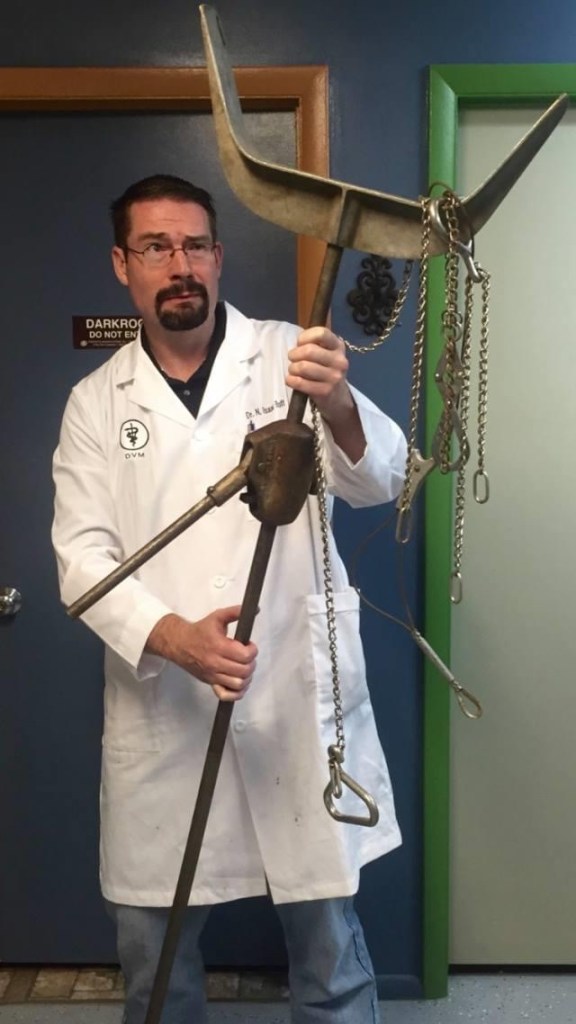
Most experts say you should not apply more force than that of two strong men pulling by hand. But, if you’re alone in assisting a difficult birth, a calf jack can help generate the necessary force. Luckily I had my calf jack with me.

A calf jack is a long pole with a adapter that sits against the backside of the cow, just below the birth canal. There is a handle and jack that move along the entire length of the pole. OB chains are attached to the calve’s legs and then are attached to the jack. Extreme care must be taken to not apply too much pressure while using a calf jack. The health of the calf and mother could easily be compromised if the instrument is used improperly.

I attached the chains to the jack and gently began to tighten the slack. As I applied traction, the cow went crazy! She began to jump and kick and swing her head. I jumped back as fast as I could. She bellowed and began kicking her back legs in the air as if she were a rodeo bull.

The calf jack was firmly attached and stuck out straight nearly 6 feet from her rear end. This device became a formidable weapon and this cow knew exactly what to do. She was able swing it with extreme accuracy.

And boy did she ever swing it!

My OB bag was the first victim. It went flying through the air spreading instruments all over the barn. My water bucket next was launched vertically, covering all of us with fetal fluid and blood tinged warm water.

In a swift motion, the cow pivoted on her front feet, swinging her back end in an abrupt 180 turn. My back was turned to her when this happened and it caught me completely off guard. The calf jack, still sticking straight out from her backside, struck me about 2” below the back of my knees. This caused me to do a partial backflip. I landed on the soft bed of straw head-first.

“Preston!,” I shouted, “I thought you said she was tame!”

“Well, Doc, I ain’t never hooked one of those on her before!” he replied, with a look of bewilderment in his eyes.

Together we grabbed a large panel and placed it along side the raging bovine. She immediately calmed down and I returned to my job.

The calf was born alive! It was a precocious solid black bull calf with a stripe of white extending down his forehead. It weighed nearly 120 pounds!

“Good job Doc!” Preston exclaimed, “I was a little worried there for a minute!”

“So was I,” I replied, “So was I.”

The pain in my calves finally set in as I walked back to my truck. I had a battle wound that took weeks to heal – a linear bruise left by the unforgiving calf jack stuck to the backside of a most formidable and sinister cow.

And that is My Take!

N. Isaac Bott, DVM

Sheep and Stoicism

My Take Tuesday: Sheep and Stoicism

Sheep can be stubborn. I remember as a child trying to herd our small group of ewes to a nearby pasture. Although it was only about a hundred yards away, it didn’t go well. As I turned the sheep out, they all began running in every direction. There was pure chaos. I ended up covered in sheep snot, lying on my back looking up at the blue sky. The sheep were all over town. Not one of them ended up in the desired pasture.

Not long after this, my very wise great uncle, Boyd Bott, taught me an important lesson. The trick was simple: “You can’t herd sheep. You have to lead them.” It is a lesson I will never forget.

Taking a pail of grain and walking out in front of the sheep will yield an opposite response than that described above. The sheep will literally run after you and follow where ever you want them to go. Every time I had to move the sheep from this time forward, it was easy.

Sheep have a strong instinct to follow the sheep in front of them. When one sheep decides to go somewhere, the rest of the flock usually follows, even if it is not a good decision. Humans are the same way. In the bible, sheep are often compared to people. I find this comparison very accurate. We are stubborn. We resist when we are pushed. We follow when we are led.

There is no better way to learn patience than having a small herd of sheep. They require much attention, protection and care.

Next time you find your patience running thin, think of exercising oversight instead of compulsion. It will most certainly yield a better result.

And that is my take.

N. Isaac Bott, DVM

This photo is of Dr. Bott holding a newborn lamb on his family farm in 1985.

Father’s Day

Father’s Day

The giant snowflakes gently fell in perfect rhythm. Even though it was 6:00 AM, I could see clearly through the winter whiteness.  This particular winter during the 1980’s in Castle Dale was incredibly harsh. Nearly 18” of snow had fallen over the past 24 hours. The field across the street from my parents house was covered in a thick blanket of white. I bundled up as I prepared to leave the house to do the morning farm chores. 

My dad led the way as we headed across the street to the corals. The deep snow proved to be a challenge for my short legs. I jumped and lengthened my stride as I placed my feet inside my father’s footprints. As long as I followed his steps, the path seemed manageable 

My dad is a giant of a man. I remember attending a Cub Scout pack meeting as a young boy. At this meeting, a plank was placed on the floor and a 16 penny nail was started in the center. A competition was held where all of the father’s in the room had a chance to hit the nail as hard as they could. Some were able to drive the nail in completely with 2 or 3 hits. When my dad’s turn came around, he buried the nail with a single swing of the hammer. I remember thinking how amazing that was! He could loosen old rusty bolts with a quick flick of his wrist, he could throw a bale of hay on top of a haystack and no one could use a shovel like him. In my eyes as a young boy, he seemed to be able to do anything. My dad has been my hero as far back as I can remember.

I remember a time where he had learned that a man living in town did not have a bed in his house to sleep on. My dad went and purchased a brand new bed with his own money and delivered it to this man that he didn’t even know. Years later, this man told me that this act was the kindest thing that anyone had ever done for him in his life. My dad taught me how to care for others less fortunate time and time again through his example.

Each summer, my dad would set aside time to take each of his five children camping with him individually. We would get to chose the destination of this one on one time. I remember the cold air and the damp grass. I remember the smell of the air. I remember eating Pringles and sitting by a campfire. I remember eating small boxes of Cocoa Krispies and catching fish. 

Oh how I looked forward to my annual camping trip with dad! My favorite spot was in Upper Joe’s Valley. This overnight camping trip always provided an escape  from the every day chores and busy summer days. 

Despite working 7-5 every day, somehow dad would find the time in his incredibly busy schedule to take each one of us individually every single year. This was dad‘s way of showing us how much he cared. Although he loved each of us equally, during these outings we all felt very special. I remember every single trip and I cherish these memories. 

I remember one particular time when I was working at the cemetery. The volume of work there had overwhelmed me. There was so much to do and I couldn’t get it done. Dad, after working all day at a thankless and stressful job, came to the cemetery and cut the individual daisy flowers off of the dozen or so bushes in the flower bed. This tedious process took several hours. I was thankful that night, but now looking back, tears come to my eyes. I know how tired and worn out I am after working all day. How did he have the energy to do all that he did?

In today’s world fathers come and go. Having a stable father is a rarity. My dad was always there to work with us. I remember many times going out to the farm with dad and being so stressed I couldn’t function, and after a few hours of digging ditch anything that was bothering me would disappear. Growing up,  I was taught how to do good work and to be proud of my accomplishments. My dad did this, not by leaving a list of chores to be accomplished, but by working right there alongside us, 

A statue on my dad’s dresser depicts a father with a small child sitting on his knee. The inscription reads, “Any man can be a father, but it takes someone special to be a daddy.” My daddy’s example was not lost on me. His unconditional love has inspired each of his 5 children to be the best that we can be

I have often wondered exactly what is the measure of a man? Is it the softness of his heart? Is it the hardness of his hands? Is it in the words he speaks or the legacy he leaves?

When the storms of life have blown and tossed me around, I have always been able to think about the example my dad set for me. He has walked the same path, you has wished upon the same stars and he has worried about the same things. This brings me so much comfort. It helps me tremendously when I have to make tough decisions. 

One of the most unfortunate things in my life is that it has taken me years to realize how essential my father’s role was to build my character, my ethics and most importantly, my happiness. His blood runs through my veins and his example is in my soul, and although my life has been a poor attempt to imitate his example, I am doing the very best I can.

This Father’s Day, I still find myself trying to follow my father’s footprints in the deep snow. He is my constancy and my mentor, my rock and my friend. He is my hero!

Thank you dad for your unconditional love. Thank you for your guidance. Thank you for teaching me how to work, to love and for teaching me how to treat others with kindness. 

Happy Father’s Day! 

N. Isaac Bott, DVM

Don’t worry Doc, he won’t bite

My Take Tuesday: Don’t worry Doc, he won’t bite

“Don’t worry Doc, he won’t bite.”

If ever a red flag was raised, these simple words would surely do it. I worry every time I hear the phrase. It reminds me of the required vet school class that covered the autonomic nervous system. The fight or flight impulse is part of that system. And in most cases, the fight response prevails. Invariably, when someone says this, I am going to be bitten.

It was a routine appointment, simple annual vaccinations. It should have gone smoothly.

As I administered the last vaccination, all seemed to be going smoothly. When all of the sudden, this unseeingly sweet little dog became, without warning, a biting, raging canine tornado.

This form of aggression can be defined by the word “IATROGENIC”. The definition of this fancy word is simple, it was caused by ME. This little guy was furious, and come hell or high water, he was going to let me have it.

His attack was swift. He had sunk his teeth deep into my left hand. I instinctively pulled back as he loosened his grip. I thought for a brief moment that it was over, but before I could remove my hand, he chomped down a second time.

Blood poured from my lacerated fingers.

The owner looked up, shook her head, and said, “Come to think of it, he did that to the last vet also.”

“Gee thanks,” I muttered.

If anyone ever tells you, “Don’t worry, he won’t bite.”

Take it from me – BEWARE!

You are about to be bitten!

And That is My Take

N. Isaac Bott, DVM

The Universal Human Animal Bond

My Take Tuesday: The Universal Human Animal Bond

A few years ago, I had the opportunity to spend several weeks in Mexico working as a veterinary ambassador. It was an incredible experience.

The first week, we traveled to the outskirts of a city called Queretaro. We sat up a set of tents and hosted an animal wellness clinic. We spent an entire day vaccinating dogs and cats.

The next two days were spent in Guadalajara. Here we also set up vaccine clinics. Over the three day period we vaccinated the pets of over 1,800 families. We spent time with each individual and answered questions about the pets they had and educated them on preventive care and how to assure a long and happy life for their 4 legged family members. These are among the longest days I have had as a veterinarian. It was exhausting to speak to so many people. However, the exhaustion was insignificant compared to the happiness I experienced by helping in these activities. 

When we look at veterinary medicine on a global basis, people everywhere are attached to their pets and want their pets to be healthy. In the villages where we held our clinics, people couldn’t imagine putting their dogs on a leash; they would consider that cruel. If they want their dogs to walk somewhere, they pick up the dog’s front legs and walk them on their hind legs. The dogs are amazingly patient with this practice.

Lines each day extended around the block. Hundreds of people stood in line for hours under the hot sun to receive the services we were providing. Dozens of children brought their beloved pets, often in a grocery bag or carried safely in their arms, to be vaccinated and dewormed. They showed the same love towards their pets as anyone I have ever seen back home. The Human-Animal Bond is the same across borders – it is the same in the hearts of people everywhere. The happiness I experienced while performing these vaccine clinics was inexplicable.

It is commensurate with service to experience reciprocity. What effort we exert is returned many fold. I find the satisfaction of such service to be rewarding beyond comparison.

Veterinary medicine is a unique profession. What motivates us is the important services that we provide. There has to be a love of service and of reaching the hearts of the people who own the pets. I concur with what Dr Seuss conveyed through the character the Lorax, “Unless someone like you cares a whole awful lot, nothing is going to get better. It’s not.”

At Mountain West Animal Hospital, we care. We value life. We are advocates for those who have no voice. We believe that all animals have the right to a life free of pain and suffering. Everything we do is centered around this principle. We strive to provide the care that pets need and deserve.

And that is my take.
N. Isaac Bott, DVM

Hazel and the Skunk

My Take Tuesday: Hazel and the Skunk

As a teenager growing up in the small town of Castle Dale, I looked forward to summers at the end of each school year. Summer meant freedom from both homework and sitting at a school desk.

For me, a perfect summer day would have to include vanilla ice cream, snow cones and strawberry shortcake. The tranquil Castle Valley evenings provided frequent opportunities to cook hot dogs, hamburgers and steaks on the grill, corn on the cob on the stove, and juicy Green River watermelon slabs with each meal.

Summertime also meant hard work. Apart from the irrigating and farm chores, there were a number of elderly widows in Castle Dale that would hire my siblings and I to mow their lawns each week during the summer.

Hazel was my favorite. Her small house stood just north of the new recreation center in Castle Dale. Hazel was like family to me. Her friendly demeanor and kindness was manifest each and every time I mowed her lawn.

She had a small but verdant lawn that surrounded her small gray house. Along the south end of her property, huge trees stood as sentinels protecting the house from the frequent Castle Valley wind. The deep green leaves of the tall trees overlooked a perfectly manicured garden with straight rows of Swiss char, chives, radishes, peas, carrots, spinach and lettuce.

Her lawn was difficult to mow. The frequent flowers and bushes required extreme care and precision with the lawn mower and edger. I would frequently graze her chives and the onion smell would instantly give away my error.

“On no, you hit my chives!” she would say. I anticipate that she planted larger quantities each year knowing that some would certainly fall prey to my mower.

After finishing the mowing, Hazel would prepare red punch and cookies. I would sit on a couch in her living room as I savored the snacks week after week. Hazel would ask about how my life was going and she would tell stories of her Seely and Livingston pioneer ancestors that helped settle Utah and build the iconic Salt Lake Temple.

Hazel loved cats. She had a cat door that would lead out to the back yard from her kitchen. She would place a large bowl of cat food in the center of the kitchen and the cats could enter and leave as they please.

On this particular day, Hazel commented about how much cat food she had been going through. She noted that she would have to fill the cat dish 3 or 4 times a day and that each time she entered the kitchen, the bowl would be empty.

As I sat on the couch, I had a clear view of the cat bowl in the kitchen. As Hazel spoke, from the corner of my eye I noticed some movement near the bowl. As I turned my head and looked into the kitchen, the biggest skunk I had ever seen wobbled over to the food bowl and began gorging.

“Hazel!” I exclaimed. “That is not a cat, it is a big fat humongous skunk!”

“My laws!” she gasped. “Get it out of here!”

As I jumped up, the startled skunk made a dash for the door. Its overweight body condition inhibited it from any appreciable speed. The large belly nearly dragged on the ground as it meandered away. As it leaped for the cat door, the front half of the body exited perfectly, however, its back half didn’t quite make it. As the obese animal heaved its back end though the door, it simultaneously and voluminously sprayed the contents of its scent glands in my direction. This wallop of its defense mechanism filled the entire kitchen.

If you haven’t experienced the mephitic smell of a skunk from up close, the odeur fétide is actually a thick, volatile, oily liquid that obtains its pungency from sulfur-based thiols. There in nothing that smells worse than skunk spray inside your nose!

Hazel and I exited out the front door. We propped open the kitchen door and placed a fan on the floor to help air out the house. We laughed about it for hours.

Hazel passed away shortly after Memorial Day in 2003. I sure do miss her.

Each and every summer day brings back the fond memories of Hazel, the obese skunk, and the all-you-can-eat Mephitis buffet.

And that is my take!

N. Isaac Bott, DVM