My Take Tuesday: The Disgruntled Veterinarian


Veterinarians are some of the most kind and compassionate people on the planet. They are hard workers, and are some of the best people I have ever met.


As with any profession, there are occasional outliers.


When considering the prospect of attending veterinary school, I visited a veterinary clinic, here in Utah County, one day as an undergraduate.


I introduced myself to the veterinarian and asked a little about his experience as a veterinarian. As soon as I began asking questions about which veterinary school to attend, he interrupted me.


“Hey kid, why do you want to be a veterinarian?”, he asked.


I gave the answer I had given so many times. I replied, “Because I love working with animals. I also like working with people and this profession will allow me to help people by helping their animals.”


“What are you? You stupid #%$@>?”, he continued, “What are you going to do when those animals you love bite you and kick you? And what about those people that do not respect you and your expertise and expect you to work miracles? They are far from loyal and they couldn’t care less about you! Get a life kid. This ain’t for you!”


Wow! I couldn’t believe what I was hearing. Here was a veterinarian that was clearly dissatisfied with life in general.

After years of grueling work and what he deemed as little professional reciprocity, he had become very cynical. He made it very clear, anyone wanting to be a veterinarian was making a huge mistake. His goal was to dissuade any would be veterinarian that entered the doors of his practice from making the same mistake he did.
To put is delicately, this guy was the south end of a horse facing north.


I feel sorry for him, looking back. My experience as a veterinarian has been the complete opposite.


The clients I work with are very loyal. My interactions with them are nearly all positive and they love their pets. They follow my recommendations and are always willing to provide the care that their pets need and deserve.


I am glad I did not heed his advice.


Mark Twain eloquently counseled, “Keep away from people who try to belittle your ambitions. Small people always do that, but the really great make you feel that you, too, can become great.”


I am thankful for those who encouraged me. Who supported me. Who believed in me long before I believed in myself.


Their contributions have led me to where I am today.

And That is My Take

N. Isaac Bott, DVM

My Take Tuesday: Airport Security

They say hindsight is 20/20. Looking back, it was clearly a mistake.

I hurriedly prepared my luggage, assuring that everything would fit in a carry on. I have a perfect record, in all of my travels I have never had my luggage lost. Taking a single carry-on bag is the only way to assure your luggage gets to your destination on international flights.

The destination this trip, was the Philippines, and it was my first trip to Asia. I had been called to travel there to assist in establishing both Water Buffalo and deer reproduction programs in this far away country.

I placed my required instruments, long forceps and miscellaneous items used for freezing semen delicately in my bag. The last piece of equipment was something called an electro-ejaculator.

In the practice of veterinary medicine, it is common to collect semen from domestic ruminants using electro-ejaculation.

This instrument is an electric probe that is inserted into the rectum of an animal, adjacent to the prostate gland. The probe delivers an AC voltage, usually 12–24 volts. The probe is activated for 1–2 seconds, referred to as a stimulus cycle. Ejaculation usually occurs after 2–3 stimulus cycles. The instrument fits in your hand and runs on a traditional 9 volt battery, the exact battery most smoke alarms use. It is a valuable tool when collecting semen from agricultural and wild animals.

It fit, without a problem, in my suitcase.

Salt Lake City International Airport was busy on this particular day. The lines extended over the sky bridge and nearly to the parking garage.

I passed through the metal detector and my bag went through the usual belt driven scanner. As I waited for my bag to come out, the operator of the scanner lowered his head and spoke into his mouthpiece. What he said was inaudible, but the response it triggered was anything but quiet.

I was circled by at least 10 TSA agents and hurried off to the far right end of the security entrance. If there ever was a suspicious item, this was it.

A tall gruff man asked, “Sir, do you have any prohibited items in your bag?”

Now clearly, they know the answer to this question before they ask it. On a prior trip, I had left a small pocket knife in my bag. They asked the same thing, and I had completely forgot it was in my bag. My answer then was, “I don’t’ think so?” Fortunately, they allowed me to mail my pocket knife home and the delay was minimal.

Clearly today it was not going to be as easy.

“I have a medical device called an electro-ejaculator in my bag”, I tried to explain. One of the TSA workers removed the device. Clearly red flags were raised, and rightly so. Here is an electronic device with a push button, a red light and metal tongs protruding from the probe. The gruff man demanded, “What is this and why do you have it?”

“It is used to collect semen from animals,” I explained, “you insert this end in the rectum and push this button. It then applies current over the prostate, and ejaculation occurs.”

The gruff man’s face went from viable anger to disgust in less than two seconds.

“What? Ewwwww!!! Are you serious?”, he continued, “Why would you ever do that to an animal?”

“I am a veterinarian”, I explained, “And my expertise is in animal reproduction.”

“Man kid, I thought my job was tough,” he replied, laughing this time.

Fortunately for me, the device was labeled as such and my story was collaborated. I was allowed to pass.

En route to Manila, we stopped in Narita, Japan. Even though it was just a connecting flight, I had to pass through a security line once again before continuing on to the Philippines. Once again, a huge mess unfolded as I tried to explain in English why I would have such a dangerous looking device in my bag.

There are a couple dozen airport security officers around the world who now know, albeit unwillingly, what an electro-ejaculator is and how it is used.

After an eventful and productive stay in the Philippines, I entered the airport in Manilla, excited to be going home. As I stepped up to the counter, the ticket agent asked, “Sir, do you have any bags you would like to check?”

“Yes, I sure do”, I quickly replied.

I made my way to the gate and sat down to await my flight. I was relieved that I didn’t have to once again explain what was in my luggage. It appeared my trip home would be uneventful.

All of the sudden, over the loud speaker I hear the following announcement, “Passenger Nathan Isaac Bott, please report to the security desk immediately!”…………

And that is my take.

N. Isaac Bott, DVM

Hugh Peterson

My Take Tuesday: Hugh Peterson

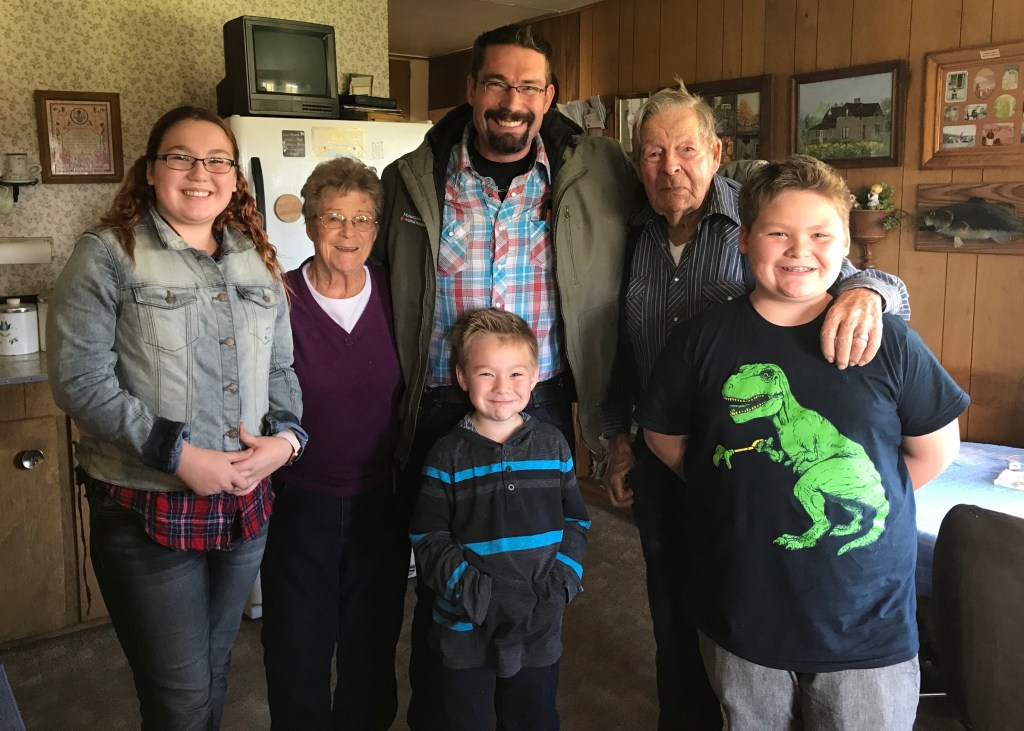
This past week, while attending a veterinary conference in Nebraska, I received the devastating news that my only remaining grandparent had passed away. This news came just as I was preparing to address the conference attendees during the annual storytelling night and banquet. 

As the tears began to flow, I worried that I would not be able get up in front of a room of people. Just then, a calming feeling came over me. It felt like my grandpa was sitting right there in the room. Grandpa was the best storyteller I have ever known. His blood runs through my veins. I composed myself, and gave the very best performance I could give, in dedication to him. 

For those lucky enough to know Hugh Peterson, he was a wonderful person with a huge heart, a brilliant mind, and a most unique sense of humor. 

While in the first grade, Grandpa was mischievous. He and a couple of other boys were standing near the merry-go-round one day during recess. A group of girls riding on the merry-go-round noticed these boys trying to look up their dresses. One of the girls grabbed rock and flung it at the boys. It was a solid hit to my grandpa’s head. The girl that threw the rock became my grandma. Their story began on that day in 1937. 

They were married in 1949. They spent just shy of 72 years together. My beloved grandma passed away just last month. My grandpa only lasted 40 days without her.  

My grandpa was a remarkable man. He was a farmer, coal miner, and a father to six beautiful daughters.

I have never met anyone that can tell a story like Hugh Peterson. His excellent memory wove a tapestry of nostalgia. With each word we would move closer to the edge of our seats. With a smile on his face, and just a tad of embellishment, he told a story like a boss. He frequently made us all literally laugh until we cried.

As a teenager, I met a coal miner that had worked in the same mine as Grandpa. I told him my grandpa had worked there and that he may know who he was. When I told him Hugh Peterson was my grandpa, I noticed a tear stream down his cheek. 

“He was the best foreman I ever worked for.” He then paused, “Your grandpa is an honest and wonderful man. I would trust him with my own life.”

He then told me of a story about Grandpa working as a foreman in the coal mine. His crew had a set of twins that worked together. A mining inspector came in and was asking about the perfectly parallel tire tracks in the soft dirt that entered the underground portal, my grandpa said, “Oh, the twins were rolling some tires this morning.” Everyone, including the inspector, laughed uncontrollably when he said this. 

Grandpa had a small white pickup truck when I was a child. His Chevy Luv was his calling card in the 80’s. It was an iconic vehicle and the only one like it in the small town of Emery. I loved riding in the back of the truck. Grandpa would drive us around the block every time we went to visit. All of the grandkids loved this! I remember one particular ride, when Grandpa slowed down and put the truck in neutral on 200 North. He rolled his window down and said it was having mechanical issues. We all got out and pushed it. A dozen 5-12 year old kids make for a great team, we pushed the truck for a few feet and then grandpa said, “Oh wow! You fixed it! Jump in!” The smile on his face as we got into the back of the truck was one of absolute joy and happiness.  

The last time I saw my grandfather was at my grandmother’s viewing; just a few weeks ago. He was seated next to my mother in front of the casket. As I went through the line and spoke with each of my wonderful aunts, I wept as I looked at my grandfather. His spouse, of nearly 72 years, was gone. His mind, weathered from the long years of his life, could not comprehend the passing of his north star, his one and only constancy. 

As I passed through the line, his eyes met mine. As only Hugh Peterson could, he made a motion with both of his arms. He clenched his fists and extended his arms in unison. This is a signal both of us would make to each other over the past 25 years. If either of us made this motion, it meant that we were nervous. 

My family loved to play games. My aunts and cousins would raise all kind of noise as they played card games and Pit. I remember one Thanksgiving, as my grandparents house filled with laughter and noise from a Pit game, my grandpa mentioned to me that he was nervous. I felt the same way. I am really a very shy person, just like my grandfather was. He mentioned to me that all off this noise made him nervous and on edge. I then motioned to him the very signal that became our calling card. The extension of the arms and the clenching of the fists. 

The last time I saw my grandpa, he recognized me. Despite the deterioration of his memory, he remembered who I was. This is a wonderful last memory for me to have of this wonderful man who is a mountain to me.

He never ran from a battle

And when he was thrown from the saddle, 

He would get back up and be ready for more. 

Just like fine wine and good leather

He only got better and better

The more that he was weathered and worn

They just don’t make cowboys like him anymore

He was not afraid to work in the coal dust and the dirt

And he always put his wife and six daughters first

And with my everything I’ll be the best that I can be

Just trying to live up to his wonderful legacy

Grandpa Papookas, I love you. Thank you for being such a loving and kind soul. Thank you for teaching me to forgive imperfections and how to love unconditionally. Give Grandma a hug. Please remember me and watch over me and my family from that place high in the sky, just out of sight, between the rainbows and the rain. 

Love, 

Isaac

My Take Tuesday: The Society for Theriogenology

My Take Tuesday: The Society for Theriogenology  

Greeting from 30,000 feet! This week I am writing from the air. As I peer out the plane window, I see a limitless sky. I love flying! I am en route to Omaha, Nebraska to attend the annual conference of the Society for Theriogenology. It is so nice to be able to attend an in-person veterinary conference. The past 18 months have made all of us miss out on so much that can only be felt through in-person human interaction. 

This conference is an annal event that I have attended since 2007. Each year the meeting is held in a different city around the country. I eagerly await this conference each summer. 

What is Theriogenology? Theriogenology is the branch of veterinary medicine concerned with reproduction, including the physiology and pathology of male and female reproductive systems of animals and the clinical practice of veterinary obstetrics, gynecology, and andrology. It is analogous to the OBGYN, Neonatologist and Andrologist of human medicine – all combined in a single broad specialization. From antelope to zebras, Theriogenologists work on all species of animals. It is a challenging, unique and rewarding discipline.

I became interested in theriogenology as an undergraduate at Southern Utah University. A professor and mentor named Dan Dail introduced me to this most unique area of veterinary medicine. I learned a lot from him. He entrusted me with a research project looking at the correlation of body condition scores and first service conception rates in heat synchronized beef cattle. His mentorship, along with this research contributed to my acceptance into veterinary school. 

At Washington State University, I had the privilege of working extensively with Ahmed Tibary, a world renowned theriogenologist.  He has made endless contributions in teaching, published books, chapters and scientific articles. His comparative approach taught me how to think and reason through difficult cases. He also entrusted me with the animals under his care. We published a significant amount of information on reproduction in alpacas. I remember with fondness my time working with him.

My theriogenology work has made me a better veterinarian. My clinical approach has been shaped and molded by the examples of so many mentors and teachers. What drives me is the comparative medicine; that’s what makes my brain move. Whether I am in the clinic working on dogs or cats, or out working with bighorn sheep, elk, alpacas or water buffalo, I am doing what I love.

Upon a cabinet in the lobby of Mountain West Animal Hospital, a small statue sits. The statue depicts a bull named Nandi.  Nandi is the white bull which symbolizes purity and justice in Hindu art and serves as the symbol of fertility in India. It is a Bos indicus bull anointed with gold and silver jewelry and its association in Hindu art and scriptures can be traced to the Indus Valley Civilization where dairy farming was the most important occupation. There are a numerous temples in India dedicated solely to Nandi.   

This statue was awarded to me after serving as president of the Society for Theriogenology in 2018. It is one of my most prized possessions. I am humbled by the opportunities that have came my way over the years as I have interacted with this unique group of veterinarians. 

Kindness is a commonality among veterinarians who are reproductive specialists. They are approachable and humble. In a profession where arrogance often is the norm, they are a refreshing example of the best of the best. They are among the leadership at nearly every veterinary school in North America. They are leaving a lasting impression on the profession. 

I am so proud to be a member of this group. 

This is by far my favorite conference to attend. I look forward to learning from the best in the world this week and I can’t wait to apply what I learn in my own veterinary practice. 

And that is my take.

N. Isaac Bott, DVM

My Take Tuesday: Mold-A-Rama, the Magical Manufacturing Marvel

I had the privilege of being raised on a small farm in Castle Dale, Utah. Living in a small town had its perks for sure, for one, I rarely had to tell my parents when I got in trouble at school; as fast as word spreads in a small town, someone had almost always beaten me to it and mom and dad knew knew all of the details before I could even get home.

I loved growing up in a small town. I treasure the many wonderful people who helped shape my education and point me on the path I am on today.

My parents would set aside a few days each year where we could get away from the daily farm chores and spend time together as a family. I always looked forward to the time when we were able to leave Emery County and travel to the big city.

Vacations while growing up were typically short, lasting only a couple of days. I have many fond memories of visits to all of the national parks in the state and overnight trips to Salt Lake City. The overnight trips to Salt Lake were often planned around business meetings for my dad. We would typically come up early Friday morning and return home late Saturday.

We would usually stay at the Red Lion hotel in downtown Salt Lake. This hotel is still there, but it is now a Hilton hotel. I still remember the hotel layout. The swimming pool was located on the second floor. We must have stayed there a dozen times growing up.

Breakfast was always west of the temple at a Denny’s restaurant. It was a short 5 block walk from the hotel. I remember enjoying these meals immensely, despite the food being typical greasy breakfast items.

Following breakfast on Saturday morning, we would make a trip to the zoo. As children, we loved visiting the Hogle Zoo. I particularly looked forward to the Mold-A-Rama machines. These peculiar machines would make wax animal figurines on demand. The process melted polyethylene pellets at about 225 degrees and then injected the resulting liquid into a two-piece mold. Before the plastic could completely cool, a blast of high-pressure air would push any remaining liquid out a drainage hole in the bottom of the mold, leaving the sculpture hollow. Next, antifreeze was pumped inside and then drained to cool and harden the waxy plastic shell. The mold separated and the finished figure was ready. The whole process took less than a minute to complete.

For a five year old kid, they were a magical manufacturing marvel. These figurines were of many different animals and colors. I remember getting a gorilla, a giraffe, a lion, and many others. I still remember the smell of the freshly molded wax. The animals were quite hot when the came out of the machine, necessitating a fair amount of cooling off by rapidly blowing on them from all sides. These were treasures to us. They would eventually crumble and fall apart, but they were placed on shelves in our rooms until that happened. There was something mystical and mysterious about owning a 4 inch mold of wax shaped like a gorilla.

Much of my love for animals was sparked by these trips to the zoo. In particular it instigated the comparative curiosity that has made my career so unique. I remember comparing different breeds of monkeys and apes, using the appearance of their hands, in particular their thumbs. I also wondered what was inside the camel’s humps, a question that took over 20 years to find the true answer, which came firsthand from the world’s foremost expert in this species. These trips led to my collecting zoo animal cards and reading about animal facts as a hobby.

It is impossible to look forward and connect the dots of the random chances in our lives, but looking back, I can see it clearly. It is interesting how these experiences all pointed to what I now do as a profession. I am glad I had the opportunity to go on these annual trips and for the wonderful memories that still remain.

And that is my take.

N. Isaac Bott, DVM

My Take Tuesday: The Making Of A Legend

My Take Tuesday: The Making Of A Legend

Dr Charles Leathers is the smartest person I have ever met. I had the privilege of meeting him during my first year of veterinary school. He taught the “Introduction to Pathology” class during my first spring semester. 

In early December of 2015, I traveled back to my alma matter as a guest lecturer. As always, I spent some time visiting with many of the professors that acted as mentors during my years as a veterinary student. I stopped in to speak with Dr Leathers on my last day at the school. He welcomed me in and spoke briefly with me. He was preparing for retirement after more than 30 years of teaching. 

I cannot imagine my veterinary school experience without Dr Leathers. His class stands out for all of the veterinarians who were fortunate enough to have learned from him. He had a unique style of teaching. I still remember exam questions from his class 10 years ago. His lectures were legendary. He used an overhead projector like a boss. His style was one of a kind. His teaching inspired us. His assignments challenged us.

An example of this was shared by my entire veterinary school class. Dr Leathers spoke clearly and concisely. He desired all of his students to share in this quality. Nearly all of us use what are called fillers in our conversations. Filler can consist of words, such as “like,” or “you know,” frequently combined in the phrase “like, you know . . .” In these instances, the words are essentially meaningless except as conversation cues. A related phenomenon is speech disfluency, when one pauses in mid-sentence to try to recall the rest of the thought. Most of us are unaware of the extent we use fillers. The best way to become self-aware is to record a conversation or speech. This was Dr Leather’s way of teaching us to be better. 

The task seemed simple. Prepare a 1 minute speech. Only 1 minute. It could be on anything you wanted to talk about. This 60 seconds of material needed to be memorized and presented to the 100+ member class. Each student’s speech was to be recorded. 

Our assignment was to then take the tape home and play it back. We were required to write down exactly what was said (including the ums, sighs, coughs, grunts, ands, and other filler words we inadvertently use while speaking). This task is not a pleasant one. For most of us, these sounds are probably more common than the words between them. Following this, we were to correct the transcription and submit a final document stating what we should have said in the absence of filler words. 

This exercise proved to be a learning experience. I became much more aware of my speech. I focused specifically on avoiding filler words. It changed the way I interacted with those around me. It helped me professionally. 

Dr Leather’s has taught and influenced thousands of veterinary students over the years. His legacy is unparalleled at Washington State University. I count myself privileged to have been taught by one of the best. 

My final question for this revered professor was simple. I asked,  “You have had a remarkable career. What advice would you give to young veterinarians just beginning this journey?”

His response is one that I will forever remember. 

“Just focus on your sphere of influence. Just do the best that you can and expect that others are doing the same.” 

I think it would be wise for all to follow this cogent and concise advice from Dr. Charles Leathers. 

And that is my take!

N. Isaac Bott, DVM

Spit Happens!

My Take Tuesday: Spit Happens

I received a call a while back regarding a sick llama. It was from a new client that wanted to know if I knew anything about llamas and alpacas. 

Calls like this are somewhat frequent. Asking a vet if they know anything about llamas is like asking a pediatrician if they know anything about 8 year olds. I responded, that I was indeed familiar with all camelids and had worked extensively with them as a veterinarian.

As I arrived at the farm, it was obvious that this wasn’t a typical llama ranch. It seemed as though I had traveled back in time to the 60’s. I was meandering into an apparent neighborhood of Hippie-ville. The van parked outside the gate looked just like the Mystery Machine from Scooby Doo. 

The bright colors were also painted on each of the barns and small buildings of the property and even covered the bases of the tall Chinese Elm trees.

One would not immediately equate going barefoot with farm life, I suppose, especially if the farm in question is shared with livestock. There are serious concerns regarding hook worm, and other parasites that could easily be transferred through the lack of shoes, and to be certain, stepping on manure barefoot has little appeal to the average person. However, a couple of barefooted and worry-free people were standing at the end of the driveway to greet me on this particular day.

One of the owners held a small white paper cup in her hands. As I greeted her, she held the cup up and asked me to take a sip.

“What is it?”, I asked, not fully anticipating the response I received.

“It is Holy Water”, she responded. “We always make the healer drink before the llama.”

Perhaps the shock of the colorful ambience and barefoot attendants clouded my judgement, what ever the reason, I grabbed the cup and took a small drink. Immediately, I realized my mistake, but could do nothing but swallow the mysterious potion. It was the most disgusting thing I had ever ingested. I smiled, and politely asked where the sick llama was located.

The large white llama was setting in a “kush” position, a term llama farmers use for sternal recumbency. As I approached, he raised his mouth in the air and pinned his ears back against his head.

I moved cautiously, as these signs are consistent with a llama that is going to spit at you. This nasty dark green elixir is actually not spit at all, but is the regurgitated contents from the first stomach compartment. The slew is a mixture of partially digested feed, stomach juice and miscellaneous microbes.

Llamas are well aware of a veterinarian’s never-ending quest to stick needles in them; and if provoked, they will spit copiously at you with unpleasant accuracy of aim.

There is a classic sound a llama will make before spitting. The unmistakable gurgling sound is followed by a distinct “pfffffpth”, as the stomach contents spew from the mouth.

The cause of the llama’s discomfort was a large Russian Olive thorn sticking out from the back of the left elbow. I gently reached down and removed the dagger like thorn.

It appeared as though I had escaped unscathed. The llama, with its ears still pinned back, watched me closely, but did not spit.

As I turned my head slightly, I began to speak with the owners. I explained the after care that would be required for a full recovery and encouraged them to remove the large Russian Olive plants that lined the south side of their pasture. I asked if they had any questions and turned back towards the llama.

My mouth was between words then the attack happened. The trajectory and accuracy were unparalleled. The llama spit with sharp-shooter accuracy, and the stomach contents went directly into my mouth.

I immediately began to gag. I then began to dry heave uncontrollably. The owners stood in awe as I struggled to rid my mouth of the fowl taste of fermented llama feed.

There is no amount of listerine that can remove the taste of llama spit. It will stay in your mouth for days.

“Are you alright?,” the bearded man asked.

“Yeah”, I muttered, as I looked up.

“You got to learn to keep your mouth closed, Doc”, he continued, “Especially if you are going to work on llamas.”

I didn’t know how to respond. After working on literally thousands of llamas and alpacas, this was the first time spit had actually entered my mouth.

I accepted my defeat and curiously inquired, “Can I have another sip of Holy Water?”

And that is my take!

N. Isaac Bott, DVM

Don’t worry Doc, she’s a tame cow

My Take Tuesday: Don’t worry Doc, She’s a Tame Cow

“Is the cow where you can catch her?,” was my first question.
Preston was a longtime client and on this particular day he had a cow that was having difficulty calving.

Responses to this question can vary. On this particular occasion the gentleman stated, “Don’t worry Doc, she is a tame cow. I raised her on a bucket.” He then gave a caveat, “Besides, she is too sick to run.”

“I really do not like trying to pull a calf without restraining the cow. I don’t want to get hurt,” I replied.

“We could even tie her up to one of the pillars in the barn,” he continued.

Now clearly, this should have raised a red flag. A 1800 pound snorting bovine is not to be taken lightly. The thought of working on her without a squeeze chute was ludicrous. Just think of the danger I would be subjecting myself to. A well placed kick could easily end my career.

“Can you please help me out, Doc?”, he begged.

Veterinarians all have a soft spot. We like to help people, and often we do so placing our own health and wellbeing on the back burner.

“I guess I could stop by,” I replied, “But please be sure to have a good rope handy.”

“You got it Doc!,” He promised.

When I arrived, Preston had the cow tied up to the center pillar of the barn. The massive beam was actually an old telephone pole.

The cow stood, chewing her cud as if nothing was amiss. A foot was clearly sticking out from the back end of the cow. From the appearance and position of the foot, I could immediately tell it was a back leg.

Delivering a breached calf is no easy feat. The size of the calf would make it impossible to turn around, and the best option was to attempt to pull the calf as it presented. The test for delivery of a calf in the backwards presentation but normal position and posture differ because the fetus should be first rotated 45-90 degrees by crossing the legs before attempting delivery to take advantage of the widest diameter of the cow’s pelvis.

Most experts say you should not apply more force than that of two strong men pulling by hand. But, if you’re alone in assisting a difficult birth, a calf jack can help generate the necessary force. Luckily I had my calf jack with me.

A calf jack is a long pole with a adapter that sits against the backside of the cow, just below the birth canal. There is a handle and jack that move along the entire length of the pole. OB chains are attached to the calve’s legs and then are attached to the jack. Extreme care must be taken to not apply too much pressure while using a calf jack. The health of the calf and mother could easily be compromised if the instrument is used improperly.

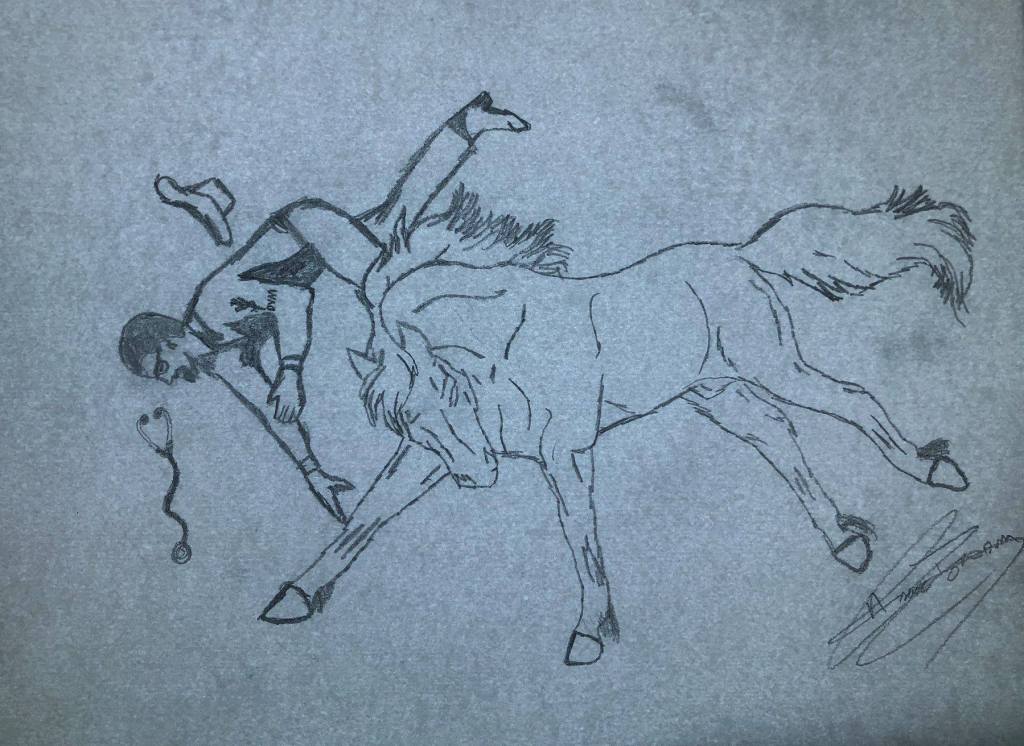
I attached the chains to the jack and gently began to tighten the slack. As I applied traction, the cow went crazy! She began to jump and kick and swing her head. I jumped back as fast as I could. She bellowed and began kicking her back legs in the air as if she were a rodeo bull.

The calf jack was firmly attached and stuck out straight nearly 6 feet from her rear end. This device became a formidable weapon and this cow knew exactly what to do. She was able swing it with extreme accuracy.

And boy did she ever swing it!

My OB bag was the first victim. It went flying through the air spreading instruments all over the barn. My water bucket next was launched vertically, covering all of us with fetal fluid and blood tinged warm water.

In a swift motion, the cow pivoted on her front feet, swinging her back end in an abrupt 180 turn. My back was turned to her when this happened and it caught me completely off guard. The calf jack, still sticking straight out from her backside, struck me about 2” below the back of my knees. This caused me to do a partial backflip. I landed on the soft bed of straw head-first.

“Preston!,” I shouted, “I thought you said she was tame!”

“Well, Doc, I ain’t never hooked one of those on her before!” he replied, with a look of bewilderment in his eyes.

Together we grabbed a large panel and placed it along side the raging bovine. She immediately calmed down and I returned to my job.

The calf was born alive! It was a precocious solid black bull calf with a stripe of white extending down his forehead. It weighed nearly 120 pounds!

“Good job Doc!” Preston exclaimed, “I was a little worried there for a minute!”

“So was I,” I replied, “So was I.”

The pain in my calves finally set in as I walked back to my truck. I had a battle wound that took weeks to heal – a linear bruise left by the unforgiving calf jack stuck to the backside of a most formidable and sinister cow.

And that is My Take!

N. Isaac Bott, DVM

Shonna Dean Peterson

This week’s My Take comes from a special sheltered corner in the fleshy tablet of my heart.

As I write this, I am physically in a beautiful costal city in southern Mexico. Mentally, I am in a small tiny town along Highway 10, in central Utah, an alkaline oasis called Emery. 

Yesterday, as the wheels of the plane touched down here in Mexico, I received the devastating news that my sweet grandma, Shonna Peterson had passed away. 

News like this hurts like hell because that is exactly what it is.

I struggle to find the words that can adequately express the profound sadness that I feel and the immense hole that her passing has left behind. 

There are 19 people on this earth that are privileged to call this wonderful woman our grandma. Although each of us are vastly different, she loved each and every  one of us equally and unconditionally. 

Certainly, enough tears have fallen from each of us to flood the muddy creek that winds down the Wasatch Plateau and through the canyons and gullies of the blue clay hills near Emery. 

I have had the privilege to have my grandma be part of my life for over 40 years. Some of my earliest memories are of setting on her lap and listening to her soothing voice. 

As a young child, I looked forward to each and every visit to Emery to visit my grandma. With each visit, I literally felt the love she had for me as I entered her house, 

During the summers of my youth, I would raise lambs to show at the yearly stock show in Ferron. The sunny, long hot July days were brutal. I remember many of these difficult days were ameliorated by my grandma pulling up in her tan Buick. Inside, she always had a cooler full of soda pop and snacks. 

There are hundreds of memories that I have of my grandma coming to the rescue. 

Looking back now, during most of these times, she was working full time and had just barely completed her long days work. Most of us would immediately head home to clear our minds and to get some rest.

However, none of us are Shonna Peterson.  

She worked all day, and then afterwards she worried about others before giving any thought to herself. She taught me what unconditional love was, without saying a word. 

She married her high school sweetheart in 1949. Together, they raised 6 beautiful daughters. My grandparents have spent over 7 decades by each other’s side. 

My grandma had a very unique perspective about life. One of my favorite teachings from her pertained to being happy with what you have. So much happiness in the world seems to be conditional; “If I had this or that…….. then, and only then will I will be happy.”

Grandma’s words were succinct, “You may not have the very best, but whatever you have is the BEST YOU HAVE and you need too take care of it the very best you can.”  

Grandma taught me to be happy right now. She taught me to enjoy the moment and to be satisfied with what was in front of me.

The last time I saw my grandma was just two weeks ago. As I gave her a good bye hug, I held on a little longer than I normally would. I gazed at her beautiful face. I memorized each and every wrinkle and mark. I know that each one was forged through her worry and love for each of her children, grand children and great grand children. I wept as I realized that there was one for me too. 

As I looked into her eyes, I told her that I loved her. She told me that she loved me too and that she had been thinking about me a lot lately. She then wrapped her arms around me and placed her head on my chest. In this pose, my last photo with her was taken. 

As the tears stream down my face, I miss my sweet grandma. Her love for me was real. It was raw and it would roar for me if required. It will stay with me in quietness and will forever be my comfort. 

After all, real love will celebrate with you, and raise you up. It will keep you going when the world is against you. It will triumph at the end of each and every day. 

Thank you for teaching me this grandma Shonnie.

Thank you for kissing the scars I hid from others, and for helping me turn the pages of my life that hurt so bad to read. I love you. Always and forever. 

My only request grandma, is that you please wait for me so that one day we can walk together across the stars.

Love, 

Isaac

The Red Handkerchief

My Take Tuesday: The Red Handkerchief

As a veterinarian, I all too often find myself in precarious situations.

Upon graduating from veterinary school in 2009, I moved back home here to Utah. My first job out of school was right here in Utah County.

It was not unusual for me to be called to attend a dozen or more lame and injured cows on a particular day. You might arrive to find them in a paddock with no sorting pen and therefore no means of restraining them for treatment. What are you going to do? Unfortunately, farmers often have the attitude that you’re the vet, they’ve called you out to do the job, so they expect you just to get to it. Often these cattle facilities left much to be desired. A few broken palates, some bent powder river panels and a welded together squeeze chute constitute pretty decent working conditions.

Usually some unsatisfactory compromise could be sorted out which would reinforce the fact that you were not half as good as their old vets.

Max was no exception. He stool 6’1″ and was as skinny as a bean pole. He always had a runny, drizzly nose, and he kept a red handkerchief in the front pocket of his bib overalls. Max didn’t want a new young vet working on his cows. He was used to the old school way, and had no reason to change.

I was greeted on one of these farm visits by this familiar refrain: “We used to use old Doc SoandSo. Have you heard of him? Best dairy vet in the county. Of course, you’re new and not used to dealing with dairy cows down here are you?”

Perhaps I am unduly sensitive, but being told you’re second best before you’ve even begun is either irritating or depressing—depending on how your day has been. This day tipped more toward the irritating side.

Suzy was the name of his milk cow. She was a tall Holstein crossbreed cow. On this particular day, Miss Suzy stood in the knee deep pasture staring at us as we entered the field. She was swollen up like an engorged wood tick. On her left side, her stomach was protruding so far that she was as wide as she was long. The diagnosis, even from afar was obvious. 

She was bloated.

Bloat is a digestive disorder characterized by an accumulation of gas in the first two compartments of a ruminant’s stomach (the rumen and reticulum). Production of gas (primarily carbon dioxide and methane) is a normal result of fermentation processes. The gas is usually discharged by belching (erutication) but, if the animal is unable to remove the excess gas, pressure builds up in the rumen-reticulum exerting pressure on the diaphragm which prevents the animal from inhaling, and bloat occurs. The most common type of bloat is frothy bloat where gas builds up in a foam or froth above the rumen contents and the normal belching is inhibited.

Imagine a 40 gallon tub of partially digested green stomach contents. The pressure of this stomach is such that when it is alleviated, it is similar to popping a balloon, this disgusting smelly concoction will spew in a fashion similar to the Old Faithful Geyser.

Before we could even isolate her in the corner to begin treatment, Max decided he needed to blow his nose. As he pulled out his bright red handkerchief, he flipped it with his wrist and positioned it to evacuate his proboscis. Suzy caught sight of this red temptation and came charging full speed – like a freight train – straight for us. She was bellowing and blowing snot in a fit of rage.

In a situation like this, it doesn’t matter how quick you are. The only relevant assessment of speed is how fast you are in relation to the other person in the pasture. I figured I could beat Max to the gate, but would feel guilty in so doing.

I braced myself for the impact. Max yelled, “Hey Now!”

Suzy collapsed just steps before she reached us. The massive pressure caused by the bloat had cut off her air supply. She lay in a heap in front of us.

The treatment for bloat in a case like this is to relieve the pressure as fast as possible. An incision in made through the left side of the abdomen and the rumen is decompressed. In a situation like this, you only have a few seconds to act. My surgical instruments were in my tool box over by the gate. I knew there wasn’t time to retrieve them.

I reached in my pocket and pulled out my Old Timer pocket knife. I made a quick incision with the sharp point. 

Immediately, air began spewing out. It sounded like removing a valve stem from a car tire. It whistled as the massive stomach returned to normal size. Shortly thereafter, Miss Suzy was back on her feet and back to her normal self.

As I prepared to leave, Max commented, “Hey Doc, I guess you are alright after all.”

Max then pulled out the red handkerchief and blew his nose as he inquired, “How much do I owe you?”

And that is my take!

N. Isaac Bott, DVM