
Category: Uncategorized
The Premise of Prevention
The Premise of Prevention
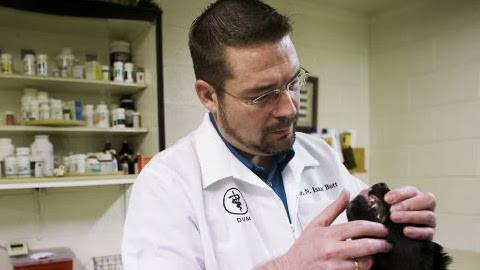
Dogs and cats are living longer and healthier lives thanks to regular physical exams and preventive care. Preventive medicine, or ‘wellness,’ is something that started in humans and then went to animals (often advances in medicine work the other way around). The premise is this: if you can prevent or catch illness early on, it’s easier on the pet, the owner and the pocketbook.
Routine blood and urine tests are a thorough way of assessing your pet’s general health. These screen for key indicators that arise much before clinical signs are noted. I routinely diagnose kidney and liver disease in pets that are acting completely normal.
Dogs and cats cannot tell their family or their veterinarian the subtle signs of illness that humans express. When dogs and cats begin to show outward signs of illness, the health concerns are often so advanced that they are no longer treatable. “Survival of the fittest” is Mother Nature’s rule. Animals have an instinct that if they are weak, they succumb to predation. For that reason, in most cases your pet will often not show any signs of concern until they are very ill.
I believe a clinical focus on prevention is the most effective approach to pet health. Routine check-ups allow your veterinarian to diagnose, treat and protect your pet from contracting serious, costly and sometimes fatal diseases. I strive to partner with my clients to make sure their pets receive proper preventive care through:
Vaccinations
Dental Care
Parasite Control (heartworm, flea/tick, deworming)
Nutritional Counseling
Behavioral Counseling
Comprehensive Annual Examinations
It is this simple: If you want to save money on pet care, you need to work on preventing illness instead of having it treated after health problems have advanced. By practicing preventive care, you will save money, and you’ll also spare your pets a lot of suffering.
When a pet-lover and a veterinarian work together on preventive care for a pet, the result is a longer, happier life for your pet.
At Mountain West Animal Hospital, we believe a clinical focus on prevention is the most effective approach to pet health.
And that is my take.
N. Isaac Bott, DVM
Airport Security
Airport Security
They say hindsight is 20/20. Looking back, it was clearly a mistake.
I hurriedly prepared my luggage, assuring that everything would fit in a carry on. I have a perfect record, in all of my travels I have never had my luggage lost. Taking a single carry-on bag is the only way to assure your luggage gets to your destination on international flights.
The destination this trip, was the Philippines, and it was my first trip to Asia. I had been called to travel there to assist in establishing both Water Buffalo and deer reproduction programs in this far away country.
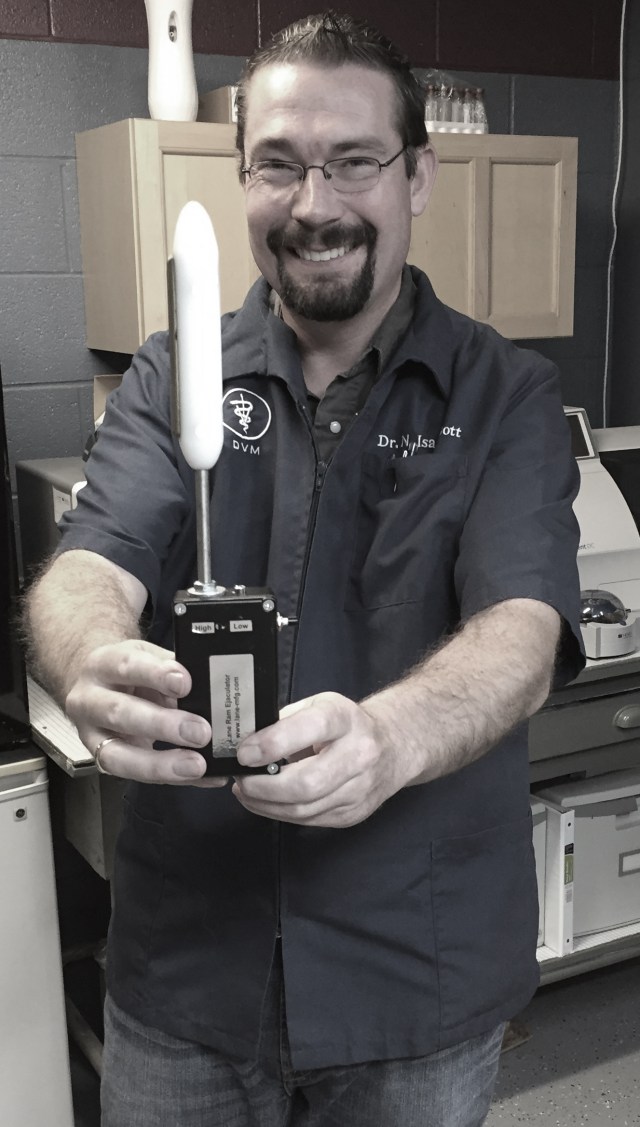
I placed my required instruments, long forceps and miscellaneous items used for freezing semen delicately in my bag. The last piece of equipment was something called an electro-ejaculator.
In the practice of veterinary medicine, it is common to collect semen from domestic ruminants using electro-ejaculation.
This instrument is an electric probe that is inserted into the rectum of an animal, adjacent to the prostate gland. The probe delivers an AC voltage, usually 12–24 volts. The probe is activated for 1–2 seconds, referred to as a stimulus cycle. Ejaculation usually occurs after 2–3 stimulus cycles. The instrument fits in your hand and runs on a traditional 9 volt battery, the exact battery most smoke alarms use. It is a valuable tool when collecting semen from agricultural and wild animals.
It fit, without a problem, in my suitcase.
Salt Lake City International Airport was busy on this particular day. The lines extended over the sky bridge and nearly to the parking garage.
I passed through the metal detector and my bag went through the usual belt driven scanner. As I waited for my bag to come out, the operator of the scanner lowered his head and spoke into his mouthpiece. What he said was inaudible, but the response it triggered was anything but quiet.
I was circled by at least 10 TSA agents and hurried off to the far right end of the security entrance. If there ever was a suspicious item, this was it.
A tall gruff man asked, “Sir, do you have any prohibited items in your bag?”
Now clearly, they know the answer to this question before they ask it. On a prior trip, I had left a small pocket knife in my bag. They asked the same thing, and I had completely forgot it was in my bag. My answer then was, “I don’t’ think so?” Fortunately, they allowed me to mail my pocket knife home and the delay was minimal.
Clearly today it was not going to be as easy.
“I have a medical device called an electro-ejaculator in my bag”, I tried to explain. One of the TSA workers removed the device. Clearly red flags were raised, and rightly so. Here is an electronic device with a push button, a red light and metal tongs protruding from the probe. The gruff man demanded, “What is this and why do you have it?”
“It is used to collect semen from animals,” I explained, “you insert this end in the rectum and push this button. It then applies current over the prostate, and ejaculation occurs.”
The gruff man’s face went from viable anger to disgust in less than two seconds.
“What? Ewwwww!!! Are you serious?”, he continued, “Why would you ever do that to an animal?”
“I am a veterinarian”, I explained, “And my expertise is in animal reproduction.”
“Wow kid, I thought my job was tough,” he replied, laughing this time.
Fortunately for me, the device was labeled as such and my story was collaborated. I was allowed to pass.
En route to Manila, we stopped in Narita, Japan. Even though it was just a connecting flight, I had to pass through a security line once again before continuing on to the Philippines. Once again, a huge mess unfolded as I tried to explain in English why I would have such a dangerous looking device in my bag.
There are a couple dozen airport security officers around the world who now know, albeit unwillingly, what an electro-ejaculator is and how it is used.
After an eventful and productive stay in the Philippines, I entered the airport in Manilla, excited to be going home. As I stepped up to the counter, the ticket agent asked, “Sir, do you have any bags you would like to check?”
“Yes, I sure do”, I quickly replied.
I made my way to the gate and sat down to await my flight. I was relieved that I didn’t have to once again explain what was in my luggage. It appeared my trip home would be uneventful.
All of the sudden, over the loud speaker I hear the following announcement, “Passenger Nathan Isaac Bott, please report to the security desk immediately!”…………
And that is my take.
N. Isaac Bott, DVM
The Human Reindeer Connection

Humans have been interacting with reindeer for at least 45,000 years.
A reindeer engraved on the wall of a cave in south Wales has been confirmed as the oldest known rock art in Western Europe. It is believed to have been created at least 14,000 years ago!
A recent study on reindeer mtDNA identified at least two separate and apparently independent reindeer domestication events, in eastern Russia and Fenno-Scandia (Norway, Sweden and Finland). Substantial interbreeding of wild and domestic animals in the past obscures DNA differentiation, but even so, the data continue to support at least two or three independent domestication events, probably within the past two or three thousand years.
When people think of reindeer, they often visualize Rudolf and his friends pulling Santa’s sleigh. As cute as this image may be, there is so much more to these fascinating creatures.
Their ecology, physiology, and anatomy are very unique. They have been domesticated for thousands of years, yet we know very little about them from a veterinary standpoint. Attempts at artificial insemination, embryo transfer and other reproductive technologies have been met with considerable challenges and mixed results.
Although many sources erroneously claim that caribou and reindeer are the same – Caribou and Reindeer are different subspecies. Reindeer are classified as Rangifer tarandus tarandus and the alaskan caribou are classified as Rangifer tarandus granti. Even National Geographic and many prominent zoos in the United States are wrongly classifying these animals. A recent genetic mapping published in Nature shows the migration pattern of these mammals in North America over the last 21,000 years, and claims that they are actually different animals — but closely related cousins.
I never considered working on reindeer while in veterinary school, yet they have become an important species to me as a practicing veterinarian. I have traveled all over North America and Asia working on this species.
Reindeer have a long history in culture and myth. That history has given way to further study to learn about how unique they are. I have been privileged to be a part of some of these scientific advancements.
And that is my take!
N. Isaac Bott, DVM
White Lightning
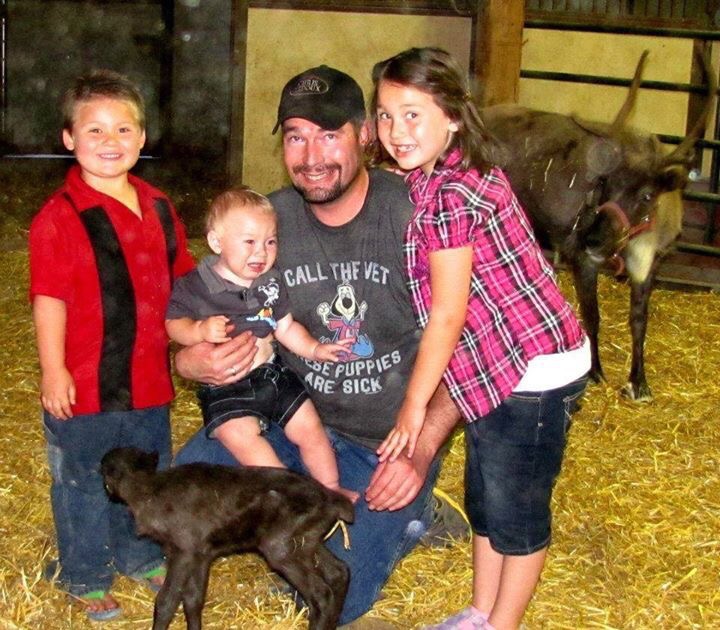

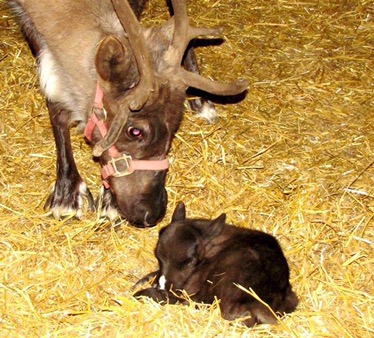
Reindeer rarely have difficulty giving birth. Fortunately, nature has provided this species with amazing vitality. Young calves stand within minutes of being born. Predation is the primary cause of death in newborn calves. To minimize this, cows synchronize their birthing. If all of the calves are born at the same time, fewer are killed by predators. Gestation length can vary as much as 45 days to accomplish this. Such synchrony is fascinating, but provides considerable challenges with domesticated herds. Occasionally, calves are born premature and lung development is not complete. Sadly, many of these calves die.
As a veterinarian, I perform a considerable number of artificial inseminations on reindeer each year. The calves produced by this procedure are especially valuable. Intense care is given to newborns to ensure the best chances of survival.
A few years back, a young male calf was born during the summer. He had a unique white marking on his nose. This calf was a charmer. We all instantly fell in love with him.
On examination, the calf showed considerable effort in his breathing. His lungs were not working as they should. Research has shown that these calves lack a chemical called Surfactant. Surfactant reduces the surface tension of fluid in the lungs and helps make the small air sacs in the lungs (alveoli) more stable. This keeps them from collapsing when an individual exhales. In preparation for breathing air, fetuses begin making surfactant while still in the the uterus. With some reindeer calves, this production is incomplete when they are born.
Treatment consists of replacement surfactant therapy. This is often not feasible in veterinary medicine because of the high cost of synthetic surfactant. When is is available, it must be administered within 6 hours of birth to be effective.
The second treatment is placing the calf in an incubator (very similar to ones used with human neonates) and administering oxygen. Some calves will improve with this treatment. We placed him inside the oxygen chamber and waited. Feeding was required every 2-3 hours. The first few hours were touch and go, but little by little, improvement was noted. His tiny lungs slowly began to function properly.
Fortunately, things improved for this beautiful calf. We named him White Lightning, reflecting the distinctive white stripe on his nose.
Miraculously, on this hot summer day, a life was saved. As you can see in the photos, we were all happy to pose with the calf, with the exception of my youngest son, KW. He fortunately has overcome his fear of reindeer. 🙂
N. Isaac Bott, DVM
DocBott got ran over by a reindeer!
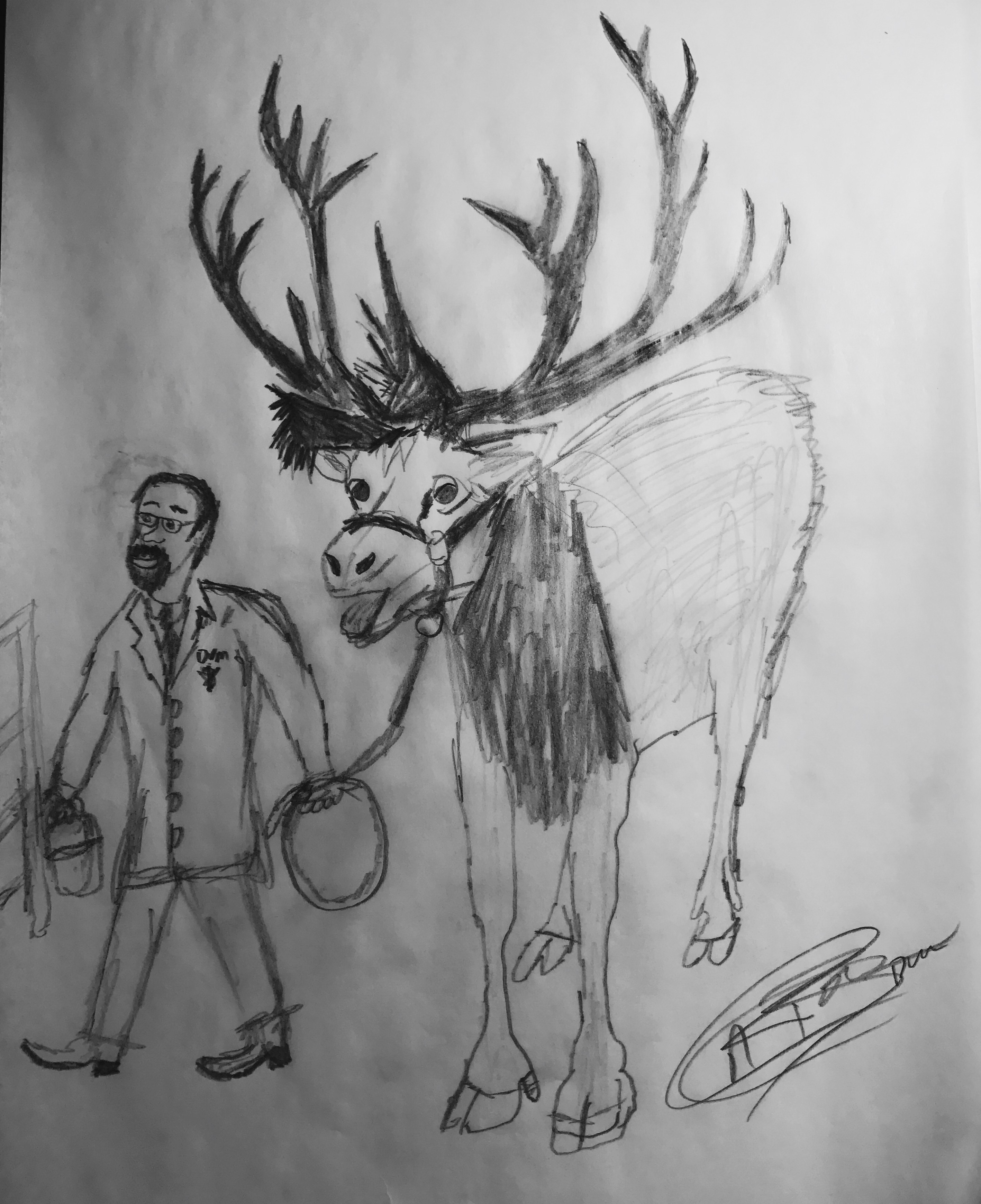 Many of the pictures I post are of Mountain West Animal Hospital’s resident reindeer. They are very docile and love the attention. Sven and Titus will pose for photos and love little children. Sven even has a fondness for the color pink.
However, not all reindeer are like this. A male reindeer’s personality changes dramatically as the breeding season approaches. Circulating levels of testosterone dramatically increase in late August. This hormone will make an otherwise tame male become a raging, grunting and aggressive mess.
A couple of years ago, I received a call from a reindeer farmer in northern Utah. He had a male reindeer that had injured the base of his antler. August heat and fresh blood are a recipe for complications due to either a severe bacterial infection and/or an infestation of disgusting maggots.
I arrived at the farm and immediately realized that the bull was in full rut. I had just left the office and, like a true nerd, had placed an external hard drive for my computer in my front pocket.
The bull was not very happy to be caught. It took three of us to restrain him while I treated his injury. His massive antlers could easily lift us off the ground and fling us in any direction desired.
Just as I finished the treatment, he broke lose. He immediately turned toward me. I had very little time to react. I stood there holding empty syringes and iodine in my hands, helpless and very much vulnerable. His attack was swift. A single charge knocked me on the ground.
I lay there struggling to catch my breath. The sudden impact of the ground on my back left me with temporary paralysis of the diaphragm which made it difficult to take a breath. When I finally did breathe, I was bombarded with excruciating pain over the left side of my chest. I reached into my pocket and removed the external hard drive. It was shattered.
I was very much defeated and beaten, but overall ok after I got on my feet. The pain was caused from two cracked ribs. Other than that, I had no further damage from the incident.
I learned my lesson that day. Rutting male reindeer cannot be trusted. They are the most dangerous animal I have ever worked with. They make a Jersey dairy bull seem like a young puppy.
I am glad I had the external hard drive in my pocket. The antlers would have easily punctured my lung and inflicted life threatening injuries.
If you ever see a male reindeer grunting, snorting and peeing on itself – STAY AWAY!
You have been warned.
And that is my take!
N. Isaac Bott, DVM
Uncle Jerry
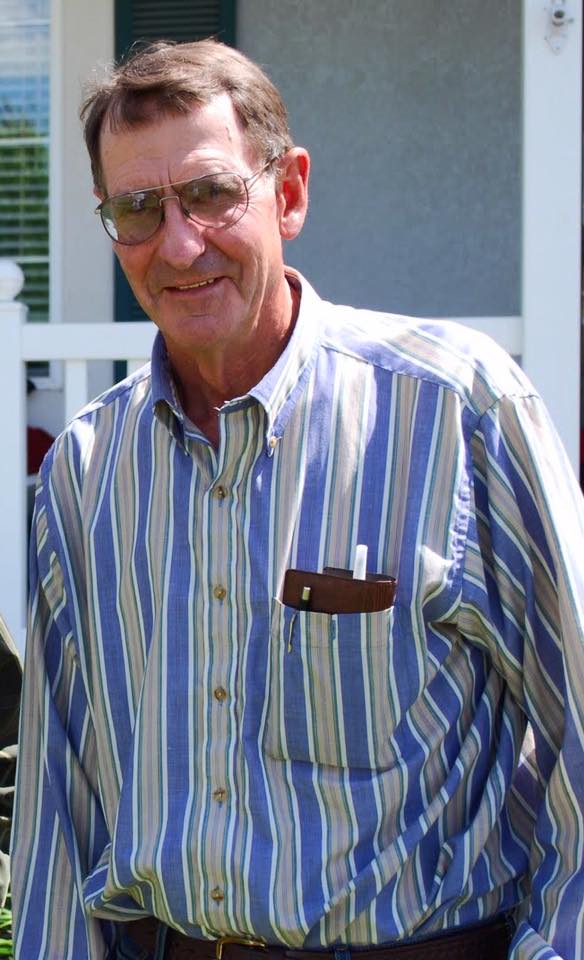
Heroes cease to exist in two ways, either through disappointment or death. If you are lucky, the later is the case.
My childhood hero just took his last breath.
As I sit here with tears streaming down my cheeks, I hope that I can eloquently articulate my feelings.
If you are lucky enough to know my uncle Jerry Bott, then you have the privilege of knowing the best person I have ever met. There is no better example of loyalty, charity and love than he was.
I grew up right across the streets from him. Our gray house faced his small white house. For my entire life growing up, I would see Jerry at least two times every day.
I owe my very life to my uncle Jerry. Once, as a curious 5 year old, I was standing in the doorway to his kitchen. Jerry had a bag of those pink chalky wintergreen disc candies. I placed one in my mouth, and somehow got it lodged inside my trachea. Jerry must have sensed my panic, but he calmly walked over and gave a firm push on my stomach and the piece of candy shot across the room.
There is no one more patient than my uncle Jerry. It would be impossible to be so. I remember every day growing up, Jerry dropping everything he was doing, even if it was sleeping following a graveyard shift, to give my little brother Seth a tractor ride down the street. I know that many days he didn’t want to do it, but he never complained a single time. He was grateful for the time to spend with Seth.
I remember my younger brother Seth having a severe seizure as a child. He was rushed to the hospital by ambulance. I was beside myself. Uncle Jerry came over and silently sat in a recliner next to me for the entire night. After an hour or so, he looked at me and said, “don’t worry Isaac, Seth is going to be ok.” He was right. Although it was a very long night, he sat there the entire time.
Years later, after a cousin of mine was killed in a car crash, we were standing at the grave side. I watched Jerry walk over and give my uncle a hug. Jerry began to sob. I could literally feel the love he had for my cousin and my uncle’s family.
While in high school, I did not know what direction I needed to go in life. Jerry one day, quietly predicted that I would become a veterinarian. I remember thinking that notion was crazy! But, as always, he was right.
In high school, following my first heartbreak, I remember sitting in his kitchen crying as I recounted what had happened. Jerry calmly looked at me and told me it would be ok. He was right, everything did turn out ok, but it was his words of comfort that calmed my troubled soul.
The corrals below Jerry’s house become filled with manure in the winter. It is at least knee deep by February. I remember one year standing in this disgusting green pool of filth with a scoop shovel. The task seemed insurmountable, the stench seemed inconceivable, and my will power seemed inaccessible. Jerry came down, calmly entered the coral and began scooping the green filth into the wagon. He looked at me and said, “Isaac, thanks for letting me help. This is one of my favorite things to do.” Now clearly, he was bluffing, but his optimism turned this job that I absolutely despised into something tolerable. Jerry was the hardest worker I have ever met.
My generous nature is because of what I learned from my sweet uncle Jerry. Over the years he has spent hundreds of thousands of dollars helping other people. He would quietly go to the grocery store and take groceries to those who needed them. He never wanted any credit for the thousands of acts of service he provided to the fortunate residents of Castle Dale, but each of us that he served are much better people because of his love.
Jerry would use his gloves until they fell apart. Holes in the fingers were fixed with duct tape. Socks that would not stay up were held in place with rubber bands. He would sew the holes in his socks where his toe would eventually wear through. He was the absolute example of personal frugality, yet he would give so much to all those around him. Watching his generosity was inspiring, but watching him go without taught me what true sacrifice is.
Jerry would sit for hours, listening to me tell him about veterinary school. I would share my triumphs and failures. He would attentively listen, and make me feel as if nothing mattered more in that moment than I did. It must have been so boring for him to have to listen to me go on and on, but he never showed it. He picked me back up when I fell down, he consoled me when I was heart broke. There are dozens of times that he comforted me and took my pain away.
I literally could write a book on all of my memories of uncle Jerry. He has been like a second father to each one of my siblings and I. We are so lucky to have had the chance to spend so much time with him.
Every hundred or so years, God smiles and sends one of his noble and great ones to earth. These individuals lift all those around them, and share the love of the Master Himself. Jerry was indeed one of those noble souls. Today, he was called back home by that Maker who gave him life.
There is one less cowboy in Castle Dale, and a saddle that is empty today, but there is a grand reunion up in heaven as he is welcomed home by loved ones.
I love you Jerry. Thank you for believing in me before I believed in myself. Thank you for teaching me to love, and give and serve. Your influence will forever remain in my heart.
Gratitude
My Take Tuesday: Gratitude
Thanksgiving time provides an opportunity for us all to gather together and give thanks. Most of us live a life of privilege and all too often take our commodious lifestyle for granted. I find myself doing this often.
I have always wondered if the emotion we know of as gratitude
is uniquely human. Are animals capable of this emotion? If so, is it something they experience often?
Anthropomorphism is the attribution of human characteristics, such as emotion, to animals. While such comparisons are often inaccurate, there is some evidence that gives some merit to these comparisons.
Impala are large antelopes native to Africa that have been observed grooming each other. These grooming exchanges among African impala are usually unsolicited: one individual grooms the neck of a second individual, and then the second individual returns the favor, and grooms the first individual for an equivalent amount of time. It is thought that this mutual grooming behavior serves to remove ticks from parts of the body that an individual can’t reach itself.
Vampire bats, as you might expect, survive only on blood, and most feed at least once every three days. And while adult vampire bats regularly miss meals, they need not worry, as other individuals will regurgitate blood to feed them.
While the impala and vampire bat examples are interesting, they can be explained by much a simpler mechanism than gratitude: researchers call it symmetry-based reciprocity. That is, if members of a species preferentially direct favors to close associates, the distribution of favors will automatically be reciprocal due to the symmetrical nature of association. In other words, the mutual back-scratching of the impala and blood-vomiting of the vampire bat could simply be correlational: individuals who hang out together will tend to engage in reciprocal interactions, but only because they tend to hang out together.
In other species, the behavior extends beyond what is described above. For example, the common exchange of food for grooming among chimpanzees. To look at this further, researchers placed bundles of leaves and branches in the chimpanzee enclosures after the they had identified the patterns of grooming on a specific day. The adult chimps were more likely to share food with individuals who had groomed them earlier that same day.
In another experiment, primatologists Seyfarth and Cheney played recordings of vervet monkey calls and measured the reaction of recently groomed individuals. The type of vocalization that they used was a call used to threaten enemies and to solicit the support of friends, in anticipation of a conflict. When the recording was of a previous grooming partner, vervet monkeys paid more attention than when the recordings were of other individuals.
Taken together, these studies indicate that some non-human primates have the long-term memory abilities required for gratitude, as well as the ability to distinguish among individuals.
Another experience was described by a separate researcher. He tells a story about how two chimps had been shut out of their shelter by mistake during a cold rain storm. They were standing dejected, water streaming down their shivering bodies, when the researcher chanced to pass. Upon opening the door for the two chimps, Dr. James Leuba recounts, “instead of scampering in without more ado, as many a child would have done, each of them delayed entering the warm shelter long enough to throw its arms around his benefactor in a frenzy of satisfaction.”
Do animals have gratitude? It is still a much debated question. However, it is clear that some animals, such as chimpanzees and other non-human primates, seem to possess at least a more basic form of proto-gratitude, based on their ability to keep track of favors given to and received from different individuals.
When pets are rescued and adopted, they seem to display a greater-than-average appreciation (e.g. tail wagging, purring) of our care and for the food we give them. I have witnessed this time and time again.
I believe gratitude is a shared emotion.
And that is my take.
N. Isaac Bott, DVM
What are your thoughts?
Don’t worry Doc, he won’t bite
My Take Tuesday: Don’t worry Doc, he won’t bite
“Don’t worry Doc, he won’t bite.” If ever a red flag was raised, these simple words would surely do it. I worry every time I hear the phrase. It reminds me of the required vet school class that covered the autonomic nervous system. The fight or flight impulse is part of that system. And in most cases, the fight response prevails. Invariably, when someone says this, I am going to be bitten.
It was a routine appointment, simple annual vaccinations. It should have gone smoothly.
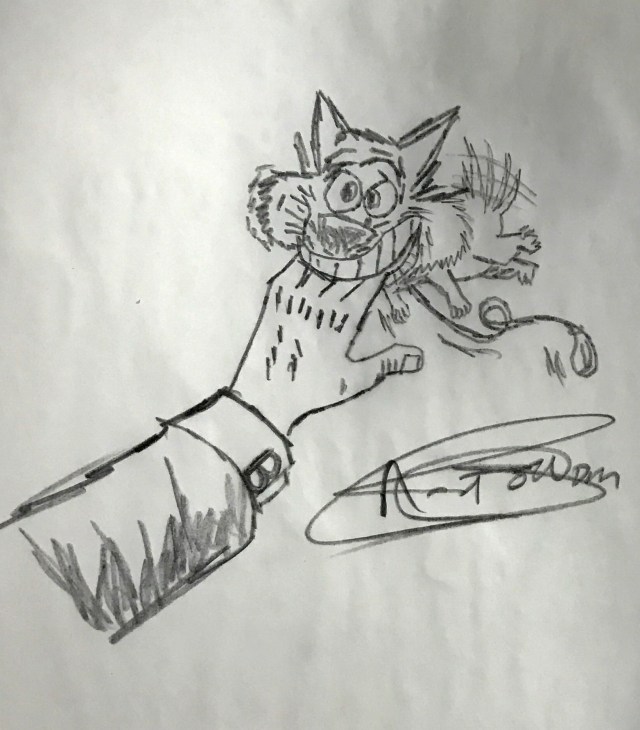
As I administered the last vaccination, all seemed to be going smoothly. When all of the sudden, this unseeingly sweet little dog became, without warning, a biting, raging canine tornado.
This form of aggression can be defined by the word “IATROGENIC”. The definition of this fancy word is simple, it was caused by ME. This little guy was furious, and come hell or high water, he was going to let me have it.
His attack was swift. He had sunk his teeth deep into my left hand. I instinctively pulled back as he loosened his grip. I thought for a brief moment that it was over, but before I could remove my hand, he chomped down a second time.
Blood poured from my lacerated fingers.
The owner looked up, shook her head, and said, “Come to think of it, he did that to the last vet also.”
“Gee thanks,” I muttered.
If anyone ever tells you, “Don’t worry, he won’t bite.”
Take it from me – BEWARE!
You are about to be bitten!
And That is My Take
N. Isaac Bott, DVM
Why did you become a veterinarian?
My Take Tuesday: Why did you become a veterinarian?
I hear this question on a regular basis. Each veterinarian has a story about why he or she decided to pursue a career in veterinary medicine. Most veterinarians share a commonality – that they have always wanted to be a veterinarian as long as they can remember. My story is a little bit different. I have always loved animals, but didn’t decide to become a veterinarian until the age of 21.
To tell my story, I must start at the beginning.
I was raised on a small farm in Castle Dale, UT. My first responsibilities as a child were to feed the chickens and gather the eggs. I began this task at 6 years of age. Each year we would purchase a variety of baby chicks from Murray McMurray hatchery. They would arrive at the post office on a scheduled day. I would wait with eager anticipation for this time. To me it was just like Christmas. My dad would let each of us pick out a chick that was “ours”. I would always name mine. I first experienced the remarkable human – animal bond with my chickens. I cried when they died. As a child, chickens became my favorite animal, and remain so until today.
Even though I spent my entire childhood around animals, I did not put much thought into becoming a veterinarian. In high school, I took an aptitude test. The test results suggested that I would not make a good veterinarian. I was not introverted. According to that particular test, I could not be successful as a veterinarian. Assuming that these tests were accurate, I pushed the veterinary idea out of my head and considered a law degree.
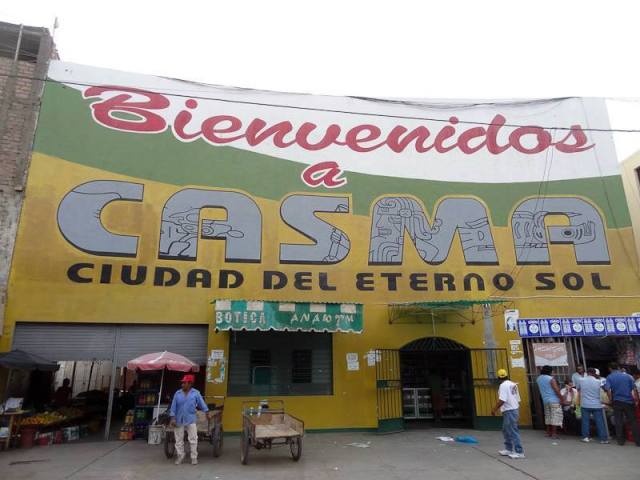
After I graduated from high school, I spent the next two years in Peru. I was immersed in a culture so much different from the one I was used to. It took nearly a year for me to adjust and to speak fluent Spanish. I remember walking down the street in Casma, Peru one day and seeing a group of men in the process of castrating a bull. It was a sight that I will never forget. They were beating the testicles with a large stick in an effort to destroy the testicular tissue and render the bull sterile. The brutality was sickening. I remember feeling so sorry for the bull.
That night I laid in bed thinking about why they would castrate a bull in such a barbaric fashion. I realized that perhaps that was the only way they knew how. Maybe they didn’t know any better. I decided at that moment that I would do all I could to teach these farmers a better way. Having a farming background, I was very familiar with animal husbandry and felt confident that I could help educate the farmers in this part of the world.
My first patient was a pig named Walter. He was a family pet that lived in a house in Casma. Walter had an attitude and his owners needed to have him castrated. I had a friend named Duilio Davelos that owned a pharmacy in town. I visited him and purchased some lidocaine, suture, iodine and alcohol. The procedure went flawlessly. Walter recovered very quickly. News spread of the event. Soon after, I began sending my free time on Monday’s castrating pigs. Farmers actually were open to learning. The supplies were very inexpensive and my services were free.
Next came chickens. Because of my time spent as a child taking care of baby chicks, I was able to teach basic poultry care and even help make incubators to boost production. I soon began helping with llama and alpaca herds. Soon, other curious Americans participated in this. In fact, a human dermatologist raised in Provo, UT had his first surgical experience South of Trujillo, Peru castrating pigs! It was very fulfilling to be able to help people out in this fashion. I felt like I was really accomplishing something. I was giving them something that would change the way they would treat their animals. No longer would they brutally castrate their animals without local anesthetic. They also knew how to surgically prep the skin, which eliminated so many post operative infections. I was helping people by helping their pets. It made me so happy.
As my time in Peru came to a close, I boarded a plane in Lima and headed back to the USA. As I sat in my seat, I reflected on the past two years. My thoughts kept returning to the animal services I rendered. It was in that moment, high in the air, that I decided to become a veterinarian. I landed in Utah, and a few weeks later began my first college classes. After 8 1/2 years or arduous study, my goal was reached and I became a veterinarian.
I often reflect on the decision I made. I look at how happy I am now. I love what I do. I love helping people by helping their animals. I have never had a boring day, nor have I ever regretted this career decision. I really feel like it is what I was meant to do.
So much in life happens by chance. I was fortunate to have my agricultural upbringing. It prepared me for the future. It is impossible to look forward and connect the dots of the random chances in our lives, but looking back, I can see it clearly.
I am glad that I had the chance to provide animal care in a far away place and how that opportunity led me down this remarkable path I am on today. I cannot imagine doing anything else.
And that is my take!
N. Isaac Bott, DVM
 DocBott