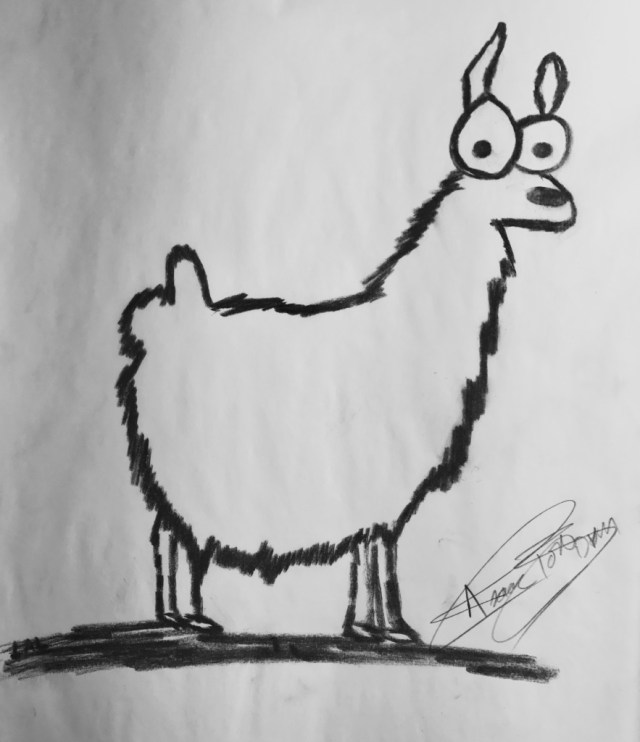
Spit Happens

vLlhwhI2Q8OTptPBaxr20A_thumb_df09

I received a call a few months back regarding a sick llama. It was from a new client that wanted to know if I knew anything about llamas and alpacas. Calls like this are somewhat frequent. Asking a vet if they know anything about llamas is like asking a pediatrician if they know anything about 8 year olds. I responded, that I was indeed familiar with all camelids and had worked extensively with them as a veterinarian. 

As I arrived at the farm, it was obvious that this wasn’t a typical llama ranch. It seemed as though I had traveled back in time to the 60’s. I was meandering into an apparent neighborhood of Hippie-ville. The van parked outside the gate looked just like the Mystery Machine from Scooby Doo. The bright colors were also painted on each of the barns and small buildings of the property and even covered the bases of the tall Chinese Elm trees.

One would not immediately equate going barefoot with farm life, I suppose, especially if the farm in question is shared with livestock. There are serious concerns regarding hook worm, and other parasites that could easily be transferred through the lack of shoes, and to be certain, stepping on manure barefoot has little appeal to the average person. However, a couple of barefooted and worry-free people were standing at the end of the driveway to greet me on this particular day.

One of the owners held a small white paper cup in her hands. As I greeted her, she held the cup up ad asked me to take a sip.

“What is it?”, I asked, not fully anticipating the response I received.

“It is Holy Water”, she responded. “We always make the healer drink before the llama.”

Perhaps the shock of the colorful ambience and barefoot attendants clouded my judgement, what ever the reason, I grabbed the cup and took a small drink. Immediately, I realized my mistake, but could do nothing but swallow the mysterious potion. It was the most disgusting thing I had ever ingested. I smiled, and politely asked where the sick llama was located.

The large white llama was setting in a “kush” position, a term llama farmers use for sternal recumbency. As I approached, he raised his mouth in the air and pinned his ears back against his head.

I moved cautiously, as these signs are consistent with a llama that is going to spit at you. This nasty dark green elixir is actually not spit at all, but is the regurgitated contents from the first stomach compartment. The slew is a mixture of partially digested feed, stomach juice and miscellaneous microbes.

Llamas are well aware of a veterinarian’s never-ending quest to stick needles in them; and if provoked, they will spit copiously at you with unpleasant accuracy of aim.

There is a classic sound a llama will make before spitting. The unmistakable gurgling sound is followed by a distinct “pfffffpth”, as the stomach contents spew from the mouth.

The cause of the llama’s discomfort was a large Russian Olive thorn sticking out from the back of the left elbow. I gently reached down and removed the dagger like thorn.

It appeared as though I had escaped unscathed. The llama, with its ears still pinned back, watched me closely, but did not spit.

As I turned my head slightly, I began to speak with the owners. I explained the after care that would be required for a full recovery and encouraged them to remove the large Russian Olive plants that lined the south side of their pasture. I asked if they had any questions and turned back towards the llama.

My mouth was between words then the attack happened. The trajectory and accuracy were unparalleled. The llama spit with sharp-shooter accuracy, and the stomach contents went directly into my mouth.

I immediately began to gag. I then began to dry heave uncontrollably. The owners stood in awe as I struggled to rid my mouth of the fowl taste of fermented llama feed.

There is no amount of listerine that can remove the taste of llama spit. It will stay in your mouth for days.

“Are you alright?,” the bearded man asked.

“Yeah”, I muttered, as I looked up.

“You got to learn to keep your mouth closed, Doc”, he continued, “Especially if you are going to work on llamas.”

I didn’t know how to respond. After working on literally thousands of llamas and alpacas, this was the first time spit had actually entered my mouth.

I accepted my defeat and curiously inquired, “Can I have another drink of Holy Water?”

And that is my take!

N. Isaac Bott, DVM
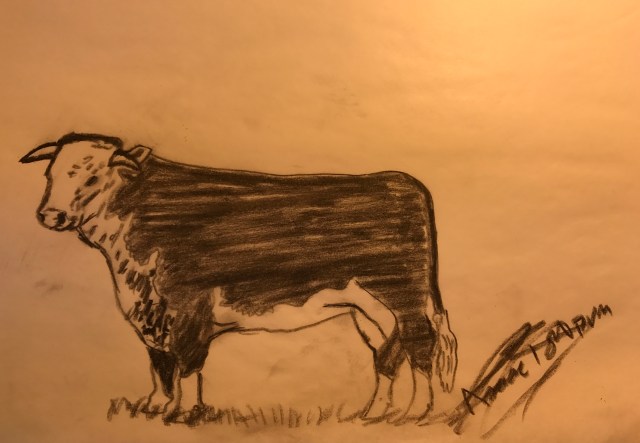
The Belligerent Bovine 

fullsizerender-32

January in Utah is a beautiful time of the year. The land is white. The peaks are white. The roof tops of the houses and barns are blanketed in white. All is lost in the colorless landscape in which a sense of peace takes over, the long nights settle in, the land is in a slumber and the world is put down to rest. Then suddenly, without just cause, comes a blast of bitter blizzards, and winter deepens her grip.

This particular morning was bitter cold. The air burned my face as I stepped out my front door. When temperatures reach twenty below zero, your nostrils sting and burn with each breath. Still, despite the extreme cold, there is a stillness and quiet peace that overwhelms you during these January nights. These quiet midnight journeys to respond to emergency calls provide a time for me to reflect and think. In my busy life, I often have little time alone and I cherish those infrequent moments.

The call on this particular night was a cow with a laceration. Somehow this massive Hereford had tangled herself up in a barb wire fence. As I arrived, the gaping wound was dripping with fresh red blood. Steam would rise from the scarlet stained snow beneath as the blood trickled down and alongside the squeeze chute.

It was obvious that sutures would need to be placed.

A test of a veterinarian’s ability could be most easily assessed by watching him or her suture a laceration in -20 temperatures. It is indeed one of the most arduous of tasks.

As I pulled out my box of supplies, I noticed that a majority of drugs within my medical box were completely frozen. Fortunately, the lidocaine remained aqueous. I pulled out a large syringe and began injecting the local anesthetic along the periphery of the lesion. The old cow bellowed as I injected the Lidocaine. It was clear that she was very unhappy with her predicament.

I began to place the sutures in a simple interrupted pattern. A break was necessary between each suture placement as the stinging cold weather rendered my fingers numb and stiff. In a futile attempt, I tried exhaling on my frozen fingers hoping that they regain some function. This only made the numbness much worse.

As I placed the last onerous suture, the cow lunged forward in the squeeze chute. Her massive belly pinned my fingers against the side of the squeeze chute. A sharp pain shot up my arm as I jumped and pulled my hand back. Nervous to check to see what damage was caused to my numb smashed fingers, I exclaimed, “Alright, turn her lose. We are done.”

As soon as the head gate opened, this massive Hereford jumped forward and exited the chute bellowing and swinging her head. She ran straight ahead for about 20 yards at which time she paused. She then turned around and set her focus on me.

I immediately knew I was in trouble. I quickly  grabbed my tools and began running for the fence; 1800 pounds of solid bovine came thundering toward me making me forget about anything except for escaping her wrath.

After a short run, with the bellowing cow in close pursuit, I reached the lodge pole pine fence that surrounded the corral. I dared not look back as I scampered over the fence. I could hear the angry cow snarling and could feel the sound of each hoof pounding the ground as she bounded towards me.

I made it across the fence safely. Upon reaching the other side I peered back at the massive cow. She stood facing the fence, head down, with a most bewildered look in her eyes. My heart pounded uncontrollably and I began to shake. This was one angry cow!

Immediately, my squished hand began to throb. The feeling in my fingers returned and I walked back to my truck.

As I drove away,  I was very much relived to be leaving the belligerent bovine far behind. This was a close call and I was very fortunate to have made it out of the pen without any serious harm.

As I headed down the cold frozen highway, my mind returned to my time as a student in veterinary school. In the large animal section of the Veterinary Teaching Hospital at Washington State University there was a magnetic sign that could be placed on the pen of a fractious animal. The sign read, “Fractious cow can make it to gate in 2.5 seconds. Can you?”

It would be fitting to have such a sign to hang near the squeeze chute on this particular Utah County farm.

And that is my take.

N. Isaac Bott, DVM

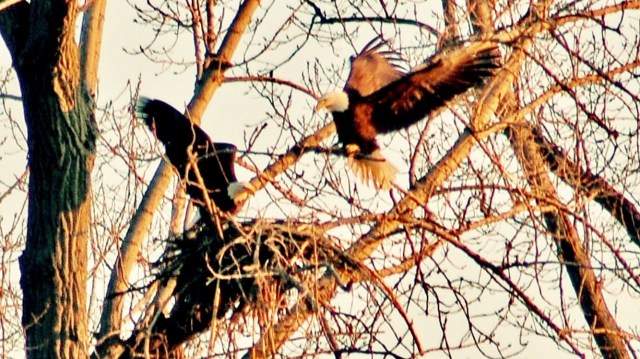
The Majestic Eagle

fullsizerender-18

Above the timberline, soaring above the lofty mountains of the Manti Lasal National Forest fly two bald eagles. These beautiful birds fly through the deep blue skies that surround Castle Valley.

For some unknown reason, this pair of eagles chose an unusual spot to make build their nest. Leaving behind the towering cliffs that surround Castle Dale, they instead close a small clump of Cottonwood trees located in the corner of a dry land  alfalfa patch.

I recall my father purchasing this land in the late 1980’s. We tilled the blue clay soil and planted alfalfa on the areas that were fertile enough to support crop production.

The very next year, while we were feeding cows, we noticed two bald eagles perched in the clump of Cottonwood trees at the bottom of the field. I recall thinking how unusual it was to see two bald eagles in the same tree.

During the next few months, these eagles built a massive nest. We watched as they carried sticks and bark from miles away. The nest was an engineering marvel, built high in the tree below the crown supported by large forked branches near the trunk. The nest was constructed of interwoven sticks. The interior was lined with grass, corn stalks, and other material. The bowl was filled with soft materials and the downy feathers from adults.

I recall the first eaglets born on the farm. In a rare event, one year 3 offspring were successfully raised.

Year after year, decade after decade, this process repeated itself producing many successful offspring.

Each breeding season, material was added to the nest and it’s size increased by up to a foot in height and diameter each year. The nest became visible from great distances as its size increased.

The bald eagles were a welcome sight. Each year they would appear right before Christmas. I remember seeing them consistently every year while growing up. They stood perched, looking down on my every move. A feeling of safety and security ensued as these majestic guardians stood watch.

Although we all recognize the Bald Eagle as the national symbol of the United States,  and as a proud icon of patriotism. I feel they could serve just as well or better as symbols of faithful monogamy. When one of these birds of prey finds his or her mate, the pair stays together for life.

Just this past week, the eagles returned to the farm in Castle Dale.

There is safety in constancy, and security in consistency. I am glad that high in the blue skies above Castle Dale, there is a welcoming place, where the eagles fly.

And that is my take.

N. Isaac Bott, DVM


Discover

15965930_741835979314312_5343828575993074771_n

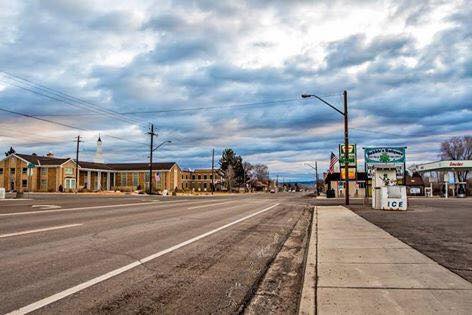
As a child, I grew up in Castle Dale, Utah. My family had a small farm where we raised sheep, cattle and chickens. We had several pastures which we would rotate the sheep and feeder calves. It was always fun when we turned the animals into a new pasture. Their first response was to run and jump and frolic at their new found freedom. I experimented and found this behavior to occur even when they were moved to a smaller pasture. This behavior consistently would occur with what seemed to be only one requirement – wide open space. This freed them from their paradigm. They respond the same way with grass, mud and even snow. Wide open space makes them run and jump and seemingly find energy and happiness.

I find myself, all to often, enclosed in a self imposed corral whose fences limit progression and success. I built these barriers and dare not venture outside these boundaries, lest I be consumed by predators. I think many of us live out our existence in such a fashion. It feels safe. If we never risk anything, we seemingly will never lose anything.

I submit that it is far more dangerous for us to remain inside these fences, never challenging ourselves, never truly reaching our full potentials. This meandering in mediocrity knows no true success. As Mark Twain stated, “20 years from now you will be more disappointed by the things you didn’t do than by the ones you did”. No growth occurs without challenge, and no challenge occurs without some level of uncertainty and presentation of incommodious circumstances.

With that, I throw off the bowlines. I set sail away from the safe harbor with the intent of catching the trade winds in my sails. I stand on the edge of the bough, letting my toes hang over just a bit. It is time to explore, dream and discover……

And that is my take.

N. Isaac Bott, DVM

4-H

15941341_741834179314492_7231369455887506159_n

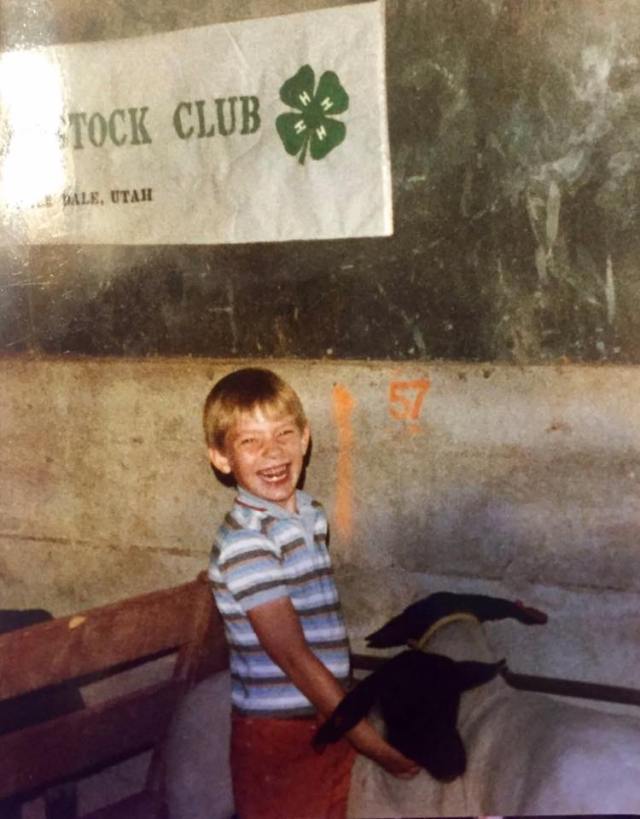
In the spring of 1988, the C-D (C bar D) 4-H club would meet frequently in anticipation for the Southeastern Utah Junior Livestock Show in Ferron, UT. Our advisor, Diane Bott, put significant effort into helping all members prepare for the event. Each meeting would include the recitation of the 4-H pledge. I still remember it.
“I pledge my head to clearer thinking,
My heart to greater loyalty,
My hands to larger service,
and my health to better living,
for my club, my community, my country, and my world.”

What is the benefit of 4-H? I am sure it is different for every 4-H’er, depending on their goals and personal situation. Many will give the typical answers; that it builds character, creates discipline, teaches youth about agriculture, teaches sportsmanship, etc., etc. While all of that is true, there is more that this program can and does do for our youth.

To me one of the greatest values of the 4-H Program is that it allows 4-H’ers the opportunity to gain confidence in themselves by caring for something that is 100% dependent on them. I remember a young 4-H’er who was uncomfortable getting in a pen with the lamb that he was going to take to the show that year. The previous year, he had been hit by a large ram while feeding the sheep with his dad. This made the boy terrified of sheep. Even though he was scared, he had to face this fear; because without him the lamb could not eat or drink and could not have a clean place to live. Little by little, this young boy became more and more comfortable around livestock. I catch a glimpse of this boy every time I look in the mirror.

I remember how attached I became to my own lamb my first year in 4-H. I was only 7 at the time. I cried the day of the sale, as I hugged my lamb goodbye.

Caring for animals will bring out the best in us. Regardless if it is a piglet, a lamb, a calf, a puppy or a kitten, children learn what it feels like to have a living creature rely on them, and that teaches responsibility in a way little else can. Caring for a pet creates a sense of empathy and a respect for life. It teaches commitment and consistency, and it builds self-confidence and provides immense joy.

I am grateful for my time as a 4-H’er. This picture is of me with my first lamb at the stock show in Ferron, UT in 1988.

The smile on my face right now is just as big as I remember this exciting day.

And that is my take!

N. Isaac Bott, DVM
The Premise of Prevention

11755276_502708883227024_418037815726716110_n

The Premise of Prevention

Dogs and cats are living longer and healthier lives thanks to regular physical exams and preventive care. Preventive medicine, or ‘wellness,’ is something that started in humans and then went to animals (often advances in medicine work the other way around). The premise is this: if you can prevent or catch illness early on, it’s easier on the pet, the owner and the pocketbook.

Routine blood and urine tests are a thorough way of assessing your pet’s general health. These screen for key indicators that arise much before clinical signs are noted. I routinely diagnose kidney and liver disease in pets that are acting completely normal. 

Dogs and cats cannot tell their family or their veterinarian the subtle signs of illness that humans express. When dogs and cats begin to show outward signs of illness, the health concerns are often so advanced that they are no longer treatable. “Survival of the fittest” is Mother Nature’s rule. Animals have an instinct that if they are weak, they succumb to predation. For that reason, in most cases your pet will often not show any signs of concern until they are very ill.

I believe a clinical focus on prevention is the most effective approach to pet health. Routine check-ups allow your veterinarian to diagnose, treat and protect your pet from contracting serious, costly and sometimes fatal diseases. I strive to partner with my clients to make sure their pets receive proper preventive care through:
Vaccinations
Dental Care
Parasite Control (heartworm, flea/tick, deworming)
Nutritional Counseling
Behavioral Counseling
Comprehensive Annual Examinations

It is this simple: If you want to save money on pet care, you need to work on preventing illness instead of having it treated after health problems have advanced. By practicing preventive care, you will save money, and you’ll also spare your pets a lot of suffering.

When a pet-lover and a veterinarian work together on preventive care for a pet, the result is a longer, happier life for your pet.

At Mountain West Animal Hospital, we believe a clinical focus on prevention is the most effective approach to pet health.

And that is my take.

N. Isaac Bott, DVM

Airport Security

IMG_2688

Airport Security

They say hindsight is 20/20. Looking back, it was clearly a mistake.

I hurriedly prepared my luggage, assuring that everything would fit in a carry on. I have a perfect record, in all of my travels I have never had my luggage lost. Taking a single carry-on bag is the only way to assure your luggage gets to your destination on international flights.

The destination this trip, was the Philippines, and it was my first trip to Asia. I had been called to travel there to assist in establishing both Water Buffalo and deer reproduction programs in this far away country.

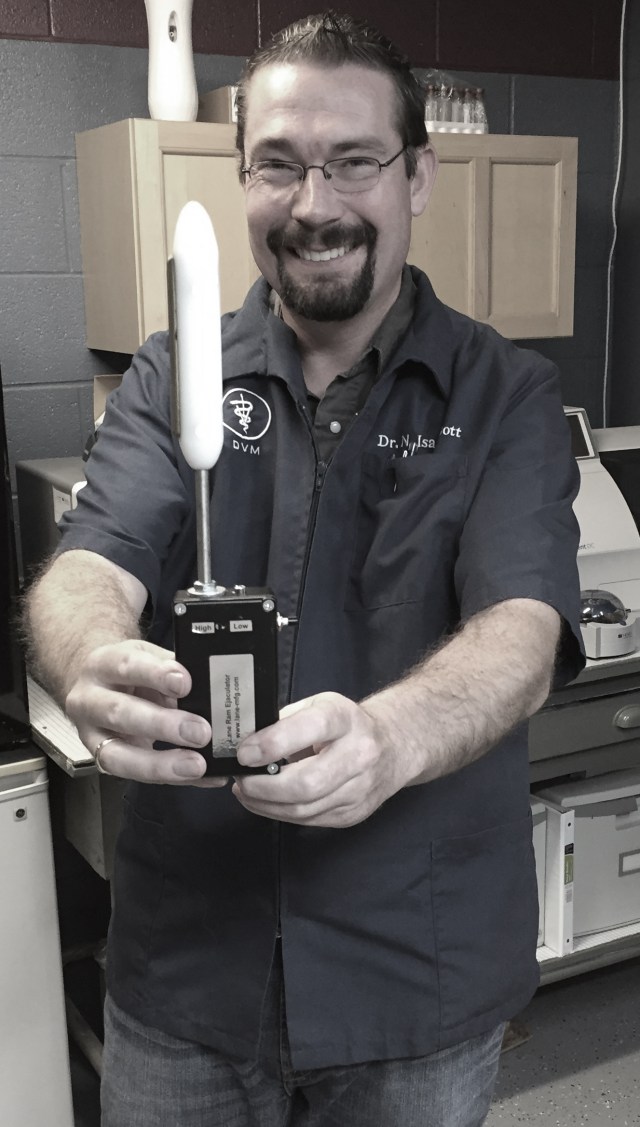
I placed my required instruments, long forceps and miscellaneous items used for freezing semen delicately in my bag. The last piece of equipment was something called an electro-ejaculator.

In the practice of veterinary medicine, it is common to collect semen from domestic ruminants using electro-ejaculation.

This instrument is an electric probe that is inserted into the rectum of an animal, adjacent to the prostate gland. The probe delivers an AC voltage, usually 12–24 volts. The probe is activated for 1–2 seconds, referred to as a stimulus cycle. Ejaculation usually occurs after 2–3 stimulus cycles. The instrument fits in your hand and runs on a traditional 9 volt battery, the exact battery most smoke alarms use. It is a valuable tool when collecting semen from agricultural and wild animals.

It fit, without a problem, in my suitcase.

Salt Lake City International Airport was busy on this particular day. The lines extended over the sky bridge and nearly to the parking garage.

I passed through the metal detector and my bag went through the usual belt driven scanner. As I waited for my bag to come out, the operator of the scanner lowered his head and spoke into his mouthpiece. What he said was inaudible, but the response it triggered was anything but quiet.

I was circled by at least 10 TSA agents and hurried off to the far right end of the security entrance. If there ever was a suspicious item, this was it.

A tall gruff man asked, “Sir, do you have any prohibited items in your bag?”

Now clearly, they know the answer to this question before they ask it. On a prior trip, I had left a small pocket knife in my bag. They asked the same thing, and I had completely forgot it was in my bag. My answer then was, “I don’t’ think so?” Fortunately,  they allowed me to mail my pocket knife home and the delay was minimal.

Clearly today it was not going to be as easy.

“I have a medical device called an electro-ejaculator in my bag”, I tried to explain. One of the TSA workers removed the device. Clearly red flags were raised, and rightly so. Here is an electronic device with a push button, a red light and metal tongs protruding from the probe. The gruff man demanded, “What is this and why do you have it?”

“It is used to collect semen from animals,” I explained, “you insert this end in the rectum and push this button. It then applies current over the prostate, and ejaculation occurs.”

The gruff man’s face went from viable anger to disgust in less than two seconds.

“What? Ewwwww!!! Are you serious?”, he continued, “Why would you ever do that to an animal?”

“I am a veterinarian”, I explained, “And my expertise is in animal reproduction.”

“Wow kid, I thought my job was tough,” he replied, laughing this time.

Fortunately for me, the device was labeled as such and my story was collaborated. I was allowed to pass.

En route to Manila, we stopped in Narita, Japan. Even though it was just a connecting flight, I had to pass through a security line once again before continuing on to the Philippines. Once again, a huge mess unfolded as I tried to explain in English why I would have such a dangerous looking device in my bag.

There are a couple dozen airport security officers around the world who now know, albeit unwillingly, what an electro-ejaculator is and how it is used.

After an eventful and productive stay in the Philippines, I entered the airport in Manilla, excited to be going home. As I stepped up to the counter, the ticket agent asked, “Sir, do you have any bags you would like to check?”

“Yes, I sure do”, I quickly replied.

I made my way to the gate and sat down to await my flight. I was relieved that I didn’t have to once again explain what was in my luggage. It appeared my trip home would be uneventful.

All of the sudden, over the loud speaker I hear the following announcement, “Passenger Nathan Isaac Bott, please report to the security desk immediately!”…………

And that is my take.

N. Isaac Bott, DVM


The Human Reindeer Connection 

Humans have been interacting with reindeer for at least 45,000 years. 

A reindeer engraved on the wall of a cave in south Wales has been confirmed as the oldest known rock art in Western Europe. It is believed to have been created at least 14,000 years ago! 

A recent study on reindeer mtDNA identified at least two separate and apparently independent reindeer domestication events, in eastern Russia and Fenno-Scandia (Norway, Sweden and Finland). Substantial interbreeding of wild and domestic animals in the past obscures DNA differentiation, but even so, the data continue to support at least two or three independent domestication events, probably within the past two or three thousand years.

When people think of reindeer, they often visualize Rudolf and his friends pulling Santa’s sleigh. As cute as this image may be, there is so much more to these fascinating creatures.

Their ecology, physiology, and anatomy are very unique. They have been domesticated for thousands of years, yet we know very little about them from a veterinary standpoint. Attempts at artificial insemination, embryo transfer and other reproductive technologies have been met with considerable challenges and mixed results.

Although many sources erroneously claim that caribou and reindeer are the same – Caribou and Reindeer are different subspecies. Reindeer are classified as Rangifer tarandus tarandus and the alaskan caribou are classified as Rangifer tarandus granti. Even National Geographic and many prominent zoos in the United States are wrongly classifying these animals. A recent genetic mapping published in Nature shows the migration pattern of these mammals in North America over the last 21,000 years, and claims that they are actually different animals — but closely related cousins.

I never considered working on reindeer while in veterinary school, yet they have become an important species to me as a practicing veterinarian. I have traveled all over North America and Asia working on this species.

Reindeer have a long history in culture and myth. That history has given way to further study to learn about how unique they are. I have been privileged to be a part of some of these scientific advancements.

And that is my take!

N. Isaac Bott, DVM