Sheep On The Loose!

IMG_0267.jpg

My Take Tuesday: Sheep on the Loose! 

The morning was colder than expected. I zipped up my jacket as I climbed out of my truck ready to begin a day of veterinary appointments. The clouds scuttled across the sky, the sun breaking out in bursts as I made my way through the make-shift corrals that are a common sight in Utah County. A single tree, standing along the fence caught my eye as I crossed the fence. I marveled at the beauty of the crisp copper leaves falling off the lone tree that sway gently in the Autumn wind. 

A single golden leaf pirouetted down an invisible spiral of breeze, spinning through the air as it let itself be carried down. It shook slightly, as if it could have been whisked away any second by the grip of an icy wind, but it kept floating down the twirling course. It blew past my face and landed lightly on the ground, the shiny, vibrant color standing out against the ambers and bronzes beneath it.

Sheep are short-day breeders. The breeding season coincides with the decreasing day length each fall brings. Today’s appointment is a routine breeding soundness evaluation of a group of Rambouillet rams. 

The Rambouillet breed of sheep originated more than two centuries ago, in 1786, when Louis XVI of France purchased over 300 animals from Spain’s famed Merino flocks, which were producers of the world’s finest wool.  

The males of this breed have characteristic large curved horns that are well developed with wide spirals. They weigh around 300 pounds at maturity. 

A large horse trailer was backed up against the gate of the pen, with about two feet of space between the edge of the the fence and the trailer. I could hear the deep bleating and baaing of a dozen rams echoing from inside the aluminum trailer. 

I stood in the small gap between the fence and the trailer in an effort to stop any rams from escaping the enclosure. As the gate was opened, the the first ram paused and then ran quickly from the trailer, giving a bounding leap as he landed on the ground. The remainder of the rams followed in perfect succession, pausing and bounding in unison. 

The last ram exited the trailer and hesitated as it approached the rest of the herd. He turned his massive frame slightly as he looked in my direction. Suddenly, without warning, he lowered his stout head and neck and charged. 

I braced myself for the impact. Anticipating a blow to the legs, I lowered my body into a football stance. This massive ram, in a fit of ovine rage, leaped over my head and landed harmlessly on the gravel patch surrounding the pen. 

He then let out a low “Baaaaaaaa”, as if to beckon the remaining rams to follow his lead. This flock mentality is a sure thing, meaning that if one sheep finds an escape route then the entire flock will follow. The remainder of the herd stampeded towards me in a frenzy. The lead ram lowering his head in apparent contestation head bunting stance. I knew that an attempt to stop a charging ram of this bold carriage would be futile. I stepped aside and yielded as the rams charged through the small alley on their way to apparent freedom. 

I grew up around sheep. My family had a small flock that provided me with valuable insight into sheep behavior and husbandry. One of the valuable lessons I learned is to always have a perimeter fence in case as a backup when working with sheep. 

Sheep are a prey species, and their only defense is to flee. The flock of rams fled in unison down the gravel path. They all stoped abruptly as they arrived at the closed perimeter gate. Accepting their defeat, they turned and charged back through the alley and into their original pen. 

The remainder of the morning was uneventful. Each examination revealed a healthy ram and the group was cleared for the upcoming breeding season. 

As I walked back to my truck, I step through the golden brown carpet of leaves, as they crunch under foot and quiver in gusts of the October wind. 

The deep sound of the rams bleating in concert echoed from the horse trailer. The cool breeze scattered the leaves in all directions and sent a chill down my spine. I took a deep breath and was warmed instantly by the smell of a nearby wood burning stove. 

I sighed, relishing the feeling of fall. It was something I’d have to wait a whole year to experience again. 

And that is my take!

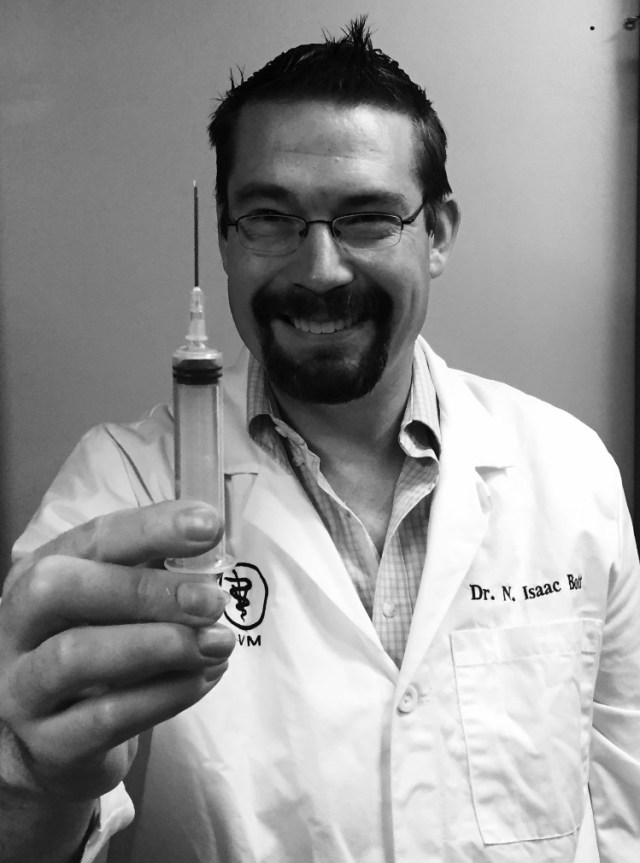
N. Isaac Bott, DVM

Playing Possum

IMG_9951.JPG

My Take Tuesday: Playing Possum

Fall has arrived in the Rocky Mountains. The beautiful red and yellow mountainsides that surround Utah Valley are a sign of the changing weather. The olive-green leaves of the quaking aspen groves are quickly changing to orange and brilliant yellow.

I love this time of year! The cool, crisp, fall air, the warm evenings and cold mornings signal the arrival of October. I enjoy the first day that is just chilly enough for a flannel shirt and the taste of a cup of hot apple cider, and the smell of wood-smoke beginning to billow from the chimneys.

There is much to accomplish before winter sets in. It is a busy time for me as a veterinarian. Sheep, goats, reindeer and elk breeding seasons require traveling all over the country as I provide assisted reproductive techniques on farms and ranches from Alaska to Arizona, and from Texas to Oregon.

Local farmers are bringing their cattle and sheep home from summer ranges and are preparing their horses for winter.

A recent farm call brought me to the beautiful grass pastures south of Salem, Utah. The owner, a friend of mine, met me at the beautiful wooden fence at the entrance to his pasture. A large Percheron draft horse was undergoing a routine hoof trim and the farrier was having some difficulty. This massive animal would not allow its left hindlimb to be trimmed.

I administered an intravenous sedative as soon as I arrived at the farm. This sedative works almost instantaneously. The huge draft horse’s head tilted downwards as his lower lip began to sag. Typically, this allows for quick non-painful procedures to be performed without protest from the horse.

The farrier attempted to lift the left rear limb after the sedative kicked in. Immediately, the horse angrily slammed down its massive hoof in a stubborn response. Because of the danger of such a large animal kicking and injuring all involved, I quickly made the decision to administer general anesthesia and to lay the animal down on the soft grass of the beautiful pasture.

Ketamine is commonly used in horses. It is of the cyclohexamine class of anesthetics. It is effective at rendering the animal motionless. The difficulty is safely getting a 2000 pound horse to lay down and get back up afterwards without injuring itself or landing on me. It is terrifying to stand next to an animal over 8 feet tall as it falls to the ground asleep. I take extreme caution in where I stand, how I place my hands on the halter, and how I am going to get to safety if something goes wrong.

As I administered the ketamine in the massive jugular vein, the large animal smoothly slumped and laid down as it entered a deep sleep. I positioned myself on the neck of the sleeping giant, as the farrier and my friend began the process of trimming the problematic hoof.

A group of curious pasture mates began to form in a circle around us as we worked. These inquisitive horses couldn’t figure out why this large Percheron, the alpha and bully of the herd, was sleeping in the middle of the day.

A sorrel gelding flared his nostrils as he sniffed the face of the napping equine. I reached out and touched his nose to assure him everything was alright.

Suddenly, without warning, this gelding stomped his right front hoof directly on the face of the sleeping horse. My fingers were just centimeters away from the hoof hammer as it came down. I gasped in bewilderment at what had just happened. Suddenly, I felt the giant underneath me move. Within a second, the large Percheron went from being sound asleep to standing up and alert. This rapid motion gave me little time to respond. I was flung like a rag doll from atop the neck of this huge animal. The soft grass broke my fall as I came crashing down.

The three of us looked at each other in disbelief about what had just occurred. Fortunately, we were all safe and unharmed and the horse was unaffected by the stomp on its face.

Sometimes the unpredictable is best met with humor. A roar of laughter erupted as we replayed the sight of me flying headfirst through the air.

Even though Utah is not home to the mischievous opossum, there is a large Percheron draft horse in the pastures south of Salem that can play the part extremely well!

And that is my take!

N. Isaac Bott, DVM
Why did you become a veterinarian?


img_4976

My Take Tuesday: Why did you become a veterinarian? 

I hear this question on a regular basis. Each veterinarian has a story about why he or she decided to pursue a career in veterinary medicine. Most veterinarians share a commonality – that they have always wanted to be a veterinarian as long as they can remember. My story is a little bit different. I have always loved animals, but didn’t decide to become a veterinarian until the age of 21. 

To tell my story, I must start at the beginning. 

I was raised on a small farm in Castle Dale, UT. My first responsibilities as a child were to feed the chickens and gather the eggs. I began this task at 6 years of age. Each year we would purchase a variety of baby chicks from Murray McMurray hatchery. They would arrive at the post office on a scheduled day. I would wait with eager anticipation for this time. To me it was just like Christmas. My dad would let each of us pick out a chick that was “ours”. I would always name mine. I first experienced the remarkable human – animal bond with my chickens. I cried when they died. As a child, chickens became my favorite animal, and remain so until today. 

Even though I spent my entire childhood around animals, I did not put much thought into becoming a veterinarian. In high school, I took an aptitude test. The test results suggested that I would not make a good veterinarian. I was not introverted. According to that particular test, I could not be successful as a veterinarian. Assuming that these tests were accurate, I pushed the veterinary idea out of my head and considered a law degree. 

After I graduated from high school, I spent the next two years in Peru. I was immersed in a culture so much different from the one I was used to. It took nearly a year for me to adjust and to speak fluent Spanish. I remember walking down the street in Casma, Peru one day and seeing a group of men in the process of castrating a bull. It was a sight that I will never forget. They were beating the testicles with a large stick in an effort to destroy the testicular tissue and render the bull sterile. The brutality was sickening. I remember feeling so sorry for the bull. 

That night I laid in bed thinking about why they would castrate a bull in such a barbaric fashion. I realized that perhaps that was the only way they knew how. Maybe they didn’t know any better. I decided at that moment that I would do all I could to teach these farmers a better way. Having a farming background, I was very familiar with animal husbandry and felt confident that I could help educate the farmers in this part of the world. 

My first patient was a pig named Walter. He was a family pet that lived in a house in Casma. Walter had an attitude and his owners needed to have him castrated. I had a friend named Duilio Davelos that owned a pharmacy in town. I visited him and purchased some lidocaine, suture, iodine and alcohol. The procedure went flawlessly. Walter recovered very quickly. News spread of the event. Soon after, I began sending my free time on Monday’s castrating pigs. Farmers actually were open to learning. The supplies were very inexpensive and my services were free. Next came chickens. Because of my time spent as a child taking care of baby chicks, I was able to teach basic poultry care and even help make incubators to boost production. I soon began helping with llama and alpaca herds.  Soon, other curious Americans participated in this. In fact, a human dermatologist raised in Provo, UT had his first surgical experience South of Trujillo, Peru castrating pigs! It was very fulfilling to be able to help people out in this fashion. I felt like I was really accomplishing something. I was giving them something that would change the way they would treat their animals. No longer would they brutally castrate their animals without local anesthetic. They also knew how to surgically prep the skin, which eliminated so many post operative infections. I was helping people by helping their pets. It made me so happy. 

As my time in Peru came to a close, I boarded a plane in Lima and headed back to the USA. As I sat in my seat, I reflected on the past two years. My mind in particular was focusing on the animal services I rendered. It was in that moment, high in the air, that I decided to become a veterinarian. I landed in Utah, and two weeks later began my first college classes. After 8 1/2 years, my goal was reached and I became a veterinarian. 

I often reflect on the decision I made. I look at how happy I am now. I love what I do. I love helping people by helping their animals. I have never had a boring day, nor have I ever regretted this career decision. I really feel like it is what I was meant to do. 

So much in life happens by chance. I was fortunate to have my agricultural upbringing. It prepared me for the future. It is impossible to look forward and connect the dots of the random chances in our lives, but looking back, I can see it clearly. 

I am glad that I had the chance to provide animal care in a far away place and how that opportunity led me down this remarkable path I am on today. I cannot imagine doing anything else. 

And that is my take!

N. Isaac Bott, DVM
 

The Attribute of Adaptability

My Take Tuesday: The Attribute of Adaptability

The Rocky Mountain elk (Cervus canadensis) became the official State animal of Utah in 1971. Called ‘wapiti’ by the Shawnee Indians, elk are members of the deer family and associate closely with the deer and moose of Utah.
 
Elk, no matter what time of year, are a remarkable sight. So large in stature, these animals have become an admired icon of the American West. Elk are amazingly adaptable and can live almost anywhere—forests, deserts, mountains, and plains. They eat a wide variety of plants. Their typical diet consists of grasses (year-round), woody plants (winter) and forbs (summer). This adaptability is unique and ensures the species survival.
 
As a child growing up near the Manti LaSal National Forest, I frequently encountered these animals in the wild. I remember camping in the crisp early fall. The tranquility of those nights is unparalleled. The silence was only occasionally broken by the high pitched shrill of a bull elk – a guttural cry unique to this species. It is a sound that will hasten the heart rate of even the most seasoned of outdoorsmen. The sound echoes through the pines. Such an experience is breathtaking.
 
As a veterinarian, I am privileged to be able to work with a number of herds of elk. I very much enjoy this. Pictured is a herd of elk near Tooele, UT.
This animal is a symbol of power and strength. It is also a symbol of ultimate freedom.
 
We can learn a lot from elk. If we were as adaptable as this species, we would thrive in any situation where we are placed. We would be unafraid, undaunted, valiant and courageous.
 
When I am confronted with changes in life, I always think of the majestic elk.
 
And that is my take.
N. Isaac Bott, DVM

The Plasticity of Parturition

My Take Tuesday: The Plasticity of Parturition

Mongolian gazelle (Procapra gutturosa), are a medium-sized antelope with a heart-shaped patch of white fur on their rump. They are among the last great herds of migratory wildlife. Over 1.5 million of these antelope migrate across the vast expanse of Mongolia’s Eastern Steppe—the largest intact grassland in the world—as they search for forage throughout the year.

Herds of as many as 100,000 gazelle are commonly seen across the steppe with larger congregations occasionally reported. During the two weeks of the calving season, up to 400,000 females will gather, and the vast majority will give birth within a four-day period. This is a unique phenomenon. This is thought to be a strategy to reduce neonatal death loss due to predation. This synchronicity also ensures that the young will grow big enough by winter to survive the harsh weather.

Some studies also hypothesize and attribute the synchronization of parturition to plant phenology, with birth occurring when there is maximum available forage.

This synchronization of parturition has been described in reindeer, caribou, alpacas, wildebeest and many other migratory species. It has also been described in other species such as the banded mongoose. Induction of parturition among animals varies greatly, but nearly all of them involve progestagens, estrogens, progtaglandins and oxytocin. These adaptations are not only beneficial to the offspring, but are mutualistic for the dam as well.

Nature has created many adaptations that we are just beginning to understand. Over thousands of years, these species have survived because of these unique adaptations. As we learn more about exactly how this phenomenon occurs, it will have a significant impact on use in species conservation and agricultural animal production.

Clearly, the future of this technology in the conservation of endangered species as well as in agricultural production will rely on our developing a better understanding of the interaction of reproductive function with such diverse aspects of animal management as behavior, nutrition, stress and genetics. Who knows, perhaps this technology application can also help humans.

And that is my take.

N. Isaac Bott, DVM

Videos

For those of you following the story of Miss Kiss, here is an update on her touching story. I am so happy that she is doing so well. We thank Utah Valley Animal Rescue, PoundWishes and Levitate Med…

Source: Videos