Category: Uncategorized
The Late Night Call

The Universal Human-Animal Bond
My Take Tuesday: The Universal Human Animal Bond
A few years ago, I had the opportunity to spend several weeks in Mexico working as a veterinary ambassador. It was an incredible experience.
The first week, we traveled to the outskirts of a city called Queretaro. We sat up a set of tents and hosted an animal wellness clinic. We spent an entire day vaccinating dogs and cats.
The next two days were spent in Guadalajara. Here we also set up vaccine clinics. Over the three day period we vaccinated the pets of over 1,800 families. We spent time with each individual and answered questions about the pets they had and educated them on preventive care and how to assure a long and happy life for their 4 legged family members. These are among the longest days I have had as a veterinarian. It was exhausting to speak to so many people. However, the exhaustion was insignificant compared to the happiness I experienced by helping in these activities.
When we look at veterinary medicine on a global basis, people everywhere are attached to their pets and want their pets to be healthy. In the villages where we held our clinics, people couldn’t imagine putting their dogs on a leash; they would consider that cruel. If they want their dogs to walk somewhere, they pick up the dog’s front legs and walk them on their hind legs. The dogs are amazingly patient with this practice.
Lines each day extended around the block. Hundreds of people stood in line for hours under the hot sun to receive the services we were providing. Dozens of children brought their beloved pets, often in a grocery bag or carried safely in their arms, to be vaccinated and dewormed. They showed the same love towards their pets as anyone I have ever seen back home. The Human-Animal Bond is the same across borders – it is the same in the hearts of people everywhere. The happiness I experienced while performing these vaccine clinics was inexplicable.
It is commensurate with service to experience reciprocity. What effort we exert is returned many fold. I find the satisfaction of such service to be rewarding beyond comparison.
Veterinary medicine is a unique profession. What motivates us is the important services that we provide. There has to be a love of service and of reaching the hearts of the people who own the pets. I concur with what Dr Seuss conveyed through the character the Lorax, “Unless someone like you cares a whole awful lot, nothing is going to get better. It’s not.”
At Mountain West Animal Hospital, we care. We value life. We are advocates for those who have no voice. We believe that all animals have the right to a life free of pain and suffering. Everything we do is centered around this principle. We strive to provide the care that pets need and deserve.
And that is my take.
N. Isaac Bott, DVM
The Negative Review

My Take Tuesday: The Negative Review
When was the last time you heard of someone phone shopping for the price of their hysterectomy? Imagine being on the receiving end of such a phone call. As strange as it may sound, this is something that veterinary clinics deal with every single day.
Our policy at Mountain West Animal Hospital is not to give estimates for surgical procedures without first seeing a pet. Prices vary greatly with most medical care, especially surgery. Every animal is unique and individual. Prices vary on the need of each animal. Depending on health and condition some patients require different anesthesia, more care, different treatments to go home and so forth. There are myriads of variables that must be considered when providing an estimate for a surgical procedure and a thorough physical examination is required to provide such an estimate accurately.
Despite the misinformed general public perception, a “spay” is not a simple surgery. The ovaries are held in place, in close proximity to the kidneys, by a ligament. Arteries that branch from the aorta supply the blood to each ovary. Two additional arteries provide the blood supply to the uterus. Each of these 4 major arteries are ligated during a “routine” spay. This is a very invasive procedure. Despite this, the total cost to spay a 100 pound dog is still only around $300. In contrast, the total cost to perform an ovariohysterectomy (“spay”) on a 100 pound woman is about $40,000 – over one-hundred times as much!
As a veterinarian, I have always been interested in parallels between my profession and the human health care profession. While veterinarians, on some levels, seem to try to model what we do after “how it’s done in human medicine”, there are some things that I hope we will always do differently.
We have been able to keep our fees for most procedures relatively low compared to the same procedures in human medicine. The reasons for this difference are numerous, but in my opinion come down to mostly two things. The first is that we, as human patients, have become so dependent on insurance to cover our medical bills that we have removed competition from the equation.
Another major difference between veterinary medicine and human health care is the degree of specialization. Yes, we do have a growing number of specialties in veterinary medicine, including surgeons, cardiologists, neurologists, dermatologists etc., etc., but for the most part, we as general practitioners, are still able to do what we feel we are capable and qualified to do. Therefore, we are able to treat most problems that arise in pets very efficiently and without having to refer our patients to a specialist for everything more severe than a laceration or an ear infection.
All too often in human medicine, many different specialty practitioners share in the care of a patient. As Dr. Bob Encinosa has observed, “One doctor takes care of Mary’s diabetes, while another takes care of her heart condition and yet another handles her dementia or her arthritis. It becomes very easy to overlook the question, “How is Mary?”
At Mountain West Animal Hospital, we provide individualized care. We strive to provide the best possible veterinary care for our patients by maintaining and utilizing state of the art facilities and equipment, and by employing and developing a well-trained competent and caring staff. We are dedicated to providing friendly, compassionate service to our clients in an atmosphere of professionalism, respect and concern. We advocate community and client responsibility in improving the welfare of animals. We seek to be a positive, contributing influence within the community we serve.
Veterinarians are some of the most caring and considerate individuals on the planet. There is widespread damage done to all veterinary professionals when they receive the message that what we do is not valuable and should not cost money, and that we are terrible people who are only in it for the money. Suggesting we are only in it for the money, or that if we cared for animals we would do this for free, is laughable to any veterinarian. We love animals more than anything. We have made caring for their health and welfare our life’s work. We have given up so much to do this.
As a veterinarian, I experience the emotional ups and downs that happen to each of us. It can be difficult to maintain a happy, smiling face, especially after I have dealt with a case of animal abuse, neglect, or after performing a euthanasia. I am human. I am fallible. When this happens, I try my best to make things right. I earnestly strive to treat each client and patient with the dignity and respect that they deserve.
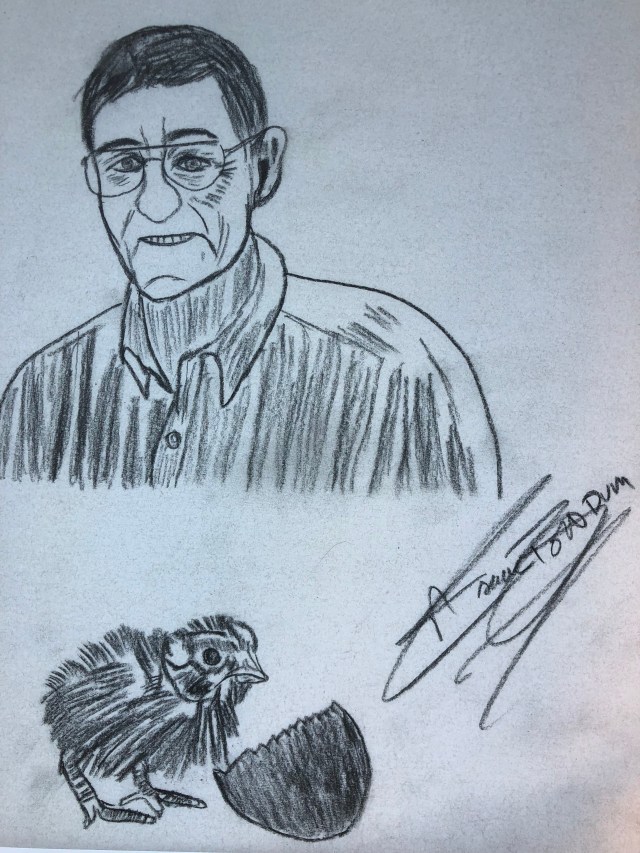
Unfortunately, occasional negative reviews are posted that reflect a lack of respect for our high standard of care and commitment to pets. Sometimes they are vicious and mean. These can be hurtful. Often fake names and accounts are made and utilized as an anonymous base from which these cowardly attacks can be made. The review pictured is made from one of those fake accounts.
I recently listened to Larry The Cable Guy talk about how when he looks out at an audience, if there is a single person that is not laughing and smiling, he takes it personal. It doesn’t matter if 10,000 people are laughing, the one outlier is what he will remember. I can certainly relate to this.
If you appreciate our individualized care and our unique team at Mountain West Animal Hospital, I encourage you to provide a positive google review.
I feel that we have the best clients and patients out there. I consider myself blessed to work with such extraordinary people and to be able to help their beloved four-legged family members.
And that is my take!
N. Isaac Bott, DVM
Up a Tree

My Take Tuesday: Up A Tree
In the early spring, when the ice and snow begin to disappear, most of the fields in Utah County are a muddy disgusting mess. A farmer would be wise to avoid calving their cattle during this time. A clean environment required for calving is impossible to find in a swampy, muddy field.
Dwane is not a typical farmer. To him, this is the perfect time of year for calving. His solution to the muddy disgusting mess in his pasture was simple: A four wheeler.
Each morning he would ride around the cow pasture to check on his pregnant stock. On this particular day, had spotted one cow calving and could see the infant’s nose and one foot exposed. Circumstances such as this require help from DocBott.
“Hey Doc, I need some help with one of my cows,” Dwane stated matter-of-factly, “She is kind of a wild one, so I don’t dare work on her by myself.”
I know better than to get myself into a situation like this. There is no way it can end well. Unfortunately, as it often goes, I gave in and headed towards Dwane’s place in Palmyra.
Dwane sat, on his Honda four wheeler at the gate. Every inch of the machine was covered in dark brown mud. As I looked into the field, I could see a few cows standing literally knee deep in mud.
“What a mess!”, I exclaimed, “Dwane, you really need to get a barn if you are going to calve out this time of year.”
“Yeah, I know,” he replied, “But you know how beef prices are this year.”
He did have a point, unpredictable and forceful influences that have negligible affect on most businesses, can dramatically alter the beef industry. From changing product demand, rising input costs and market fluctuations, to weather patterns and even consumer nutrition and lifestyle trends, farmers and ranchers must balance a long list of variables in order to be successful. The beef industry is not for the faint of heart.
“Where is she?,” I asked.
“Hop on, Doc, I will take you to her”
Out in the center of the field, along side a large cottonwood tree, the big Angus cow was comfortably sitting. As we approached her on the four wheeler, the wide eyed cow jumped up on her feet. Almost instantly, out popped the calf.
“Wow!” Dwane explained, that was easier than I thought it would be.
“It sure was,” I replied.
We should have just kept driving on the four wheeler at this point. The mother and newborn were both apparently healthy. There was no reason to stay, except that Dwane felt this was an opportune time to put a tag in the calf’s ear while we were near.
We dismounted and quietly approached the new born calf. Dwane reached down and quickly placed the tag in the left ear of the calf. The small calf let out a quiet but deliberate “moooooo”.
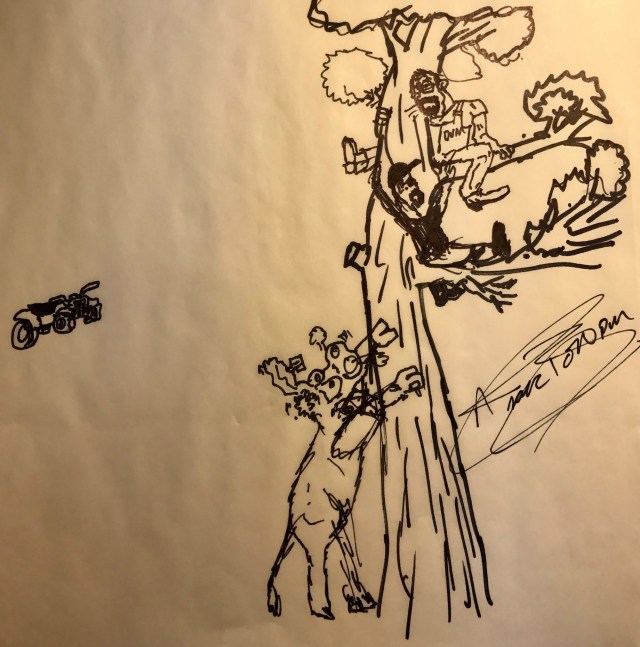
No sooner had the calf opened its mouth, the cow charged. She hit Dwane squarely in the chest. He immediately flew backwards towards the tree. He quickly jumped up and raced behind the tree, trying to use its massive trunk as a shield from the raging bovine.
I raced behind the tree as she bellowed and snorted. I looked at Dwane and he looked at me. We both knew there was only one way out – and that was up! We both climbed as fast as we could. Our mud covered rubber boots slid as we tried to climb the massive tree.
A large low hanging branch provided support as we held on and climbed on top of the life saving perch.
“Are you ok?” I asked
“Yeah,” Dwane replied between gasps, “I thought we were both dead!”
“Me too!” I agreed.
Fortunately, we have cell phones in today’s world, if not for that, Dwane and I would have had to stay in the tree for who knows how long.
“Just look for a four wheeler and a savage cow circling a tree,” I heard Dwane say as he grinned.
As we rode out of the pasture, he commented, “Hey Doc, I think I just might get that barn after all.”
“That sounds like a great idea,” I agreed, “I ain’t much of a tree climber!”
And that is my take.
N. Isaac Bott, DVM
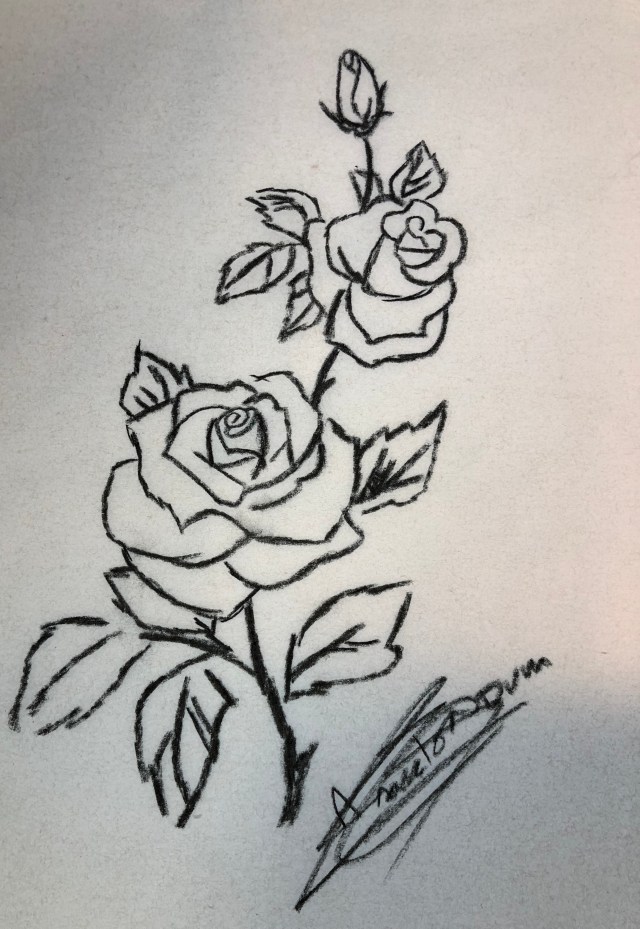
I thought you were a salesman!

Skunked

My Take Tuesday: Skunked
A couple of weeks ago, a Boy Scout troop stopped by the clinic at the end of the day for a tour. As I showed them around and answered their questions, I couldn’t help but reminisce about my time as a boy scout.
The year was 1995.
Boy scout troop 306 of the Castle Dale 1st Ward embarked on a week long 50 mile hike during the month of July. The hike began on a Monday at Ferron reservoir and ended on Saturday at Indian Creek Campground in the beautiful Manti Lasal National Forest.
As a 14 year old kid, I was just like most of the other boys in my troop: wholly naive and completely unaware of my ignorance. My sense of adventure far outweighed sound logic and I was prone to encounter trouble because of my mischievous nature. My little brother Caleb and my best friend Zac were my partners in crime and were witnesses to myriads of situations that shaped our imaginative Boy Scout days working on merit badges, monthly camp outs and high adventure events that eventually led to each of us earning ours the rank Eagle Scout. These experiences consequently helped make us into the men we are today.
On the second night of this long hike, we made camp at a place called Cove Lake. This beautiful lake is just a few miles from the scenic skyline drive and is nestled in a large grove of Douglas Fir and Ponderosa pines.
As Boy Scouts do, we set out to set up camp and explore the lake. We soon found out that we were not the only species inhabiting the camp on this particular night. We shared the campsite with one of the most widely distributed mammals in North America, Mephitis mephitis, or the common striped skunk. The fecund creatures were everywhere. As we floated around the lake on a makeshift raft, we could see dozens of them around the waters edge.
We clearly had a dilemma. Almost immediately, the skunks began ransacking our tents and food supply. These smelly striped critters were endlessly curious about the bipedal invasive species that had entered their territory.
Passive in nature, skunks will avoid contact with humans and domestic animals; however, when challenged they are amply prepared to protect themselves.
If a skunk feels threatened, it will give a warning which includes hissing, stomping of feet, and elevation of the tail. Failure to heed the warning signs will result in the unlucky aggressor being sprayed with the skunk’s anal gland secretions. Skunks are highly accurate in their aim and can spray 7 to 15 feet away!
A dozen rambunctious boys were immediately perceived as a threat by the striped beast. They seemed to coordinate the invasion of the camp, approaching from all directions.
A scout watching the skunk rodeo spoke to me, “Hey Isaac, if you hold a skunk by its tail it can’t spray you.”
The notion had some truthiness to it, after all, if it can’t plant its feet it likely wouldn’t be able to empty its scent glands.
Without any further thought, I reached out and grabbed the nearest skunk by the tail. I lifted it directly in the air and held it suspended with my arms straight out.
The little guy simply twirled slightly and lined his backside to my face and fiercely sprayed with all that he had.
It went directly in my mouth and up my nose. It covered my entire face and some even got in my eyes.
I immediately began vomiting uncontrollably. By eyes burned and my vision became blurry.
What a lesson! Take my word for it, a skunk can certainly spray when it’s feet aren’t off the ground. This equivocated logic is dangerous.
As Mark Twain once observed, “It ain’t what you don’t know that gets you into trouble. It’s what you know for sure that just ain’t so.”
The odeur fetide that I experienced is actually a thick, volatile, oily liquid that obtains its pungency from sulfur-based thiols. There in nothing that smells worse than skunk spray inside your nose!
It took weeks before I stopped smelling skunk.
Frantically, I raided the food tent in search of cans of tomato juice. I found 8 cans and a can opener. I then took a tomato shower. I scrubbed my head in it, my whole body was covered in tomatoes. You haven’t lived until you take a shower in tomato sauce.
The rest of the week proved to be much less adventurous. I was forced to sleep in my own tent and I walked behind everyone else along the trails.
Now when I see a skunk, I give it plenty of space. And I tell everyone that I can that contrary to popular myth, a skunk can spray even when being held off the ground by its tail!
And that is my take!
N. Isaac Bott, DVM
The Majestic Eagle

My Take Tuesday: The Majestic Eagle
Above the timberline, soaring over the lofty mountains of the Manti Lasal National Forest fly two bald eagles. These beautiful birds fly through the deep blue skies that surround Castle Valley.
For some unknown reason, this pair of eagles chose an unusual spot to make build their nest. Leaving behind the towering cliffs that surround Castle Dale, they instead close a small clump of Cottonwood trees located in the corner of a dry land alfalfa patch.
I recall my father purchasing this land in the late 1980’s. We tilled the blue clay soil and planted alfalfa on the areas that were fertile enough to support crop production.
The very next year, while we were feeding cows, we noticed two bald eagles perched in the clump of Cottonwood trees at the bottom of the field. I recall thinking how unusual it was to see two bald eagles in the same tree.
During the next few months, these eagles built a massive nest. We watched as they carried sticks and bark from miles away. The nest was an engineering marvel, built high in the tree below the crown supported by large solid branch extending straight east. The nest was constructed with thousands of interwoven sticks. The interior was lined with grass, corn stalks, and other material. The bowl was filled with soft materials and the downy feathers from adults.
I recall the first eaglets born on the farm. In a rare event, one year 3 offspring were successfully raised.
Year after year, decade after decade, this process repeated itself producing many successful offspring.
Each breeding season, material was added to the nest and its size increased by up to a foot in height and diameter each year. The nest became visible from great distances as its size increased.
The bald eagles were a welcome sight. Each year they would appear right before Christmas. I remember seeing them consistently every year while growing up. They stood perched, looking down on my every move. A feeling of safety and security ensued as these majestic guardians stood watch.
Although we all recognize the Bald Eagle as the national symbol of the United States, and as a proud icon of patriotism. I feel they could serve just as well or better as symbols of faithful monogamy. When one of these birds of prey finds his or her mate, the pair stays together for life.
Just this past week, the eagles were spotted overlooking the open fields just south of Castle Dale.
There is safety in constancy, and security in consistency. I am glad that high in the blue skies above Castle Dale, there is a welcoming place, where the eagles fly.
And that is my take.
N. Isaac Bott, DVM
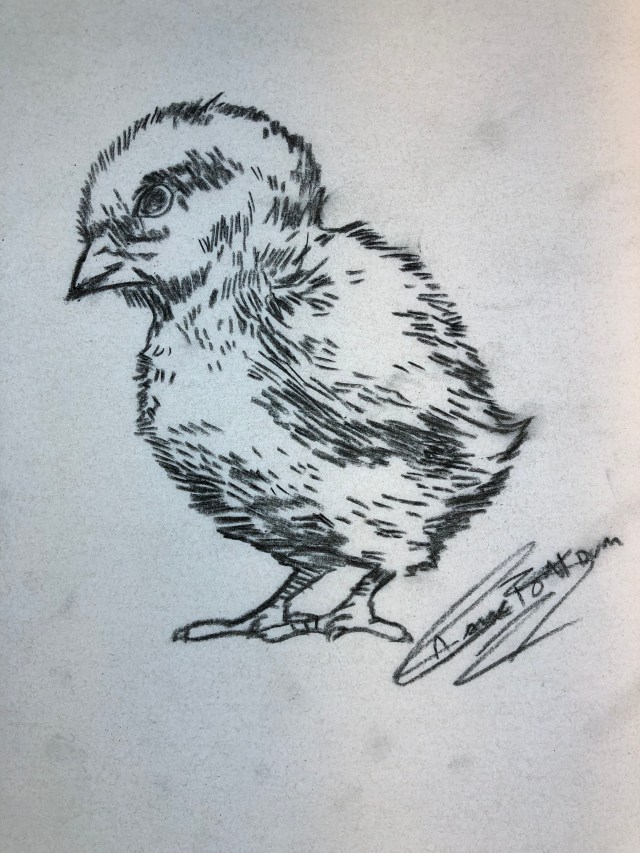
Doc, what ever she has, I’ve got the same thing too!

My Take Tuesday: “Doc, whatever she has, I’ve got the same thing too!”
Animals and people dictate what happens every day for me. Simple routine appointments can turn out to be complex once the unpredictable yet potent potion of human personality is added to the mix.
A few months back an elderly woman came in to the clinic. Her cat had been suffering for weeks with non-stop itching. As I examined the cat I noticed that this itch was insatiable. The poor cat had scratched and irritated nearly every inch of its body in an effort to satisfy the intense itch. The scratching was so intense, that nearly her entire body was covered with bleeding sores.
A diagnosis of mites was made after taking a skin scrape and looking at it under a microscope. This particular mite is elusive and difficult to find even for the most experienced veterinary dermatologists. However, it is highly contagious.
As I began speaking with the owner about the severity of the diagnosis and the need for immediate treatment, I could tell that her mind was wandering. She was clearly not focusing on what I was saying. I politely asked if I had said something that did not make sense or if she had any questions. Often, the open ended questions will allow a client to discuss their concerns, however, I was not prepared for what happened next.
“Doc, do you think I have what she has?”, her voice was inquisitive. “Excuse me?”, I replied, “What do you mean?” Before I could say another word, this elderly woman dropped her pants. Literally right to the floor. Her legs were covered in large red lesions. They actually looked like checker boards. I learned that day, albeit involuntarily, what “granny panties” look like.
I am easily embarrassed, and when this happens my face turns a deep red. I stammered, “I…. I’m… a… I am sorry ma’am, you will have to go to your doctor for that”. The beet-red shade on my face persisted even after I exited the room.
As crazy as this may seem, I have had worse things happen while going about my daily appointments. However, those are saved for another My Take Tuesday.
My job is never boring. The two legged creatures that come in keep it from ever being so.
And that is my take.
N. Isaac Bott, DVM
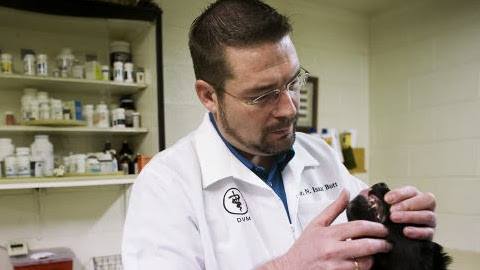
Forget Me Not

My Take Tuesday: Forget Me Not
There is a flower that grows in the beautiful mountains of Alaska. It is a tiny plant that is easily overlooked, it’s small and unassuming stature is easily lost as the surrounding vegetation is observed. However, on closer look, this flower is a remarkable example of nature’s masterpiece. The dark green stems and leaves are much like those of other plants, but its flowers are what make this flower unforgettable. The sky blue pedals perfectly match the beauty of a clear, cloudless day. The tiny flower displays a most unique and unforgettable beauty. It is a true marvel of creation and is aptly named, “Forget Me Not.”
A few weeks ago, I visited a massive cemetery. I walked quietly along the long never-ending rows of marble headstones. Many were from the 18th and 19th century. Moss was visible along the base of many of the markers. Names and dates, weathered and worn, were fading on many of them.
As I looked around, the headstones numbered in the thousands. Who were these people? What were they like? What is their story? Only a handful are remembered, and unfortunately, most are largely forgotten.
I pondered as I read the inscriptions. I questioned, “Is this what is to come of me? When I go the way of all living things, will I be remembered? Will I leave a legacy?”
My mind turned to the small cemetery in the town where I was raised. Castle Dale, Utah is a small place, one easily overlooked by most. The cemetery is located on the north end of Center Street. I spent a summer during high school working as a caretaker there. Each week, I would mow the lawn. Care was taken as the grass was trimmed around each and every headstone.
Many of my ancestors are buried in the cemetery in Castle Dale. My great great grandmother, my great grandparents, grandparents, a beloved uncle and an infant cousin all rest in this special place.
My great grandfather passed away long before I was born. I have a picture of him smiling and sitting on the grass in a pair of bib overalls. He is aged and tired, but his character is still evident in the old photograph. It reminds me of a wise observation that Thomas Edison made concisely by stating, “I have friends in overalls whose friendship I would not swap for the favor of all of the kings of the world.”
My grandfather died when I was only three years old. My memories of him are largely limited to what others have told me. He served as county clerk for over two decades. Like his father, he was a dry land farmer. He worked tirelessly to provide for his six children. The ground he and his father tilled and planted year after year, still remains in the family today.
My uncle passed away in 2016. I owe my very life to my uncle Jerry. Once, as a curious 5 year old, I was standing in the doorway to his kitchen. Jerry had a bag of those pink chalky wintergreen disc candies. I placed one in my mouth, and somehow got it lodged inside my trachea. He must have sensed my panic, but he calmly walked over and gave a firm push on my stomach and the piece of candy shot across the room. If you are lucky enough to know my uncle Jerry Bott, then you have the privilege of knowing the best person I have ever met. There is no better example of loyalty, charity and love than he was.
All three of their graves are located next to each other in the south side of the middle section. Each lived wonderful lives. Each treated their fellow men in kind with an honest word, a helping hand and a smile. With the years and the long hard miles, each always did their best. When the storms of life broke lose, each valiantly fought with courage.
As long as my heart beats, each will never be forgotten.
They inspire me still. Their legacy invites me to be a better father, a better friend, and a better man.
Like the small unassuming Forget Me Not flower, each of us, no matter how small or inconspicuous we are, have an important part to contribute to the tapestry of our posterity and the majesty of creation and life.
And that is my take.
N. Isaac Bott, DVM