My Take Tuesday: “Doc, whatever she’s got, I’ve got the same thing too!”
Animals and people dictate what happens every day for me. Simple routine appointments can turn out to be complex once the unpredictable yet potent potion of human personality is added to the mix.
A few months back an elderly woman came in to the clinic. Her cat had been suffering for weeks with non-stop itching. As I examined the cat I noticed that this itch was insatiable. The poor cat had scratched and irritated nearly every inch of its body in an effort to satisfy the intense itch. The scratching was so intense, that nearly her entire body was covered with bleeding sores.
A diagnosis of mites was made after taking a skin scrape and looking at it under a microscope. This particular mite is elusive and difficult to find even for the most experienced veterinary dermatologists. However, it is highly contagious.
As I began speaking with the owner about the severity of the diagnosis and the need for immediate treatment, I could tell that her mind was wandering. She was clearly not focusing on what I was saying. I politely asked if I had said something that did not make sense or if she had any questions. Often, the open ended questions will allow a client to discuss their concerns, however, I was not prepared for what happened next.
“Doc, do you think I have what she has?”, her voice was inquisitive.
“Excuse me?”, I replied, “What do you mean?”
Before I could say another word, this elderly woman dropped her pants. Literally right to the floor. Her legs were covered in large red lesions. They actually looked like checker boards. I learned that day, albeit involuntarily, what “granny panties” look like.
I am easily embarrassed, and when this happens my face turns a deep red. I stammered, “I…. I’m… a… I am sorry ma’am, you will have to go to your doctor for that.”
I quickly prepared the medication to send home and finished the appointment with the caveat, “For human use, this has not been approved.”
The beet-red shade on my face persisted even after I exited the exam room.
As crazy as this may seem, I have had worse things happen while going about my daily appointments. However, those are saved for another My Take Tuesday.
My job is never boring. The two legged creatures that come in keep it from ever being so.
Just west of Castle Dale, Utah, the sky above Horn Mountain turns a beautiful cinnamon on clear summer nights as the sun sets over the place I call home. These summer nights smell of freshly cut grass and alfalfa, of sagebrush and lilacs.
If you are heading west along Bott Lane, just past the tall poplar trees, lies a piece of ground that was homesteaded by my great-great grandfather. This piece of land has passed from generation to generation, from fathers to sons, and has always remained in my family.
On the east side of this piece of land, a silhouette of a Ford Tractor and a Hesston Hydroswing Swather were visible on many beautiful summer evenings during my childhood. On the tractor, sat my uncle Jerry Bott.
Jerry was a giant of a man. He stood over 6’4”. His gentle demeanor and kind heart were his most precious of character traits. His soft voice and carefully chosen words were never cross or unkind. At least two times every day, I would be able to greet my uncle as I would enter his house before milking our cows. He became my constancy, my anchor, as I grew from a small child into the man I am today.
On this particular night almost 30 years ago, in 1990, my uncle Jerry was cutting the first crop of hay. The tall grass makes this cutting the most difficult on the equipment. Constant attention must be given to the rotating wheel and hay knives that were prone to clogging.
This time of year, hen Ringneck pheasants are on their nests. They sit so still that even the loud rumbling of a tractor and the ground tremors of the hay cutter leave her undeterred. Occasionally, these hens are injured or killed as they sit on their eggs. The nest, whether it be full of chirping hatchings or incubating eggs, is left to the merciless predators from the air and the nearby fortress of trees and Russian Olives that run along Cottonwood Creek.
As the sun faded behind the towering cliffs of Horn Mountain, I stood on my parents lawn, looking eagerly at the approaching two-toned tan GMC Sierra. My hero was coming home for the night.
As Jerry exited his truck, he held under his arm a brown paper grocery bag. His long stride headed towards me instead of his house across the street.
As he approached, he called my name.
“Isaac,” his low and gentle voice called, “I have something for you.”
He handed me the brown paper bag. Inside, a green towel was wrapped gently around 8 medium sized olive colored eggs.
“These are pheasant eggs,” he continued, “and they need to be cared for.”
“Isaac, I know that you will do a good job at taking care of them.”
I looked in the sack as Jerry walked back across the street and into his house.
“How do you hatch pheasant eggs?”, I wondered as I entered my parent’s house.
My incubator was nothing special, just a Styrofoam box with a small heater inside. Knowing that peasant eggs incubate for 23 days, I set the temperature and humidity and carefully laid the eggs inside.
I faithfully turned the eggs three times a day for three weeks.
Somehow, the incubation was successful and the eggs all hatched out. The tan chicks had dark brown stripes that ran parallel along their backs.
I was overjoyed when I told my uncle Jerry about my accomplishment.
“Uncle Jerry,” I exclaimed, “I did it! The eggs hatched!”
“That is great!”, he responded, “Isaac, I knew you could do it.”
His response and validation filled my system with light and my soul with joy.
The world with all of its power and wisdom, with all the gilded glory and show, its libraries and evidence, shrink into complete insignificance when compared to the simple lesson of the fragility and value of life that my uncle Jerry taught me that warm summer evening.
Over the years, uncle Jerry repeated this phrase to me. As I graduated high school, college and eventually veterinary school, his reassurance illuminated my understanding of my potential and his unwavering love and support.
There are days that change the times and there is a time to say goodbye. My sweet uncle Jerry passed away in late 2016. His loss left a tear in the eye and a hole in the heart of all my family members.
There is a place beyond the clouds, in the cinnamon sky to the west of Castle Dale, where a precious angel flies.
Somethings never change. Yet, there are things that change us all. This experience changed me.
My uncle Jerry’s lesson, from long ago, was not lost on me.
Each and every day, I remember the immense value of life, as I attend to my four legged patients.
As lives are saved and others are lost, I remember how important it is for someone to take initiative and to tend to the responsibility to care for the helpless and to speak for those without a voice.
This is a lesson my dear uncle Jerry so effectively showed me how to apply and live, and it is a responsibility I take most sacredly.
I received a call a few weeks back regarding a sick llama. It was from a new client that wanted to know if I knew anything about llamas and alpacas. Calls like this are somewhat frequent. Asking a vet if they know anything about llamas is like asking a pediatrician if they know anything about 8 year olds. I responded, that I was indeed familiar with all camelids and had worked extensively with them as a veterinarian.
As I arrived at the farm, it was obvious that this wasn’t a typical llama ranch. It seemed as though I had traveled back in time to the 60’s. I was meandering into an apparent neighborhood of Hippie-ville. The van parked outside the gate looked just like the Mystery Machine from Scooby Doo. The bright colors were also painted on each of the barns and small buildings of the property and even covered the bases of the tall Chinese Elm trees.
One would not immediately equate going barefoot with farm life, I suppose, especially if the farm in question is shared with livestock. There are serious concerns regarding hook worm, and other parasites that could easily be transferred through the lack of shoes, and to be certain, stepping on manure barefoot has little appeal to the average person. However, a couple of barefooted and worry-free people were standing at the end of the driveway to greet me on this particular day.
One of the owners held a small white paper cup in her hands. As I greeted her, she held the cup up ad asked me to take a sip.
“What is it?”, I asked, not fully anticipating the response I received.
“It is Holy Water”, she responded. “We always make the healer drink before the llama.”
Perhaps the shock of the colorful ambience and barefoot attendants clouded my judgement, what ever the reason, I grabbed the cup and took a small drink. Immediately, I realized my mistake, but could do nothing but swallow the mysterious potion. It was the most disgusting thing I had ever ingested. I smiled, and politely asked where the sick llama was located.
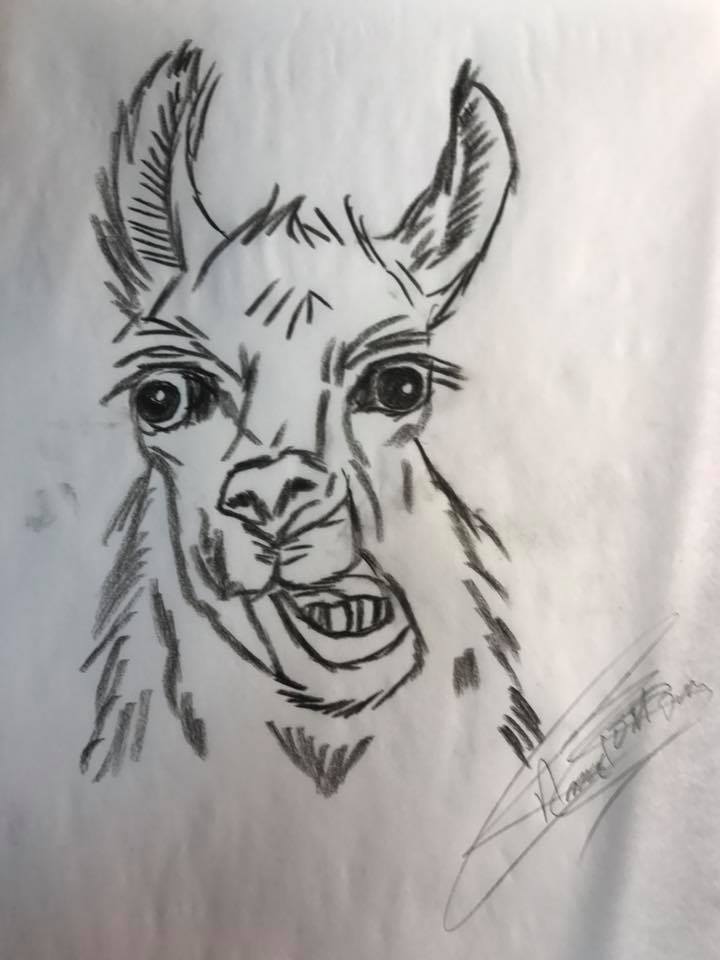
The large white llama was setting in a “kush” position, a term llama farmers use for sternal recumbency. As I approached, he raised his mouth in the air and pinned his ears back against his head.
I moved cautiously, as these signs are consistent with a llama that is going to spit at you. This nasty dark green elixir is actually not spit at all, but is the regurgitated contents from the first stomach compartment. The slew is a mixture of partially digested feed, stomach juice and miscellaneous microbes.
Llamas are well aware of a veterinarian’s never-ending quest to stick needles in them; and if provoked, they will spit copiously at you with unpleasant accuracy of aim.
There is a classic sound a llama will make before spitting. The unmistakable gurgling sound is followed by a distinct “pfffffpth”, as the stomach contents spew from the mouth.
The cause of the llama’s discomfort was a large Russian Olive thorn sticking out from the back of the left elbow. I gently reached down and removed the dagger like thorn.
It appeared as though I had escaped unscathed. The llama, with its ears still pinned back, watched me closely, but did not spit.
As I turned my head slightly, I began to speak with the owners. I explained the after care that would be required for a full recovery and encouraged them to remove the large Russian Olive plants that lined the south side of their pasture. I asked if they had any questions and turned back towards the llama.
My mouth was between words then the attack happened. The trajectory and accuracy were unparalleled. The llama spit with sharp-shooter accuracy, and the stomach contents went directly into my mouth.
I immediately began to gag. I then began to dry heave uncontrollably. The owners stood in awe as I struggled to rid my mouth of the fowl taste of fermented llama feed.
There is no amount of listerine that can remove the taste of llama spit. It will stay in your mouth for days.
“Are you alright?,” the bearded man asked.
“Yeah”, I muttered, as I looked up.
“You got to learn to keep your mouth closed, Doc”, he continued, “Especially if you are going to work on llamas.”
I didn’t know how to respond. After working on literally thousands of llamas and alpacas, this was the first time spit had actually entered my mouth.
I accepted my defeat and curiously inquired, “Can I have another drink of Holy Water?”
I love springtime in Utah County! The grass is leaving behind its dormant brown state and turning dark green, the flowers are blooming as if to welcome the longer days and the beautiful season filled with the sound of birds chirping and new life coming into the world. I love baby animals! From lambs to foals, from reindeer calves to baby chicks, Spring is filled with hope for the future.
I recall days long ago in Castle Dale, UT. While growing up, we would receive day old chicks during the third week of April. I would await this day with all of the excitement a small child could muster.
In the basement of my parents house, my dad made a make shift brooder. This was made of a large cardboard box lined with newspaper and a heat lamp placed at just the right height to provide the needed warmth for the freshly hatched chicks. They would crowd around the light bulb and nestle tightly together as they slept. There was a constant chorus of peeping.
In a sense, I was a student as I sat and watched the starlings each morning. I learned through deliberate, diligent observation. I faithfully fed and watered the hatchlings each morning and night. I carefully placed fresh newspaper in the box with each feeding. I closely observed how they would eat selectively, picking out shiny pieces of corn before consuming the finely ground mash. As they drank, they would take just a few drops in their mouth and then lift their head upwards, pointing their beaks, and would swallow each drop of water. I learned how to tell if a chick was ill or otherwise isolated, and I would tend to these with as much care as a child could muster. I remember crying as some of the chicks didn’t make it. These experiences were my first real exposure to the frailty of life and the sting of death.
As the chicks grew and matured, I was allowed to go to the chicken coop to collect eggs. One by one, I set them in my basket, the brightest white with the deepest red, the palest green alongside the softest brown.
When I was a child, I frequently dreamed that I could fly. It felt so natural to come down the stairs as if on wings, swooping out the door, joining the wild birds and eagles that soar above Castle Valley. In one dream, I coasted over our chicken coop, and peered through windows of protective wire. I saw the hens, the roosters, the pheasants and the chukars all waking and stretching their wings, as if they wanted to fly alongside me.I woke up grounded, wishing the freedom of flight could be as easy for me.
I find that in today’s chaotic world, the simplest things are forgotten and over looked. The beauty of a sunrise, the fresh dew on a summer’s morning, the sound of a mountain creek, and the clean smell in the air after it rains: these simple things are there constantly, but we have to take the time out of our busy lives for deliberate and diligent observation. No matter our circumstances, no matter our challenges or trials, there is something each day to embrace and cherish.
Just last month our lives were normal. Now, we are standing in uncertainty as the pandemic sweeps across the nation. My advice to you, take a moment to breathe and enjoy the beauty that surrounds us. This morning while driving to the clinic, a Joe Diffie song came on the radio. Sadly, he passed away over the weekend from complications of the coronavirus. The lyrics to this powerful ballad were especially poignant as it played,
“He said it’s only life’s illusions
That bring us to this bar
To pick up these old crutches
And compare each others scars
‘Cause the things we’re calling heartache
They’re hardly worth our time
We complain about a dollar
When there’s those without a dime
So here’s to all the soldiers
Who have ever died in vain
The insane locked up in themselves
The homeless down on Main
To those who stand on empty shores
And spit against the wind
And those who wait forever
For ships that don’t come in”
(Joe Diffie – Ships That Don’t Come In)
Often, our mind conflates the world and our own interpretation of it without much thought. We simply assume that the way we see is the way it is. And once that way is verbalized, put into specific words with specific meanings, it becomes all the more difficult to parse. Life is like an old time rail journey–delays, sidetracks, smoke, dust, cinders, and jolts, interspersed only occasionally by beautiful vistas and thrilling bursts of speed. The challenge, is to recognize and appreciate all of the little moments of bliss that come along and to enjoy this unpredictable journey of life.
When I am faced with a problem or challenge, I try to approach it like a young observant child. After all, the world never stops teaching us if we have the humility of a beginner’s mind and the generosity to share it with others. This is all we need to do.
As a veterinarian, I all to often find myself in precarious situations.
Upon graduating from veterinary school in 2009, I moved back home here to Utah. My first job out of school was right here in Utah County.
It was not unusual for me to be called to attend a dozen or more lame and injured cows on a particular day. You might arrive to find them in a paddock with no sorting pen and therefore no means of restraining them for treatment. What are you going to do? Unfortunately, farmers often have the attitude that you’re the vet, they’ve called you out to do the job, so they expect you just to get to it. Often these cattle facilities left much to be desired. A few broken palates, some bent powder river panels and a welded together squeeze chute constitute pretty decent working conditions.
Usually some unsatisfactory compromise could be sorted out which would reinforce the fact that you were not half as good as their old vets.
Max was no exception. He stool 6’1″ and was as skinny as a bean pole. He always had a runny, drizzly nose, and he kept a red handkerchief in the front pocket of his bib overalls. Max didn’t want a new young vet working on his cows. He was used to the old school way, and had no reason to change.
I was greeted on one of these farm visits by this familiar refrain: “We used to use old Doc SoandSo. Have you heard of him? Best dairy vet in the county. Of course, you’re new and not used to dealing with dairy cows down here are you?”
Perhaps I am unduly sensitive, but being told you’re second best before you’ve even begun is either irritating or depressing—depending on how your day has been. This day tipped more toward the irritating side.
Suzy was the name of his milk cow. She was a tall Holstein crossbreed cow. On this particular day, Miss Suzy stood in the knee deep pasture staring at us as we entered the field. She was swollen up like an engorged wood tick. The left side her stomach protruding so far that she was as wide as she was long. The diagnosis, even from afar was obvious.
She was bloated.
Bloat is a digestive disorder characterized by an accumulation of gas in the first two compartments of a ruminant’s stomach (the rumen and reticulum). Production of gas (primarily carbon dioxide and methane) is a normal result of fermentation processes. The gas is usually discharged by belching (erutication) but, if the animal is unable to remove the excess gas, pressure builds up in the rumen-reticulum exerting pressure on the diaphragm which prevents the animal from inhaling, and bloat occurs. The most common type of bloat is frothy bloat where gas builds up in a foam or froth above the rumen contents and the normal belching is inhibited.
Imagine a 40 gallon tub of partially digested green stomach contents. The pressure of this stomach is such that when it is alleviated, it is similar to popping a balloon, this disgusting smelly concoction will spew in a fashion similar to the Old Faithful Geyser.
Before we could even isolate her in the corner to begin treatment, Max decided he needed to blow his nose. As he pulled out his bright red handkerchief, he flipped it with his wrist and positioned it to evacuate his proboscis. Suzy caught sight of this red temptation and came charging full speed – like a freight train – straight for us. She was bellowing and blowing snot in a fit of rage.
In a situation like this, it doesn’t matter how quick you are. The only relevant assessment of speed is how fast you are in relation to the other person in the pasture. I figured I could beat Max to the gate, but would feel guilty in so doing.
I braced myself for the impact. Max yelled, “Hey Now!”
Suzy collapsed just steps before she reached us. The massive pressure caused by the bloat had cut off her air supply. She lay in a heap in front of us.
The treatment for bloat in a case like this is to relieve the pressure as fast as possible. An incision in made through the left side of the abdomen and the rumen is decompressed. In a situation like this, you only have a few seconds to act. My surgical instruments were in my tool box over by the gate. I knew there wasn’t time to retrieve them.
I reached in my pocket and pulled out my Old Timer pocket knife. I made a quick incision with the sharp point.
Immediately, air began spewing out. It sounded like removing a valve stem from a car tire. It whistled as the massive stomach returned to normal size. Shortly thereafter, Miss Suzy was back on her feet and back to her normal self.
As I prepared to leave, Max commented, “Hey Doc, I guess you are alright after all.”
Max then pulled out the red handkerchief and blew his nose as he inquired, “How much do I owe you?”
On 22 August 1877 Brigham Young issued a formal call for settlers to locate in Castle Valley. This was the last such directive from the “Great Colonizer” before his death just 7 days later. If you have ever visited Emery County, you come away with the realization that the best was saved for last.
Castle Valley is a state of extremes, from the mystical beauty of the towering Rocky Mountains to the west to the highest order of desolation in the San Rafael Desert on the east. Even there, among the sage brush and cedars, a pristine beauty beckons the attentive eye.
My great- great grandfather – Boye Petersen heeded Brigham Young’s call and was one of the original settlers of Castle Dale. He homesteaded the West Farm – a 48 acre piece of land that our family still owns today. The straight road it is on connects Castle Dale with Orangeville and is aptly named Bott Lane.
Growing up in Castle Dale provided three character traits that have proven to be useful. I developed a strong work ethic, a vivid imagination and a unique self awareness. This is home. There is something about Emery County that heals my soul. It is my constancy and my serene sanctuary where I can reflect and recharge. Even though I now reside two hours north in Utah County, I still feel connected and drawn to the well worn paths of my youth and the Blue Clay Hills just south of Castle Dale. I have Trail Mountain lightning running though my veins and the Castle Valley thunder pounding in my chest.
Winters in Castle Valley can be brutal. The snow and ice seem to linger. Farm chores like milking and feeding cows are much more difficult the longer the winter draws on. Piles of cow manure freeze as solid as stone and the ground around water troughs turns into a sheet of ice. One cannot help but feel a longing for warmer weather and new life.
In late winter, each morning and afternoon, I would leave my parents house and cross the street on my way to the corral. I would walk along a shaded well-worn path along the east and south side of my uncle Jerry’s house. Between the edge of the house and the sidewalk, green stems would suddenly poke through the frozen ground. The first sight of these unassuming leaves beckons to the attentive eye that the worst of winter is passed and that spring is soon to follow.
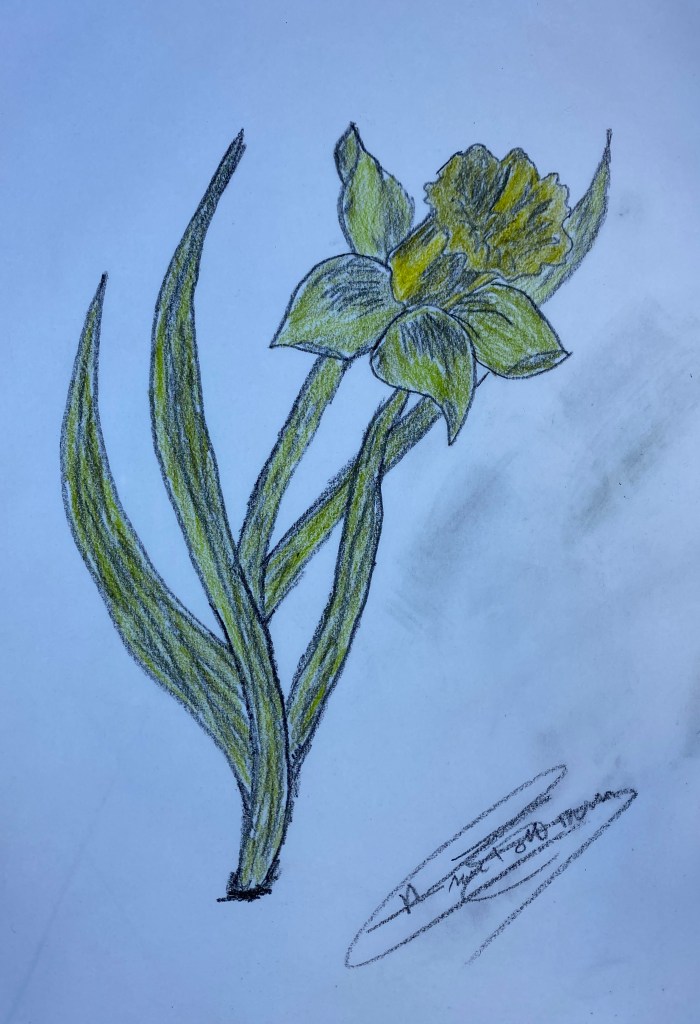
The leaves and stems grow quickly, symbolizing rebirth and new beginnings. They bloom with their cheery yellow hues. Each one is perfect, a golden trumpet amid a fanfare of halo petal.
Daffodils are majestic, but so delicate, and they wave like tomorrow is guaranteed. After a few short weeks, they are gone, not returning for the remainder of the year.
The Latin name for daffodil is Narcissus. It is believed to be named after the son of the river god from Greek mythology.
Its blooming happiness may be fleeting but at the very least, it’s still enjoyed by those observant enough to see its beauty. They stand rooted, soaking in the sunshine and taking in yesterday’s rain through their fine roots.
Daffodils remind me of my sweet uncle Jerry. He passed away in 2016. He was a gentle giant and, along with his twin brother Jeffry, are the kindest people I have even known.
As the snow melts and the days get longer, the geese will return as a symbol of change. And once again natures palate will color Castle Valley.
When the canyon rivers and mountain streams flow, spring will follow at last, in Castle Dale, UT, where the daffodils grow.
I tend to be very careful and cautious in my decision making. Most days are uneventful and pass smoothly. However, every once in a while, I will have one of those epic days where I make 4 bad decisions before 9:00 AM.
They say hindsight is 20/20. Looking back, it was clearly a mistake.
I hurriedly prepared my luggage, assuring that everything would fit in a carry on. I have a perfect record, in all of my travels I have never had my luggage lost. Taking a single carry-on bag is the only way to assure your luggage gets to your destination on international flights.
The destination this trip, was the Philippines, and it was my first trip to Asia. I had been called to travel there to assist in establishing both Water Buffalo and deer reproduction programs in this far away country.
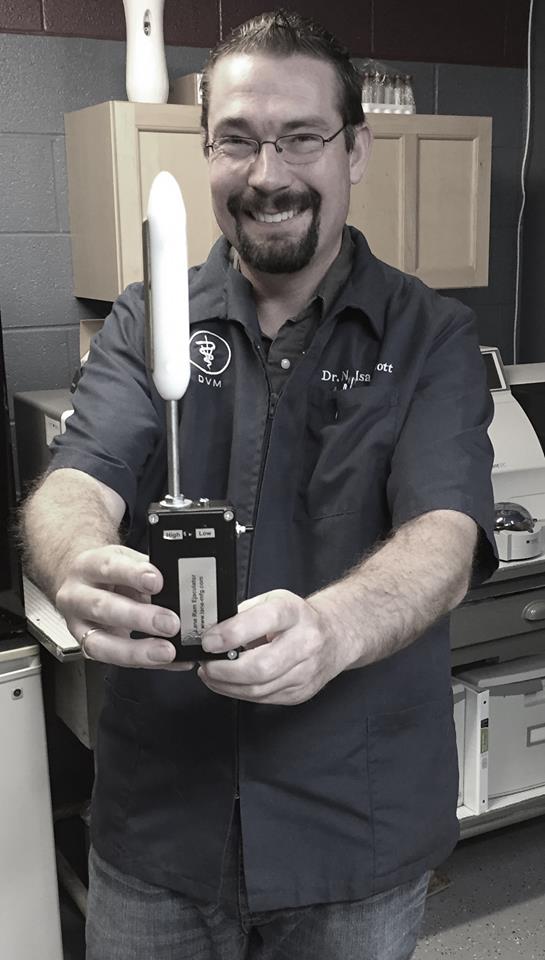
I placed my required instruments, long forceps and miscellaneous items used for freezing semen delicately in my bag. The last piece of equipment was something called an electro-ejaculator.
In the practice of veterinary medicine, it is common to collect semen from domestic ruminants using electro-ejaculation.
This instrument is an electric probe that is inserted into the rectum of an animal, adjacent to the prostate gland. The probe delivers an AC voltage, usually 12–24 volts. The probe is activated for 1–2 seconds, referred to as a stimulus cycle. Ejaculation usually occurs after 2–3 stimulus cycles. The instrument fits in your hand and runs on a traditional 9 volt battery, the exact battery most smoke alarms use. It is a valuable tool when collecting semen from agricultural and wild animals.
It fit, without a problem, in my suitcase.
Salt Lake City International Airport was busy on this particular day. The lines extended over the sky bridge and nearly to the parking garage.
I passed through the metal detector and my bag went through the usual belt driven scanner. As I waited for my bag to come out, the operator of the scanner lowered his head and spoke into his mouthpiece. What he said was inaudible, but the response it triggered was anything but quiet.
I was circled by at least 10 TSA agents and hurried off to the far right end of the security entrance. If there ever was a suspicious item, this was it.
A tall gruff man asked, “Sir, do you have any prohibited items in your bag?”
Now clearly, they know the answer to this question before they ask it. On a prior trip, I had left a small pocket knife in my bag. They asked the same thing, and I had completely forgot it was in my bag. My answer then was, “I don’t’ think so?”
Fortunately, they allowed me to mail my pocket knife home and the delay was minimal.
Clearly today it was not going to be as easy.
“I have a medical device called an electro-ejaculator in my bag”, I tried to explain. One of the TSA workers removed the device. Clearly red flags were raised, and rightly so. Here is an electronic device with a push button, a red light and metal tongs protruding from the probe.
The gruff man demanded, “What is this and why do you have it?”
“It is used to collect semen from animals,” I explained, “you insert this end in the rectum and push this button. It then applies current over the prostate, and ejaculation occurs.”
The gruff man’s face went from viable anger to disgust in less than two seconds.
“What? Ewwwww!!! Are you serious?”, he continued, “Why would you ever do that to an animal?”
“I am a veterinarian”, I explained, “And my expertise is in animal reproduction.”
“Wow kid, I thought my job was tough,” he replied, laughing this time.
Fortunately for me, the device was labeled as such and my story was collaborated. I was allowed to pass.
En route to Manila, we stopped in Narita, Japan. Even though it was just a connecting flight, I had to pass through a security line once again before continuing on to the Philippines. Once again, a huge mess unfolded as I tried to explain in English why I would have such a dangerous looking device in my bag.
There are a couple dozen airport security officers around the world who now know, albeit unwillingly, what an electro-ejaculator is and how it is used.
After an eventful and productive stay in the Philippines, I entered the airport in Manilla, excited to be going home. As I stepped up to the counter, the ticket agent asked, “Sir, do you have any bags you would like to check?”
“Yes, I sure do”, I quickly replied.
I made my way to the gate and sat down to await my flight. I was relieved that I didn’t have to once again explain what was in my luggage. It appeared my trip home would be uneventful.
All of the sudden, over the loud speaker I hear the following announcement, “Passenger Nathan Isaac Bott, please report to the security desk immediately!”…………
In the early spring, when the ice and snow begin to disappear, most of the fields in Utah County are a muddy disgusting mess. A farmer would be wise to avoid calving their cattle during this time. A clean environment required for calving is impossible to find in a swampy, muddy field.
Dwane is not a typical farmer. To him, this is the perfect time of year for calving. His solution to the muddy disgusting mess in his pasture was simple: A four wheeler.
Each morning he would ride around the cow pasture to check on his pregnant stock. On this particular day, had spotted one cow calving and could see the infant’s nose and one foot exposed. Circumstances such as this require help from DocBott.
“Hey Doc, I need some help with one of my cows,” Dwane stated matter-of-factly, “She is kind of a wild one, so I don’t dare work on her by myself.”
I know better than to get myself into a situation like this. There is no way it can end well. Unfortunately, as it often goes, I gave in and headed towards Dwane’s place in Palmyra.
Dwane sat, on his Honda four wheeler at the gate. Every inch of the machine was covered in dark brown mud. As I looked into the field, I could see a few cows standing literally knee deep in mud.
“What a mess!”, I exclaimed, “Dwane, you really need to get a barn if you are going to calve out this time of year.”
“Yeah, I know,” he replied, “But you know how beef prices are this year.”
He did have a point, unpredictable and forceful influences that have negligible affect on most businesses, can dramatically alter the beef industry. From changing product demand, rising input costs and market fluctuations, to weather patterns and even consumer nutrition and lifestyle trends, farmers and ranchers must balance a long list of variables in order to be successful. The beef industry is not for the faint of heart.
“Where is she?,” I asked.
“Hop on, Doc, I will take you to her”
Out in the center of the field, along side a large cottonwood tree, the big Angus cow was comfortably sitting. As we approached her on the four wheeler, the wide eyed cow jumped up on her feet. Almost instantly, out popped the calf.
“Wow!” Dwane explained, that was easier than I thought it would be.
“It sure was,” I replied.
We should have just kept driving on the four wheeler at this point. The mother and newborn were both apparently healthy. There was no reason to stay, except that Dwane felt this was an opportune time to put a tag in the calf’s ear while we were near.
We dismounted and quietly approached the new born calf. Dwane reached down and quickly placed the tag in the left ear of the calf. The small calf let out a quiet but deliberate “moooooo”.
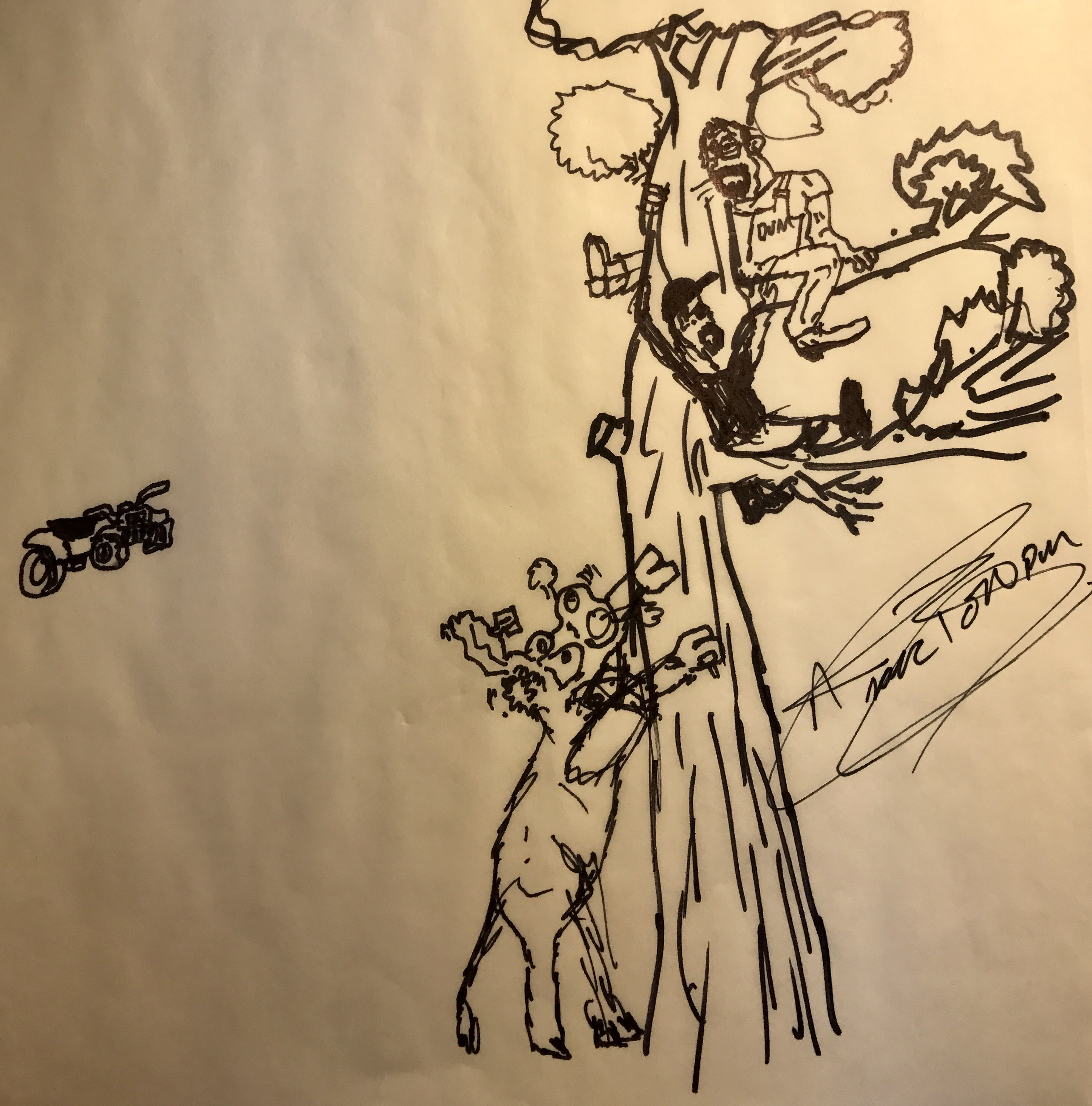
No sooner had the calf opened its mouth, the cow charged. She hit Dwane squarely in the chest. He immediately flew backwards towards the tree. He quickly jumped up and raced behind the tree, trying to use its massive trunk as a shield from the raging bovine.
I raced behind the tree as she bellowed and snorted. I looked at Dwane and he looked at me. We both knew there was only one way out – and that was up! We both climbed as fast as we could. Our mud covered rubber boots slid as we tried to climb the massive tree.
A large low hanging branch provided support as we held on and climbed on top of the life saving perch.
“Are you ok?” I asked
“Yeah,” Dwane replied between gasps, “I thought we were both dead!”
“Me too!” I agreed.
Fortunately, we have cell phones in today’s world, if not for that, Dwane and I would have had to stay in the tree for who knows how long.
“Just look for a four wheeler and a savage cow circling a tree,” I heard Dwane say as he grinned.
As we rode out of the pasture, he commented, “Hey Doc, I think I just might get that barn after all.”
“That sounds like a great idea,” I agreed, “I’m not much of a tree climber!”
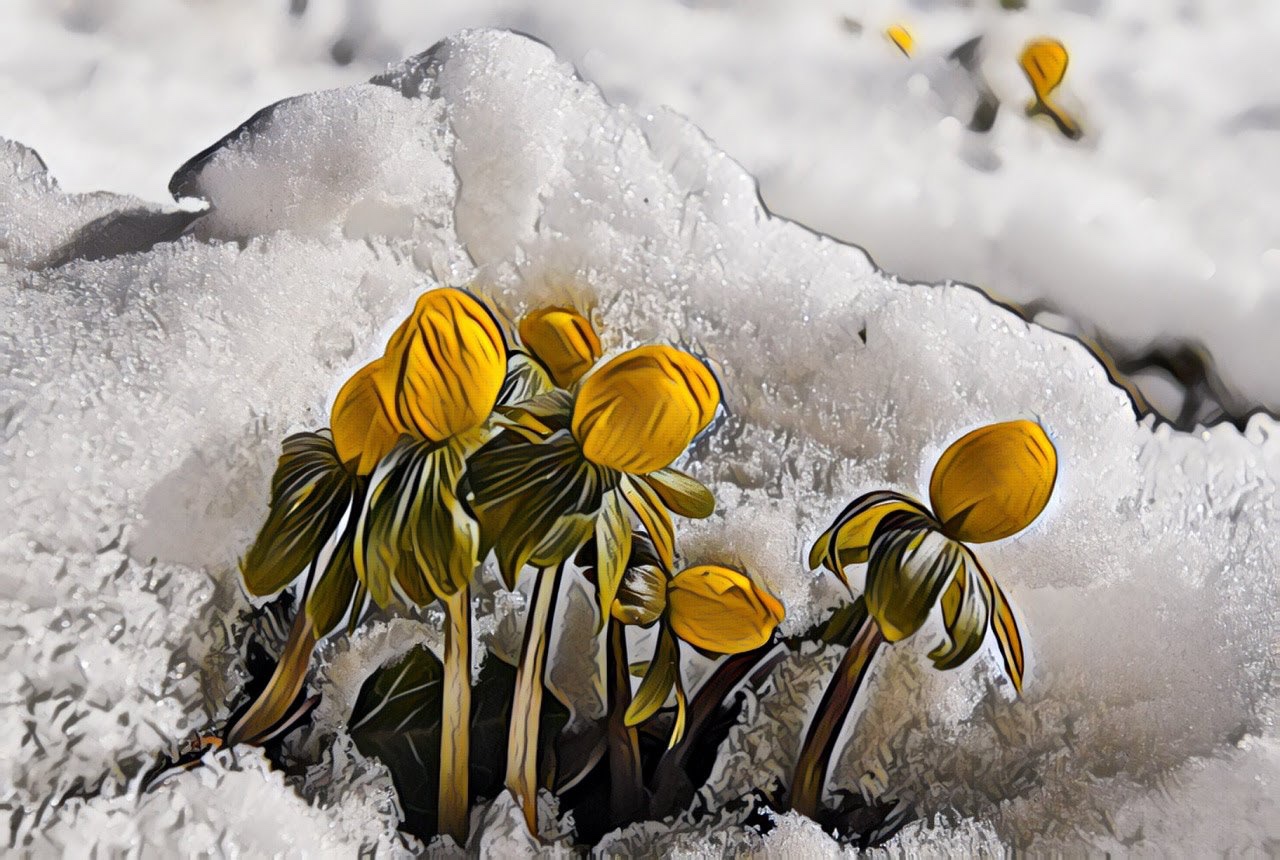
One of my favorite flowers is the Alpine Buttercup. Seen only by those who venture near or above the timberline, it follows the melting snow into the sunshine. In the early spring, it fights its way up through the cold hard earth. Along the snow banks high in the Rocky Mountains, this flower is the first to emerge, often blooming through the melting snow.
I have often wondered how this plant can be so hardy. Ranunculus acraeus is a plant of environmental extremes, hence the species name acraeus, meaning “on high”.
I often wonder what it would be like if we could switch roles with the buttercup. What if we could be as resilient as this small plant?
We would become this tender whitish-yellow chute. It hasn’t felt the suns warmth, the green is yet to come. This tender seedling pushes up through the cold hard ground.
The moment it emerges, it is subject to all of the dangers and injury that can befall anything alive and growing. A wandering deer passes by and steps on the tender plant and smashes it down. Yet, the chute pushes back up.
A hungry chipmunk discovers the plant and bites off its tender delicacy. Still out of it’s reservoir of power, the buttercup pushes up.
It struggles toward to the sun, despite the adversities that attack it.
Then one day it bursts into a tight yellow bud.
It affirms that underneath the old rotten layers of winter snow there is new good life.
My thoughts turn to an exchange in one of my favorite books, Edmond, who has suffered unspeakable torture and pain is addressing a young but courageous Albert. He says, “Life is a storm, my young friend. You will bask in the sunlight one moment, be shattered on the rocks the next. What makes you a man is what you do when that storm comes. You must look into that storm and shout… Do your worst, for I will do mine! Then the fates will know you as we know you.” (Alexandre Dumas, The Count of Monte Cristo)
The fleeting emotion we call happiness, is but a comparison of one state to another. And as such, those who have experienced extreme pain and grief, are most capable to experience supreme happiness.
Life is full of brambles and thorns. It has to be. There is no growth without challenge, and no challenge occurs without some level of uncertainty and presentation of incommodious circumstances.
A few years ago, during a severe winter storm, I passed a herd of bison standing in a large meadow on the side of the road. The storm was intense, with over 18 inches of accumulation in just a few hours. The bison, ironically, stood still in the middle of the meadow. In conditions that would kill entire herds of cattle, these majestic animals stand face first in the winter fury as the wind blows and the snow accumulates. They don’t turn their hindquarters into the wind, nor do they move with it. They stand and face the storms of life undaunted, stoic and valiant.
Perhaps we would do well to emulate the bison, as we face the uncertainties and challenges that we face in life. The storms of life will inevitably come, so why not face them? And face them with strength, determination, and power. Sure, it’ll feel uncomfortable at first, it may even be scary, but if we get comfortable with the feeling of being uncomfortable – that discomfort will begin to lessen.
I don’t know how long your storm will last or how intense it is. But I am confident we will all fare the storm better if we face it head on. Just breathe, put your head down and find a way through. We must have tough times to fully appreciate the good times that lie ahead.
Just like the Alpine Buttercup, we all contribute to the beauty of this world. We are an infinitesimal part of it. Still each of us, no matter how humble, no matter how lowly or simple, we all have a critical part to play.
I was raised on a small farm in Castle Dale, UT. We raised Guernsey milk cows, Suffolk sheep and many varieties of chickens and pheasants. My daily chores included feeding the chickens and gathering the eggs.
One day after school, I walked into the barn that housed the chickens. The barn was divided into three equal rooms. The first room is where we would store stacked straw bales. The second and third rooms were where the chickens and pheasants were kept.
On this particular day, I found our calico cat nestled with her newborn kittens. She was lying right next to the straw stack, on the ground near the chicken coop door. There were seven in all. As an 8 year old, and still to this day, new babies of any kind are an exciting experience. I dropped down and began counting the tiny kittens. I was so thrilled!
As I handled the small kittens, I noticed that something wasn’t quite right. The umbilical cord from one of kittens was wrapped tightly around a leg of each of the kittens. If I picked one kitten up, the entire litter would follow as if they were chained together. I tried to remove the cord with my fingers, but it was far too tight. Even as a little kid, I knew that something had to be done.
In Castle Dale at this time, we did not have a veterinarian. The only veterinary services available were on Thursdays when a veterinarian would travel from Richfield. It was early afternoon, so my dad was not going to be home from work for a couple of hours. I had to figure something out for myself.
I reached in my pocket and pulled out my Swiss Army knife. It was one that had a myriad of blades, nearly all of them never used, and a tooth pick and small set of tweezers in the handle. I opened the smallest cutting blade and bent down. I very carefully cut the umbilical cords from each of the kittens. I used some iodine to keep the procedure as clean as possible.
The procedure was a success. All of the kittens survived.
Fortunately, I no longer use my Swiss Army knife for surgeries. Although my surgical skills have been refined and perfected, I still have the curiosity and passion that that 8 year old displayed. I love being a veterinarian. The satisfaction I felt that day long ago is repeated every time I am able to help save a life.
I look back on my first surgical experience with fondness. It was one of the important milestones in my path to becoming who I am today.
And that is my take!
N. Isaac Bott, DVM
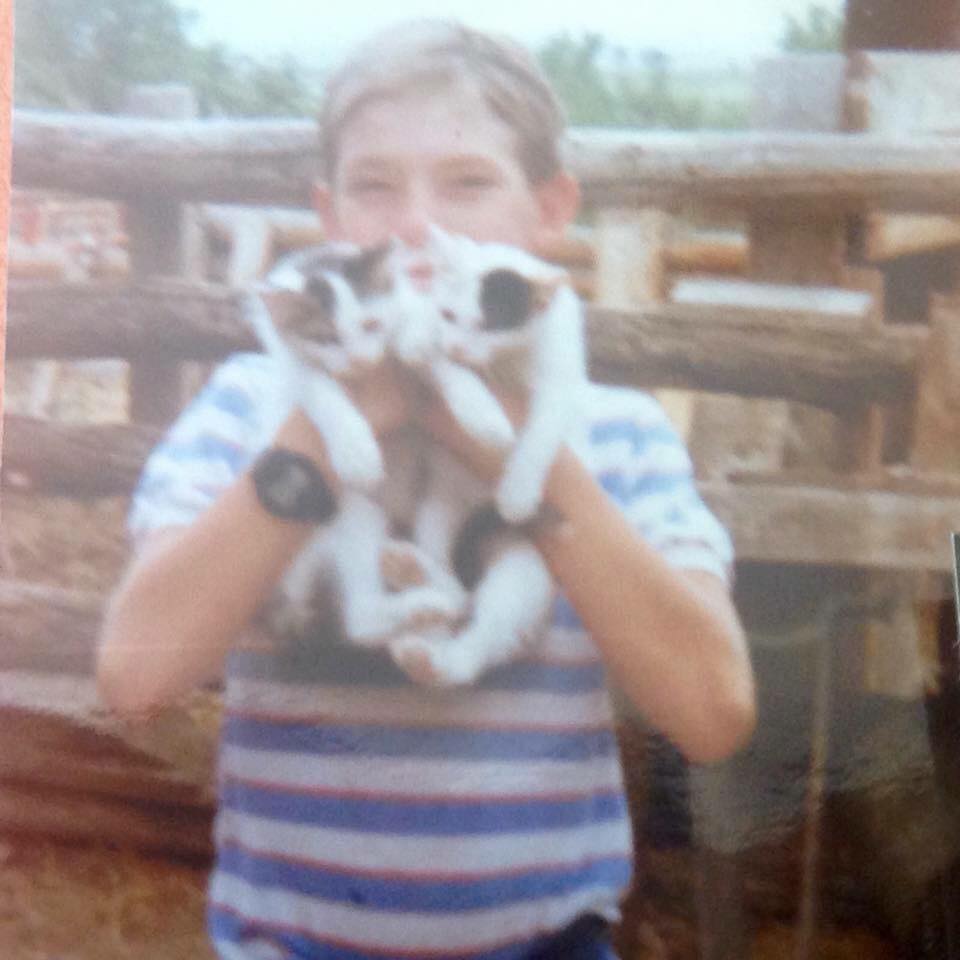
Pictured is Dr. Bott with two of the kittens from this story in 1988


 DocBott