Full Circle

My Take Tuesday: Full Circle

It was a beautiful August day in 2005. The sun reflected off of the windows of the busses lined up in the parking lot as I stepped out of Bustad Hall. I could feel the sweat drip off the palms of my hands. As I walked across the parking lot, I lugged my suitcase behind. I was surrounded by unfamiliar faces. As I boarded the bus, I peered out the window at the long line of strangers. I nervously realized that I didn’t know a single person. 

As we headed north through the rolling wheat fields of the Palouse, I thought about the upcoming days. The destination was Ross Point, a beautiful camp nestled along the scenic Spokane River. The next several days were to be spent with my 100+ of my veterinary school classmates at an event called the Cougar Orientation Leadership Experience (COLE). 

This program challenges incoming students to define their personal strengths and goals, build community with fellow students and faculty and consider their evolution from students to outstanding professionals. Veterinary schools across the world have modeled their orientation programs after this unique visionary experience first conceived at Washington State University. 

The next several days were filled with challenge by choice activities. I remember getting to know the people that I would spend the next 4 years with. It was a pleasant experience and a time of preparation and reflection. It was so helpful to have this experience prior to beginning a rigorous four-year program of veterinary education. This camp helped acclimate me to professional school and set the foundation for cooperation and teamwork over the next four years. 

In 2017, I returned to the Cougar Orientation Leadership Experience at Ross Point. I joined the class of 2021 as they kicked off their 4 years of veterinary school. I gave talks about the ups and downs of veterinary school and the opportunities that lie ahead following their graduation. 

The experience was surreal. 19 years have flown by so quickly! In so many ways, it seems like just a few months ago, that I sat in the very seats the new students now occupied. 

I saw the excitement in their eyes. I caught a glimpse of the dreams they have. I interacted with them late into the evening each night. It was a treasured experience and a true honor for me to be able to spend time with such a tremendous group of students. 

Time moves so quickly. As I look back on the last 19 years, I see the tremendous growth that I have experienced. The thousands of long arduous hours spent studying while in school are now just a fleeting memory. The classmates who became some of my dearest friends, are now practicing all over the world. 

I have been very fortunate. I have had many opportunities to learn and grow. I have had successes and failures, triumphs and defeats. It has been wonderful! I wouldn’t do anything different, as each experience has helped me become who I am. 

I love what I do. I have been extremely blessed. The past 19 years have been full of adventures all over the world with animals of all types. I have followed my heart and intuition. It has been an exhilarating ride. I am excited for what the future holds.

And that is my take!

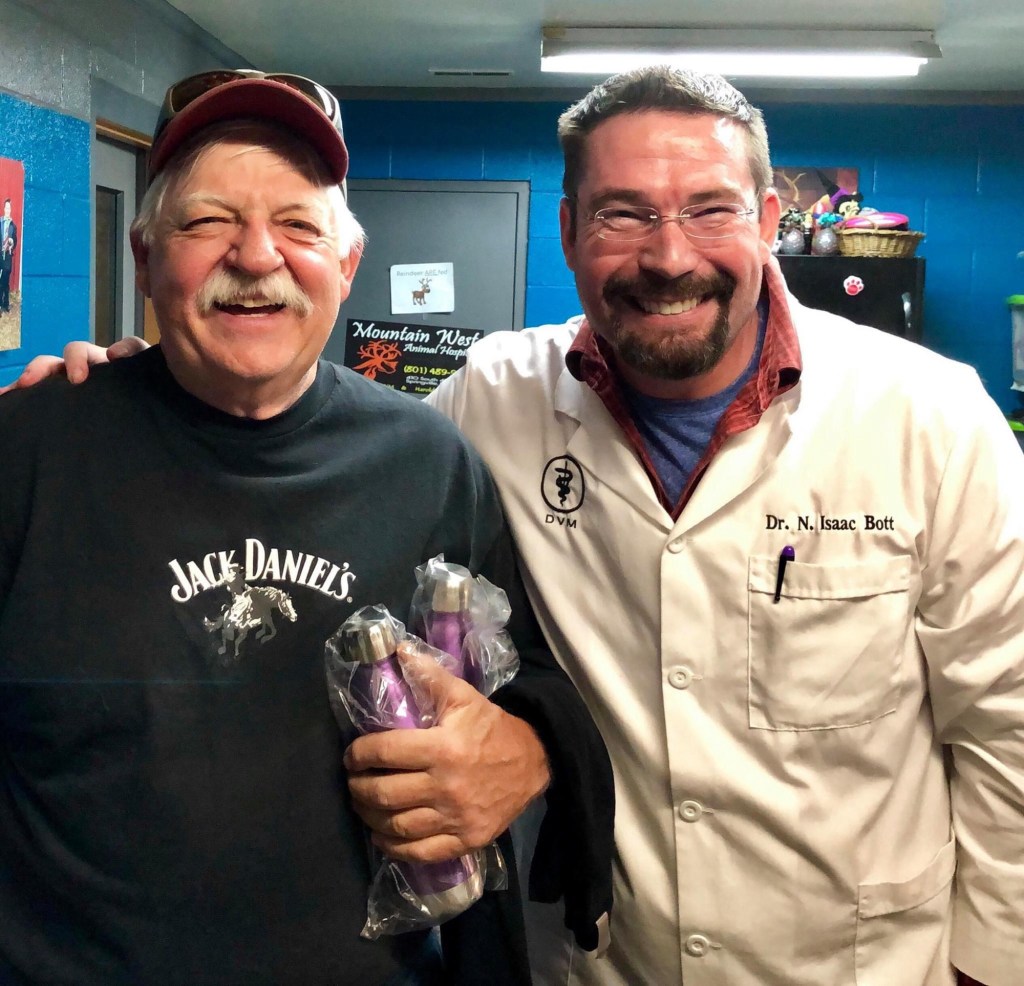
N. Isaac Bott, DVM

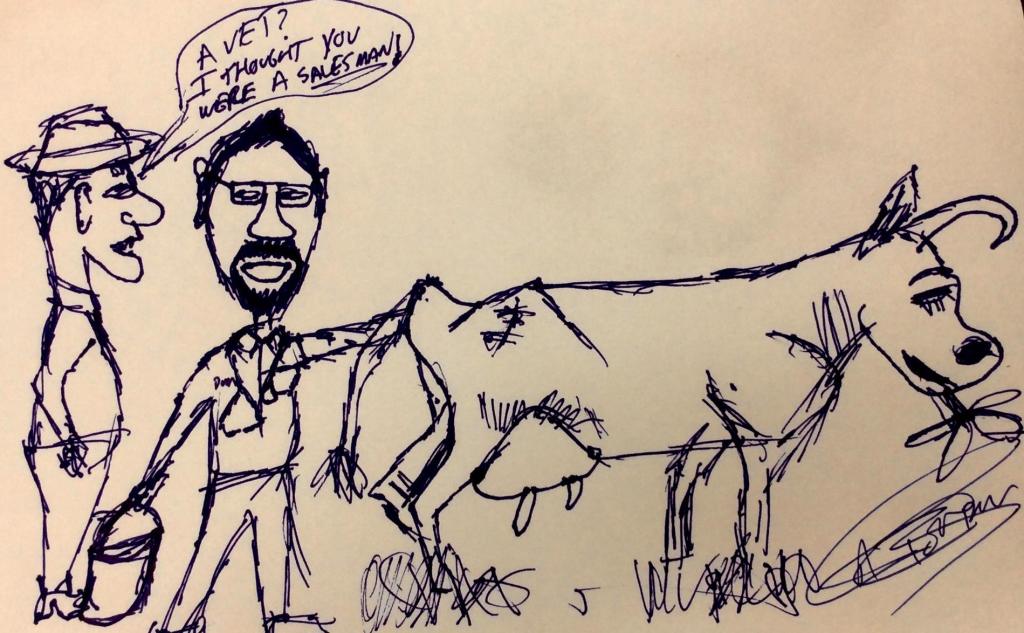
The Belligerent Bovine

My Take Tuesday: The Belligerent Bovine

January in Utah is a beautiful time of the year. The land is white. The peaks are white. The roofs tops of all of the houses and barns turn white. All is lost in the colorless landscape in which a sense of peace takes over, the long nights settle in, the land is asleep, and the world is put down to rest. Then suddenly, without just cause, comes a blast of bitter blizzards, and winter deepens her grip. 

It was a cold morning. The air burned my face as I stepped out my front door. When temperatures reach twenty below zero, your nostrils sting and burn with each breath. Still, despite the extreme cold, there is a stillness and quiet peace that overwhelm you during the Utah January nights. The quiet midnight drives to respond to emergency calls provide a time for me to reflect and think. In my busy life, I often have little time alone and I cherish those infrequent moments. 

The call on this particular night was a cow with a laceration. Somehow this massive Hereford had tangled herself up in a barb wire fence. As I arrived, the gaping wound was dripping fresh red blood. Steam would rise from the scarlet snow beneath as the blood trickled down alongside the squeeze chute. 

It was obvious that sutures would need to be placed. 

A test of a veterinarian’s ability could be most easily assessed by watching him or her suture a laceration in -20 temperatures. It is indeed one of the most arduous of tasks. 

As I pulled out my box of supplies, I noticed that a majority of the drugs were frozen solid. Fortunately, the lidocaine remained aqueous. I pulled out a large syringe and began injecting the local anesthetic along the periphery of the lesion. The old cow bellowed as I injected the Lidocaine. It was clear that she was very unhappy with her predicament. 

I placed the sutures in a simple interrupted pattern. A break was taken between each suture placement as the stinging cold weather rendered my fingers numb and stiff. In a futile attempt, I tried exhaling on my frozen fingers hoping that they regain some function. This made the numbness much worse. 

As I placed the last suture, the cow lunged forward in the squeeze chute. Her massive belly pinned my fingers against the side of the squeeze chute. A sharp pain shot up my arm as I jumped and pulled my hand back. 

“Alright,” I exclaimed, “Turn her lose. We are done.” 

As soon as the head gate opened, this massive Hereford jumped forward and exited the chute bellowing and swinging her head. She ran straight ahead for about 20 yards at which time she paused. She then turned around and set her focus on me.

I immediately knew I was in trouble. I quickly grabbed my tools and began running for the fence. 1800 pounds of solid animal came thundering towards me.

After a short run, with the bellowing cow in close pursuit, I reached the lodge pole pine fence that surrounded the corral. I dared not look back as I scampered over the fence. I could hear the angry cow snarling and could feel the sound of each hoof pounding the ground as she bounded towards me. 

I made it across the fence safely. Upon reaching the other side I peered back at the massive cow. She stood facing the fence, head down, with a most bewildered look in her eyes. My heart pounded uncontrollably, and I began to shake. This was one angry cow! 

Immediately, my squished hand began to throb. The feeling in my fingers returned and I walked back to my truck. 

As I drove away, I was very much relived to be leaving the belligerent bovine far behind. This was a close call, and I was very fortunate to have made it out of the pen without any serious harm. 

As I headed down the cold frozen highway, my mind returned to my time as a veterinary school student. In the large animal section of the Veterinary Teaching Hospital at Washington State University there was a magnetic sign that could be placed on the pen of a fractious animal. The sign read, “Fractious cow can make it to gate in 2.5 seconds. Can you?”

It would be fitting to have such a sign to hang near the squeeze chute on this particular Utah County farm. 

And that is my take. 

N. Isaac Bott, DVM

The Late Night Call

My Take Tuesday: Late Night Call

The phone rang at exactly 2:03 AM. I jumped out of bed and sleepily answered, “Hello?”.

Calls like this often come in the early morning hours. Animals, it seems, have the worst troubles while we are sleeping.

“Hey Doc, can you come out to my place?”

“What’s going on?”, I responded, wiping the sleep from my eyes.

“It is one of my ewes, Doc, she has 5 hooves sticking out of her backside!”, he explained with a dramatic tone.

“Alright, I will be right there”, I replied, as I quickly changed my clothes and dressed for the outside temperatures. Situations like this seem to always occur in January, when the temperature is below zero.

I fired up my pickup truck and headed down the road.
Mr. Johnson was a long time client and a good sheep man. He knows enough to get through most situations and is good about calling me before all hope is lost.

Farmers like Mr. Johnson are becoming more and more rare. Large corporate companies have taken over so much of the agriculture industry and have forced the small guys out, sending along the notion that each individual animal has value simply because it lives. The loss of both equates to a disappearance of my favorite part of being a mixed animal veterinarian – the interactions I have with people. The ability to help individual people through service for their animals is the hallmark and joy of being a successful veterinarian.

Bravery and survival are sojourners, and Mr Johnson still fights daily to stay afloat and continue his 100+ year family legacy of sheep farming.

As I pulled into the Johnson ranch, my headlights hit the west side of the weathered old barn. Missing slats checkered the barn wood walls and added variety to the relic that can be seen during the day from the busy interstate, I-15.

As I stepped into the barn, Mr. Johnson greeted me warmly.

“Hazel is making some hot chocolate for you Doc, we sure do appreciate you coming out in the middle of the night like this.”

He pointed me to the Suffolk ewe. She was indeed in distress, and sure enough, 5 legs and small hooves were protruding from her back side.

I calmly knelt down behind her and began my work. A trip a couple of years back to Auburn University provided me with a valuable trick in a situation like this. A small dose of Epinepherine was administered intravenously, and almost instantaneously, her uterus relaxed.

I gently pushed each of the legs back in and blindly felt around with my hand. A head was readily palpable, as was a tail, and a second head.

“Well, we at least have three!”, I exclaimed as Mr. Johnson anxiously looked on.

I continued to palpate until I was certain that I had two front feet from the same lamb and began the delivery. The first lamb was a large buck, nearly 18 pounds and jet black. The second and third were both ewes and were smaller and lighter in color. I then reached back in, and to my amazement, pulled out a 4th lamb. The last one was a buck and was much smaller in size compared to its birthmates.

All four lambs immediately began moving after being delivered. Mr. Johnson and Hazel gently rubbed each of them with warm towels as they coaxed them to breath.

After the delivery, mother and each of the quadruplets were doing remarkable well.

“We have never had 4 babies at once!”, Hazel exclaimed, “It looks like we will be busy bottle feeding!”

I sipped on my hot chocolate as I watched the newly born lambs stand for the first time.

I thanked the Johnsons as I pulled away.

As my headlights again hit the barn wall and then the straight long driveway of the Johnson ranch, the lights hit a barren tree along the fence line. The branches were covered in small ice and snow fragments that sparkled in the headlights. As I peered out my window, the barb wire strands seemed to glisten and sparkle as I traveled down the roadway.

I sat in amazement. Here is a simple ranch with a barn that is falling apart, yet on this cold winter night, it was a quiet serene paradise.

I pondered how fortunate I am. While the rest of the world is in bed, I have the privilege of bringing life into the world and seeing the majesty of God’s creation.

In this acquisitive world we must learn that in our lives we can’t have everything. But if we have freedom of spirit: to imagine, to question, to explore; then we have everything we need. To travel hopefully is a better thing than to arrive. The journey is the reward. I love being a veterinarian!

And that is my take!
N. Isaac Bott, DVM

The Christmas Cactus

My Take Tuesday: The Christmas Cactus

I never did get to meet my paternal grandmother. Her name was Caroline Westover Bott. She died several years before I was born. I wish I could have gotten to know her. I have heard stories about her humorous personality and her kind and sweet nature.

Her favorite plant was called a Christmas cactus. This plant is a long-lived plant with flat, segmented stems. Most of the year its appearance is fairly unassuming. It seems to be just a regular potted green in the corner of the living room.

Around Christmas, however, something magical happens.

With care, this plain looking plant will blossom with beautiful pink flowers. Because of this festive seasonal bloom, the Christmas cactus is a tradition in many European and North American homes during the holidays.

After my grandmother died, her husband and children continued to take care of her Christmas cactus.

Caring for this plant is much more intense than other common house plants. Despite its name, the Christmas cactus is not a desert plant, but rather has its origins in the tropical rain forests of South America.

In fall, night temperatures around 50-55 degrees will trigger Christmas cactus to form flower buds. A carefully monitored balance of darkness and sunlight will give you beautiful blooms in time for the holidays. My uncle Jerry faithfully took care of this plant year after year until he died two years ago.

One of my favorite Christmas memories is setting around this plant on Christmas morning and opening presents. I will forever treasure this family time and the pleasant memories that remain.

Another unique feature of this segmented plant is its ability to propagate. By transplanting a cutting of at least three stem segments into a small pot of soil (preferably taken from the pot of the parent plant). At least one segment is then buried. With care and time the plant will take root.

A couple of years before my uncle Jerry passed away, he gave me a small transplant from this Christmas cactus that belonged to my grandma. As it brilliantly bloomed during this holiday season, I longed to spend time with my loved ones that have passed away. I am so grateful for this tangible legacy that will continue to live on and be passed on to my children. It is my own little piece of a holiday tradition that lives on all year long. I cherish my Christmas cactus and the family ties it symbolizes.

And that is My Take!

N. Isaac Bott, DVM

An Enemy’s Christmas

An Enemy’s Christmas

The quarter sized snowflakes fell in unison. The rhythm and pace quickened as the precipitation accumulated. Over six inches of total snow arrived in just a few hours on that particular Christmas Eve in the small town of Castle Dale, Utah.

I was in a somewhat grumpy mood, as we loaded up the old green Chevy Suburban and headed down the road.

The destination this night was a small house on the other side of town. Boxes of presents were neatly wrapped and stacked in empty Sunkist orange boxes. With each turn, I could hear them slide gently back and forth in the back of the vehicle.

“Why them?” I asked.

In my 12 year old mind I did not understand why we were taking Christmas presents to this particular family. If someone ever had a reason to dislike another, I figured the events of the past few months would justify the bitterness I felt.

Just a few weeks prior, a scathing letter was published in the local newspaper that was critical of my father. I remember reading it one afternoon as I sat at the kitchen table.

“Mom, why would they say such mean things?” I inquired earnestly.

“I am not sure Isaac,” my mother replied, “Perhaps they just needed to vent and get what they were feeling out. It probably made them feel better writing it down.”

“Well,” I interjected, “It’s dumb. Not a word of what they said was true.”

Hating an enemy is what comes naturally. We hate in an effort to not allow them to continue to hurt us.

Inside I seethed. No one. No one. No one can say such vile things about my dad.

The simple fact that Mom and Dad didn’t seem at all bothered by it made me even more upset.

Yet, here we were, delivering Christmas to this very family.

“They just don’t deserve it,” I thought to myself.

As we turned off the main road and headed up the narrow road that lead up the hill, we crept along quietly. No lights. No sound. The snowfall helped damper out any audible signal of an approaching vehicle.

“Daniel and Isaac,” my dad quietly said, “I want you two to place these and knock on the door.

He continued, “Be quick. Run and hide and come back to the car without being seen.”

Daniel and I knew this would be the easy part. We were experts at doorbell ditching.

The delivery went flawlessly. We were out of sight when the porch light turned on and the front door opened.

“WOW!”, the small child’s voice pierced the snowy solitude, “Look at what Santa Claus brought us!”

The next statement pierced my heart.

“See, I knew he wouldn’t forget us!”

Several excited young voices joined in unison as the boxes were picked up and carried into the house. Then, in the blink of an eye, the porch light turned back off and the tranquility of a beautiful winter’s night returned.

A warm feeling overcame me as we arrived back at the car. The feelings of anger and resentment I had felt just moments before were no longer there. In their place was a feeling of love and what the true meaning of Christmas really is. We talked about how important it is to help and love others as we drove back home.

I thought about a bible passage that I had read so many times. “You have heard that it was said, ‘Love your neighbor and hate your enemy.’ But I tell you, love your enemies and pray for those who persecute you.” (Matthew 5:43-44) Certainly, this is not an idea that was taught only by Christ. Buddha, Gandhi, and many other great people and religions have nearly identical teachings.

It is a funny thing that I don’t remember much about any of the presents we received that year. I do, however, remember everything about giving Christmas to someone I considered an enemy.

29 years have now passed. Not a soul, besides my parents and siblings, knew who delivered the presents on that Christmas Eve.

The lesson I learned from my parents that year was not wasted on me.

Love is what makes all the difference. Herein is love, not that we first loved God, but that he loved us. Regardless of our acts, this love is unconditional. Poor or rich, young or old, religious or agnostic, His love remains as constant as the North Star.

I can assure you this is what Jesus really meant. And those words are just as true today as they have ever been. Has there ever been a time in our society where we needed to put this into practice more than now?

In one of the last recordings that the late Charley Pride released, he eloquently observes,

“He tells me money doesn’t matter

Nor the color of your skin

We could stumble or even fall, and still get up again

Cuz it ain’t about the deeds, good or bad that we have done

All we have to do is love to be disciples of the Son.”

May each of us take a moment to enjoy the simple things today. As long as there is a sunset, there will be always be moments of joy and gladness for each of us. May we love each other, even those that have wronged us. Giving this love will open our hearts and allow us to experience a new level of happiness.

I recollect with fondness the traditions my family shared. The presents are gone. The shoes and clothes are all worn out, but the memories remain. The true meaning of Christmas is, after all, about love. Our Christmases were centered around family. We were together. How grateful I am for that. A quick trip down memory lane rapidly brings back the joy and love I felt on that special Christmas Eve while growing up in Castle Dale.

Merry Christmas!

N. Isaac Bott, DVM

White Lightning

My Take Tuesday: White Lightning

Reindeer rarely have difficulty giving birth. Fortunately, nature has provided this species with amazing vitality. Young calves stand within minutes of being born.

Predation is the primary cause of death in newborn calves. To minimize this, cows synchronize their birthing. If all of the calves are born at the same time, fewer are killed by predators. Gestation length can vary as much as 45 days to accomplish this. Such synchrony is fascinating, but provides considerable challenges with domesticated herds. Occasionally, calves are born premature and lung development is not complete. Sadly, many of these calves die.

As a veterinarian, I perform a considerable number of artificial inseminations on reindeer each year. The calves produced by this procedure are especially valuable. Intense care is given to newborns to ensure the best chances of survival.

A few years back, a young male calf was born during the summer. He had a unique white marking on his nose. This calf was a charmer. We all instantly fell in love with him.

On examination, the calf showed considerable effort in his breathing. His lungs were not working as they should. Research has shown that these calves lack a chemical called Surfactant. Surfactant reduces the surface tension of fluid in the lungs and helps make the small air sacs in the lungs (alveoli) more stable. This keeps them from collapsing when an individual exhales. In preparation for breathing air, fetuses begin making surfactant while still in the the uterus. With some reindeer calves, this production is incomplete when they are born.

Treatment consists of replacement surfactant therapy. This is often not feasible in veterinary medicine because of the high cost of synthetic surfactant. When is is available, it must be administered within 6 hours of birth to be effective.

The second treatment is placing the calf in an incubator (very similar to ones used with human neonates) and administering oxygen. Some calves will improve with this treatment. We placed him inside the oxygen chamber and waited. Feeding was required every 2-3 hours. The first few hours were touch and go, but little by little, improvement was noted. His tiny lungs slowly began to function properly.

Fortunately, such was the case with this beautiful calf. We named him White Lightning, reflecting the distinctive white stripe on his nose.

Miraculously, on this hot summer day, a life was saved. As you can see in the photos, we were all happy to pose with the calf, with the exception of my youngest son, KW. He fortunately has overcome his fear of reindeer. 🙂

And That is My Take!

N. Isaac Bott, DVM

Run Over by a Reindeer!

My Take Tuesday: Run Over by a Reindeer!

Many of the pictures I post are of Mountain West Animal Hospital’s resident reindeer. They are very docile and love the attention. Sven and Yuki will pose for photos and love little children. Sven even has a fondness for the color pink.

However, not all reindeer are like this. A male reindeer’s personality changes dramatically as the breeding season approaches. Rising testosterone levels in the male reindeer are responsible for the hardening and cleaning off of the antlers. This cleaning off of the velvet has an abrupt onset. Although fresh blood is noted on the antlers as the velvet comes off, the condition is NOT PAINFUL. There is no sensation in the antlers at this point.

Testosterone will make an otherwise tame male become a raging, grunting and aggressive mess.

A couple of years ago, I received a call from a reindeer farmer in northern Utah. He had a male reindeer that has injured the base of his antler. August heat and fresh blood are a recipe for complications due to either a severe bacterial infection and/or disgusting maggots.

I arrived at the farm and immediately realized that the bull was in full rut. I had just left the office and, like a true nerd, had placed an external hard drive for my computer in my front pocket.

The bull was not very happy to be caught. It took three of us to restrain him while I treated his injury. His massive antlers could easily lift us off the ground and fling us in any direction desired.

Just as I finished the treatment, he broke lose. He immediately turned toward me. I had very little time to react. I stood there with empty syringes and iodine in my hands, helpless and very much vulnerable. His attack was swift. A single charge knocked me on the ground.

I lay there struggling to catch my breath. The sudden impact of the ground on my back left me with temporary paralysis of the diaphragm which made it difficult to take a breath. When I finally did breathe, I was bombarded with excruciating pain over the left side of my chest. I reached into my pocket and removed the external hard drive. It was shattered.

I was very much defeated and beaten, but overall ok after I got on my feet. The pain was caused from two cracked ribs. Other than that, I had no further damage from the incident.

I learned my lesson that day. Rutting reindeer cannot be trusted. They are the most dangerous animal I have ever worked with. They make a Jersey dairy bull seem like a young puppy.

I am glad I had the external hard drive in my pocket. The antlers would have easily punctured my lung and inflicted life-threatening injuries.

If you ever see a male reindeer grunting, snorting and peeing on itself – STAY AWAY!

You have been warned.

And that is my take!

N. Isaac Bott, DVM

The Llama Que se Llama Lloyd

My Take Tuesday: The Llama que se llama Lloyd

It was a typical Sunday afternoon; I was taking advantage of the quiet afternoon by sitting down on the couch. The phone startled me just as I was getting to the good part of one of my favorite movies.

I hit pause as I picked up my cell phone and gave my usual salutation, “Hello, this is Dr. Bott.”

“Hey Doc! I need you to come check on my llama. He’s gone absolutely berserk!”

I could hear panic in her voice as she continued, “He just ate my blouse from the clothesline.
Yesterday, he spit right in my eye. He keeps biting Susie and Dolly, thems my other llamas, and he keeps attacking anyone that enters his pen!”

The potent potion of human personality makes taking calls like this very unpredictable, and my experience has shown that some of the most colorful of souls happen to also have llamas.

She continued, “I tried using lavender oil to calm him, but he bit my finger!”

“Oh my!” I replied.

Over time, the term “berserk” has been used rather freely to describe llamas or alpacas that deviate from the expected behavioral norm.

I could tell this client was truly terrified of the llama and needed immediate assistance.

My next questions were precise, “Is your llama male?”

She replied, “Ya’ darn tootin’ he is.”

I quickly followed up with, “Is he castrated?”

“No, we ain’t got around to it.”

In my experience, nothing will calm a crazy macho llamoid like castration. When possible, castration should be performed before the male attains puberty.

As I drove south on I-15, I reviewed in my mind the condition known as berserk llama syndrome or berserk male syndrome (as it is more pronounced in males). It is a psychological condition suffered by human-raised llamas and alpacas that can cause them to exhibit dangerously aggressive behavior towards humans. The term has been overused, however, and is sometimes inappropriately applied to llamas with aggressive personalities that are not truly “berserk”. The condition is a result of the llama imprinting on its human handlers to such a degree that it considers them to be fellow llamas. Imprinting can be caused by bottle feeding and by isolation from other llamas.

Male llamas suffering from this condition become dangerous when this behavior is directed toward humans. This behavior can be so aggressive that these males sometimes have to be euthanized.

As I turned down the road onto the farm, a large white llama could be seen running the perimeter of the pen. His vocalization, a high shrill mixed with a gurgling, guttural sound, pierced the solitude in the cab of my pickup. It was immediately obvious, that Lloyd the Llama was very upset.

Lloyd had distinctively long hair, known as fiber in llamas and alpacas, around his face. If it weren’t for his long banana shaped ears, he could easily be confused for an alpaca.
Llamas are pseudo-ruminants – they chew their cud similar to cattle. The spit that llamas produce is actually ingesta from their first stomach compartment. This foul-smelling stuff is very unpleasant. Because of my previous llama adventures, I know that it tastes horrible, and it stings when it hits your skin or eyes.

As I approached the fence to meet Mrs. Jones, I heard the unmistakable ‘Pffffffffft” that accompanies a huge ball of llama spit. Before I could react, the large gob of green nastiness spattered across my face.

Imprecations are sure to follow something like this, even from the calmest of veterinarians.

“We need to sedate Lloyd,” I explained to Mrs. Jones, “We should look at his teeth and also castrate him while he is asleep.”

Mrs. Jones had no problem with my proposed battle plan. As she stated, “Maybe he will calm down if we chop his balls off!”

For some reason, I always have giggled when a grown up speaks like this. I smiled as I filled my syringe with the Camelid Cocktail of Anesthesia.
Administering an intramuscular injection on Lloyd proved to be no easy task. Both Mrs. Jones and I received another round of llama spit and multiple kicks from his agile hind legs.

Soon Lloyd sat down and peacefully fell asleep.
As I opened his mouth, I noticed the nidus of his outbursts. His premolars, known in this species as fighting teeth, were actually growing into the sensitive skin inside his cheek.

The fix was simple, the fighting teeth were removed. As per Mrs. Jones request, he was also castrated.

Lloyd woke up a new llama. He calmly allowed Mrs. Jones to lead him back into his pen.

“That’s my boy!” She exclaimed as Lloyd rubbed his face gently on her check.

It was no short of a miracle. Lloyd wasn’t berserk, he was simply in pain.

My job as a veterinarian would be so much easier if I could have the luxury of simply asking, “Where does it hurt?”

Even though animals can’t talk, they certainly can communicate with us if we are willing and observant enough to listen.

I will never forget this important lesson that I learned from Lloyd the Llama.

And That is My Take!
N. Isaac Bott, DVM

Black Friday

My Take Tuesday: Black Friday

It was a beautiful Friday in late November. The animals were standing, by the thousands, crowded in the isle. The primitive fight or flight instinct had clearly pushed towards the fight response on this particular day. This mammal known as man is best avoided on the day after Thanksgiving. In years past, I stood in these massive lines just to get a good deal, after all, nothing says “America” like fighting over a TV at Walmart.

This particular Black Friday, however, was spent driving to and from farms in Utah County tending to a variety of sick animals. What began as a perfect day, quickly took a turn for the worse.

The mare’s name was Dollar. She was a beautiful sorrel. She had recently given birth to a healthy young filly. 

Shortly after foaling, she developed severe lameness in all four of her feet. Her condition quickly deteriorated, and she was barely able to walk when I arrived. To make matters worse, Dollar had developed severe colic, a term referring to abdominal pain in horses. Her intense pain was caused by gut spasms and every few minutes she would suddenly drop to the ground and roll.

Upon arrival, I performed a thorough physical examination. I then administered a mild intravenous sedative and passed a tube through her nose and into her stomach. I then pumped in a half-gallon of mineral oil.

The next treatment in a case like this is to administer a non-steroidal anti-inflammatory to help with the pain. The two most common drugs that veterinarians use in this case are phenylbutazone (commonly called Bute) and flunixin meglumine (brand name is Banamine).

For me on this particular day, I reached for a bottle of Banamine. With the needle in my right hand and the syringe in my shirt pocket, I held off the jugular vein with my left hand. Dollar didn’t flinch as I quickly slipped the needle into her vein. With dark blood slowly dripping out the needle hub, I reattached the syringe and steadied my hand against her neck. Just then, a gut spasm hit, Dollar jumped up and staggered sideways. I quickly sidestepped in an effort to remain in a position where I could inject the medicine.

Without warning, and before I had injected any appreciable amount of Banamine, she reared up on her back legs. I retracted the needle immediately and instinctively stepped backwards. The momentum of her rearing up and me pulling back made me momentarily struggle with my balance. I then pulled my right arm abruptly to the side of my body to avoid falling over. As I did so, the large bore 18-gauge needle plunged over an inch and a half straight into the right side of my abdomen. The needle entered about 6” to the right of my navel and 3” below my last rib. I felt intense pain as the needle cut through my skin, subcutaneous fat, and abdominal muscle. The hub of the needle was nestled flush against my brown Carhartt Jacket. During my split-second of inattentiveness approximately 2 ml of Banamine was injected directly into my abdominal cavity.

Immediately, I grimaced in pain. The owner of the mare looked at me as I pulled the bloody needle from my abdomen. 

“Are you ok?” he inquired, “Did you just stab yourself?”

“I sure did,” I groaned.

The pain was incredible. It was so severe, that I actually laid right down in the stall and waited for the stinging to subside. It felt as though some one was burning my abdomen with a branding iron.

After nearly a half an hour, I was able to stand up and walk back over to the mare and administer the Banamine properly. I then climbed in my truck and immediately headed to the doctor’s office.

There are some veterinary drugs which are fatal when injected into humans; fortunately for me Banamine isn’t one of them. Although it relieves pain when administered intravenously in horses, I learned that day that when administered outside a vein, the effects are the total opposite.

It stung far worse than any insect sting or abdominal pain I have experienced.

“You what?”, The doctor blurted out, “How much did you inject?”

My physician is unique. His father is a veterinarian. He was raised at a veterinary clinic and spend his youth helping his father in a general mixed-animal practice. Fortunately, he knew exactly what Banamine was and what he needed to do to treat me.

Afterwards, he laughed as he reminded me, “Hey Doc, keep that needle pointed away from you next time!”

I most certainly learned a painful lesson that Back Friday.

And that is my take.

N. Isaac Bott, DVM

A Scar

My Take Tuesday: A Scar

Last year, after a long day at work, I slipped while using a knife and cut a large section of skin off the tip of my left middle finger. The pain was excruciating as I drove to the urgent care clinic. Because of the location and size of the wound, suturing it closed wasn’t an option. I was stuck wearing a large band-aid on my finger for the next few weeks. The occasional throbbing and tingling sensation reminded me throughout each day to be careful as I examined pets and went about my usual routine. I certainly have a good scar on the tip of my finger from this injury.

My left hand has been injured many times during my lifetime. Each of these injuries has left a unique scar. Each represent the best healing scenario for the injury sustained. Each scar has taught me how to deal with pain, how to be strong and each leave a detailed memory about how and when each injury happened. The most prominent of these scars is on my pointer finger. 

You can definitely see it if you look close enough, each time I extend my left hand with my palm down. It runs nearly perpendicular to the axis of my index finger.

Scars are a physical reminder of our own survival. They tell a story about places that you’ve been. They are tangible roadmaps to life’s lessons learned.

Every time I notice the scar on my finger, my mind travels back to my senior year of veterinary school in 2008. My best friends from veterinary school, Dan and Travis, were with me on this wild adventure.

It was a beautiful November day in Emmett, Idaho. The crisp fall air and dark yellow leaves of the cottonwood trees reminded me why this was my favorite time of the year.

During my last year of veterinary school, an entire month was spent at the Caine Veterinary Teaching Center in Caldwell, ID. This provided hands on training in a variety of agricultural species. Our days were spent on massive dairy operations, in the classroom and at livestock auctions.

On this particular day the sale yard was full. Cattle of every breed, gender and size were being sold and sorted through the sale barn.

My tasks were simple: 1) Vaccinate the females between 4-10 months of age. 2) Diagnose pregnancy in adult females. 3) An occasional bull calf would also need to be castrated.

Often cattle are sold because of their disposition. Wild, aggressive and flighty cattle are difficult to handle. Studies have shown a lower pregnancy rate among beef cattle that are flighty. Farmers are quick to cull cows that exhibit these traits. Therefore, wild and crazy cattle are prevalent at a livestock auction. Extreme care must be taken to avoid injury.

Facilities to process cattle make all of the difference for a veterinarian. It is very dangerous to attempt to process cattle in a rickety old squeeze chute. Unfortunately, too many sale barns have cattle handling facilities that leave much to be desired.

A black Angus calf entered the chute. I had castrated many calves before this and was very comfortable with the procedure. To facilitate castration, I entered the squeeze chute behind the calf. I reached down and made an incision. The calf immediately jumped and kicked. His right hind leg hit my right hand with incredible accuracy. The knife, still held securely in my right hand, plunged downward. The blade entered the index finger of my left hand, right between the first and second knuckles. The blade sank deep, and only stopped as it hit the bone in my finger.

The pain was immediate. I quickly exited the chute, holding my left hand tightly. Blood poured down my hand and dropped on the ground. The professor asked, “What happened?”

“I cut myself,” I responded.

As I stepped away from the squeeze chute, I glanced down at my finger. The open wound gushed blood. I immediately became lightheaded and nearly fainted as I stumbled to the truck.

I wrapped my finger tightly and headed to the nearest urgent care clinic. The throbbing pain seems to peak with each heartbeat.

After a couple hours and a few sutures, I was back at the sale yard. The remainder of the day went smoothly.

I will forever carry a reminder of that November day in Emmett, Idaho. Although time tends to color our memories optimistically, I still remember the painful lesson I learned that day.

Such is life. The ups and downs leave us battered and scarred. But with time, things get better. The pain won’t always be there and someday we will look back at each scrape and scratch and be reminded that scars are beautiful.

And that is my take!

N. Isaac Bott, DVM