An Enemy’s Christmas

An Enemy’s Christmas

The snow fell in silent harmony, each flake a dancer in an endless waltz from the heavens. By evening, Castle Dale, Utah, lay cloaked in a pristine blanket of white, the stillness broken only by the faint crunch of tires as our old green Chevy Suburban crept down a narrow, snow-covered road.

Inside the car, the magic of the evening was lost on me. At twelve years old, I sat sullenly in the back seat, my arms crossed in defiance. I didn’t want to be there.

In the rear of the Suburban, boxes of Christmas presents—wrapped with care and stacked neatly in empty Sunkist orange crates—shifted softly with each turn. The sound, a gentle whisper against the car’s stillness, grated on my nerves. It was a quiet reminder of the task I resented so deeply.

“Why them?” I muttered under my breath, the words heavy with bitterness.

To my young mind, no reason could justify this errand. Just weeks earlier, the family to whom we were delivering these gifts had penned a cruel letter to the local newspaper, a public rebuke aimed squarely at my father. I had read it myself, the words slicing deep, leaving wounds that felt fresh even now.

“Mom, why would they write such mean things about Dad?” I had asked, my voice laced with confusion and anger.

“I don’t know, Isaac,” my mother had replied gently, her tone even but tinged with sadness. “Sometimes people lash out because they’re hurting. It doesn’t make it right, but it’s what they do.”

“Well, it’s dumb,” I snapped, the injustice stoking my indignation. “None of it was true.”

Anger felt justified, even righteous. It shielded me from the vulnerability of hurt. The very idea of extending kindness to those who had wounded us seemed absurd, even offensive.

Yet here we were, delivering Christmas to them.

As the car came to a stop, the silence outside was profound. Snow muffled the world, insulating it in a cocoon of stillness. My father’s voice broke the quiet.

“Daniel, Isaac,” he said, his voice soft but firm. “I need you to carry these boxes to the porch, knock, and then leave quickly. Don’t let them see you.”

My brother and I exchanged wary glances. Doorbell-ditching was a skill we had perfected in the innocence of childhood mischief. But this—this felt different.

The cold bit at my cheeks as I stepped into the night, the boxes heavy in my arms. The frigid air sharpened my senses, but my heart felt dulled, weighed down by resentment. My brother and I worked quickly, arranging the crates carefully on the porch. I raised a fist and knocked loudly, the sound reverberating in the stillness. Then we ran, retreating to the shadows where we watched, breathless and hidden.

The porch light flickered on, and moments later, a small, jubilant voice shattered the quiet.

“WOW! Look at what Santa brought us!”

I froze, the warmth in the child’s voice catching me off guard.

“See? I told you he wouldn’t forget us!”

More voices joined in—children’s voices, bright with excitement. From behind the frosted window, shadows danced as little hands carried the boxes inside. For a moment, we watched in silence, the glow of the porch light casting long shadows over the snow. Then, just as suddenly as it had come on, the light clicked off, and the house was still again.

The world was silent, but inside me, something stirred. The bitterness I had carried so fiercely began to thaw, replaced by an unfamiliar warmth—a feeling I could neither name nor fully understand.

Back in the car, I stared out the window, my thoughts heavy. My parents spoke softly, their words weaving through the quiet as they reflected on the power of love—the kind of love that gives freely, without expectation or condition.

Their words took root in my heart, drawing me to a scripture I had heard many times but was only now beginning to grasp:

“You have heard that it was said, ‘Love your neighbor and hate your enemy.’ But I tell you, love your enemies and pray for those who persecute you.” (Matthew 5:43–44).

That night, those words became real to me.

I don’t remember a single gift I received that Christmas. But I will never forget the glow of the porch light, the sound of those children’s voices, and the quiet realization that love—when given freely—has the power to transform even the hardest of hearts.

Thirty-three years have passed since that snowy Christmas Eve, yet its lesson remains etched in my soul. Outside my family, no one ever knew who left those gifts. But the truth I learned that night endures: love is not earned; it is given. It is steady and unwavering, reaching across divides, bridging wounds, and softening hearts.

Charley Pride captured it beautifully:

“He tells me money doesn’t matter,

Nor the color of your skin.

We could stumble or even fall, and still get up again.

‘Cause it ain’t about the deeds, good or bad, that we have done—

All we have to do is love to be disciples of the Son.”

This Christmas, I hope we pause to notice the beauty in life’s simple moments—a quiet snowfall, a radiant sunset, the warmth of family. And I hope we choose love, especially when it’s hardest. For when we give love, even to those who have wronged us, we open our hearts to something far greater: peace, healing, and grace.

The toys and clothes of my childhood have long since disappeared, but the memories remain. Christmas was never about what we received; it was about who we became.

That snowy night in Castle Dale taught me this enduring truth: the heart of Christmas is not found in receiving but in giving—freely, generously, and with love.

Merry Christmas.

N. Isaac Bott, DVM

Operation Santa Claus

My Take Tuesday: Operation Santa Claus

Way out where the ponderosa pine lean to the sun,

Where the high desert wind and the bitterbrush run,

A herd once stood proud on that Oregon land—

A dream born from snow, guided gently by hand.

Sagebrush whispers on a crimson plain,


Where basalt cliffs bear wind and rain.


Snowcaps glint past juniper’s bend,


Redmond stands where earth won’t end.

It started with John Zumstein and a spark from the North,

A handful of reindeer he bravely brought forth.

From Alaska they came with their thick northern coats,

To Redmond they marched like a sleigh full of hopes.

They thrived in the dust where sleigh bells were heard,

Trading tundra for chaparral, western in word.

Then Mike and Cindy Gillaspie, with love in their grip,

Took hold of the reins for a decades-long trip.

They trained them for parades, for film and for show,

They taught them to prance, they taught joy to grow.

From Ernest Saves Christmas to Disneyland nights,

Their herd became magic in antlered delights.

But time, like snowfall, has ways of retreating—

And Mike and Cindy gave a final warm greeting.

Their herd found new homes, and two stayed with me—

Maximus strong, and sweet Yuki, carefree.

Now Maximus has passed, but he left us a sign.

That feels like a whisper of something divine.

A promise frozen in nitrogen, a new life begun—

Proof that their legacy still rides with the sun.

Yuki stood like a statue in snowfall and hush,

With frost on her lashes and velveted plush.

A crown of ice clings to each gentle tine—

The winter was hers, and the moment was mine.

You won’t find the ranch on a map anymore,

No boots by the gate, no wreath on the door.

But magic’s not housed in fences or stalls—

It lives in each hoofbeat when winter snow falls.

And when that new calf takes its first breath of air,

You’ll know Operation Santa Claus in still right here.

‘Cause legends ain’t buried—they roam, and they breathe,

In calves with a sparkle come each Christmas Eve.

DocBott

Dasher, Dancer, and the One Who Pranced All Over Me

My Take Tuesday: Dasher, Dancer, and the One Who Pranced All Over Me

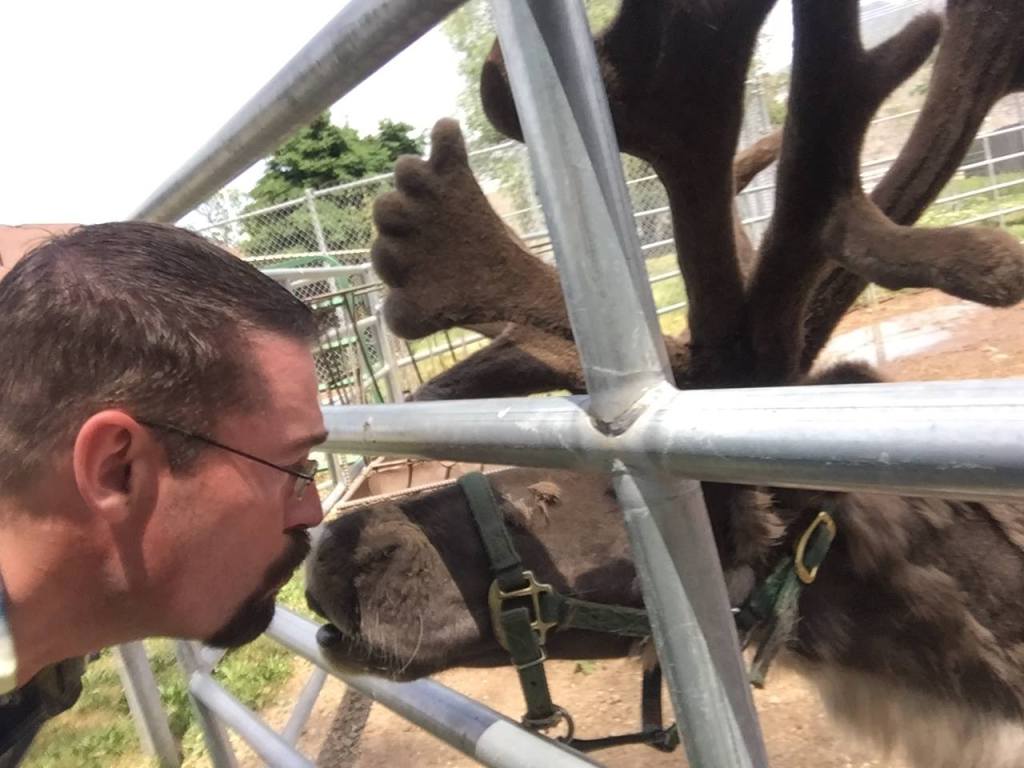
Many of the pictures I share are of our resident reindeer at Mountain West Animal Hospital. Sven and Yuki are basically Instagram influencers in velvet coats—docile, photogenic, and absolute hams for the camera. They adore kids, pose like seasoned pros, and Sven has an inexplicable fondness for the color pink. 

But let’s get one thing straight: not all reindeer are like Sven and Yuki. Some… are less snuggly. Especially during breeding season, when testosterone hits like a double shot of espresso on an empty stomach.

When male reindeer enter rut, they undergo a dramatic personality shift—think Dr. Jekyll to Mr. “I-Will-Skewer-You-With-My-Antlers.” As their testosterone climbs, their velvet-covered antlers harden and the velvet sloughs off—abruptly. Fresh blood on newly exposed antlers may look like a scene from a holiday horror film, but it’s NOT painful. By then, the antlers have no sensation. Just beauty, brawn, and unbridled rage.

A couple of years ago, I got a call from a reindeer farmer in northern Utah. His bull had injured the base of his growing antler. My first thought was this was terrible timing. August heat + fresh blood = flies, maggots, infection, and the stuff veterinary nightmares are made of.

I headed straight from the clinic to the farm. And because I’m the kind of nerd who likes to be prepared, I’d tossed my external hard drive into my front pocket before leaving—my veterinary version of a pocket protector.

The bull was in full rut: snorting, stomping, and glaring as though we’d personally offended him. It took three of us to restrain him while I cleaned and treated the wound. His antlers were massive, the kind of natural weaponry that makes you respect the airspace around them.

I had just finished when—of course—he broke loose.

He lowered his head and came straight for me.

I’d love to tell you I executed some graceful dodge-roll maneuver. I did not. I stood there like a deer—ironically—caught in the headlights, clutching a syringe and a bottle of iodine like they were going to help.

The impact was immediate and violent. The bull plowed into me and sent me flying. I hit the ground so hard my diaphragm decided to take a brief sabbatical. I scrambled frantically to catch my breath,  but it felt someone had pushed the pause button on my lungs.

When I finally sucked in a wheezy breath, pain exploded down my left side. Instinctively, I reached into my pocket and pulled out what remained of my external hard drive. It was shattered—absolutely obliterated.

But that little chunk of tech probably saved my life. Without it, those antlers would have punctured my lung. Instead, I walked away with two cracked ribs, a bruised ego, and a new appreciation for data storage devices.

I eventually staggered to my feet, reeking of iodine and regret, but alive.

Moral of the story? Don’t let the festive antlers fool you. A rutting reindeer is not Rudolph. He’s the final enemy in a holiday-themed video game. Honestly, I’d take my chances with a Jersey bull in a bad mood—and that’s saying something.

So if you ever see a male reindeer grunting, snorting, and peeing on himself like it’s a party trick—stay away.

You’ve been warned.

And that is My Take.

N. Isaac Bott, DVM


White Lightning

My Take Tuesday: White Lightning

Reindeer rarely struggle during birth. Nature has shaped them for survival in harsh places, gifting newborn calves with an astonishing vitality—they can wobble to their feet within minutes of entering the world.

Yet even with this resilience, danger lurks. Predation remains the leading cause of death in newborn calves. To counter this, reindeer have evolved a remarkable strategy: the cows synchronize their calving. When dozens of calves hit the ground at once, predators become overwhelmed by the sheer abundance of potential targets, dramatically lowering the risk for any single newborn. It’s brilliant biology at work—but in domesticated herds, synchronized calving can present its own challenges. Every now and then, a calf arrives too early, lungs still immature, and its fight for life begins the moment it takes its first breath.

Each year I perform several artificial inseminations on reindeer, and the calves born from these efforts are especially precious. We pour heart and time into giving them every possible advantage.

A few summers ago, one of those calves made an unforgettable entrance. He was a handsome young bull with a snow-white blaze on his nose, and we were smitten from the start. His presence was magnetic—one of those animals you can’t help but root for.

But within minutes it was clear something wasn’t right. His breathing was shallow and strained, the unmistakable sign of underdeveloped lungs. Premature calves often lack surfactant, the slippery, essential substance that reduces surface tension in the lungs and keeps alveoli—the tiny air sacs where oxygen exchange happens—from collapsing. Surfactant production ramps up late in gestation, so for preemies, every breath becomes a herculean effort.

Our treatment options were limited. Synthetic surfactant works wonders but comes with a price tag and a six-hour window that put it out of reach for most veterinary settings. Without it, the best lifeline is an oxygen chamber—essentially a neonatal ICU for calves—paired with intensive supportive care.

We nestled the little bull into the chamber and got to work. Feedings came every two to three hours. Monitoring was constant. The first stretch was nerve-wracking, each rise and fall of his tiny chest a small verdict on how the next hour might go.

Slowly, almost imperceptibly at first, things began to turn. His breaths deepened. His energy lifted. His will to live—always the wild card—proved strong.

Against the odds, he made it.

We named him White Lightning, after the bold streak across his nose and the spark he carried inside.

The day he turned the corner felt like a gift. We all gathered to celebrate, and even my youngest son, Kendyn—who at the time harbored a mild but persistent fear of reindeer—joined the moment. In the photo, he is very clearly crying, still convinced that reindeer are enormous, antlered monsters masquerading as cute livestock. (I’m pleased to report that he has since overcome his fear of reindeer.)

That summer, White Lightning reminded us that medicine isn’t just science—it’s heart, teamwork, timing, and sometimes a touch of grace.

And that is My Take.

N. Isaac Bott, DVM

Reindeer Reproduction

My Take Tuesday: Reindeer Reproduction

On March 28, 2010, I was heading north on I-15 toward Cottonwood Heights, the glow of the Salt Lake Valley coming into view, my mind busy with the usual churn that precedes a new job. I was to start at an animal hospital in West Jordan the next morning, and the closer I got, the more the nerves settled in my stomach.

Then my phone rang.

The voice on the other end held a familiar tremor of worry. His pet was believed to be pregnant, and he needed confirmation. But there was a twist I hadn’t seen coming: the pet in question was a reindeer.

Now, I’ve treated a fair bit of the alphabet in my veterinary career—antelope, tigers, bison, camels, you name it—but reindeer were still firmly in the “only in National Geographic” category for me. I’d never examined one, let alone a pregnant one. Still, I was only a few miles away, and curiosity nudged me forward.

I turned off the freeway and headed his way.

I arrived just in time. Mischief—an aptly named cow with a soft, inquisitive face—was laying on her side with two black legs protruding from her backside.

I couldn’t help blurting the obvious: “Well, she’s definitely pregnant!”

Minutes later, I found myself kneeling beside her as we delivered a small jet-black calf, a striking little creature who looked as if someone had dipped her in ink. She was weak, her heart rate too slow, and the situation grew serious quickly. We worked fast. I administered medication, we dried her, warmed her, urged her to fight. Over the next several days we bottle-fed her while Mischief recovered from a retained placenta.

By the end of that first week, both mother and calf had turned a corner. They were eating, standing, bonding—living. It felt like watching the tundra thaw in early spring.

Over the following weeks, I returned often to check on them. On one of those visits, the owner approached me with a question that stopped me in my tracks: would I be willing to help him start an artificial insemination program for his reindeer?

He had been searching for more than a decade for a veterinarian willing to attempt assisted reproduction in this species. Every lead had ended in a polite decline.

And truthfully, the idea was daunting. But deep down, I knew that sometimes the best adventures begin exactly this way.

I told him yes.

Once I began researching, the size of the challenge became clear. Artificial insemination in reindeer had been attempted repeatedly since 1973, yet success remained nearly mythical. Even a well-funded (tens of thousands of dollars) effort at the University of Alaska had produced only a single live calf.

We had just $2,000, a modest barn, and more determination than was probably reasonable.

There was no roadmap. We had to develop our own methods for semen collection, cryopreservation, estrus synchronization, and trans-cervical insemination. We tried, failed, adjusted, tried, and failed again. There were nights when the only thing colder than the liquid nitrogen tank was the feeling of discouragement creeping in.

But then came the spring of 2011.

That was the year we made history: the world’s first female reindeer calf conceived through frozen-thawed artificial insemination. She stood on wobbly legs, blissfully unaware that she represented decades of attempts—and more than a few stubborn streaks on our part.

Since then, the program has produced dozens of calves using new techniques in semen collection, freezing, and insemination. With consistently high post-thaw motility and strong pregnancy rates, it has grown into one of the most successful reindeer artificial insemination programs in the world.

Looking back, it’s remarkable how one unexpected phone call can reroute a career. Life often hinges on those small moments when preparation meets opportunity and something greater unfolds.

Thousands of years ago, an astute observer noted:

“The race is not to the swift, nor the battle to the strong… but time and chance happeneth to them all.” — Ecclesiastes 9:11

Time and chance were certainly at work that day on I-15.

And that is my take.

N. Isaac Bott, DVM
This photo from 2011 captures a landmark moment in veterinary reproduction—the world’s first female reindeer calf conceived using frozen–thawed semen.

The Dinner Guest

My Take Tuesday: The Dinner Guest

“Hey Doc, we’d love to have you over for dinner on Sunday. We’re grilling ribeye steaks and having banana cream pie.”

Two of my all-time favorite foods in the same sentence—how was I supposed to stay calm about that? And coming from John and Laura, two of the most loyal, salt-of-the-earth clients I’ve ever had, the invitation was even sweeter.

“I’d love to!” I said, probably faster than a man should admit.

“Perfect,” John said. “We’ll eat at seven. Come a little early—you can have some root beer and check out the new shed I’m building.”

“You bet,” I promised.

Sunday evening, I pulled into their driveway at 6:45 sharp. John was already waiting at the gate like he’d been tracking my ETA on radar. In his hand: a frosted mug big enough to double as a flower planter.

“Here you go, Doc. Fresh made.”

I took a sip. Vanilla. Cold. Sweet. The kind of root beer that hits the back of your brain and makes you rethink your brand loyalties.

“Now that is good,” I said, maybe a little too loudly.

John beamed and led me around the yard. I’d spent most of my hours with them out on the ranch, so seeing their home place was a change of pace. The lawn looked manicured enough to host a wedding reception. Lilacs were blooming, and the whole place smelled like spring was throwing a party.

“Come on in, Doc,” Laura called. “Dinner’s on the table!”

The kitchen table was an absolute spread—potatoes, warm bread, olives, ribeye steak, and the banana cream pie sitting there like a crown jewel. It was one of those meals you pause to appreciate before you even pick up a fork.

We ate, talked, laughed, and for a while, everything tasted as perfect as it looked.

Then, midway through the meal, John nudged the platter toward me. “Doc, there’s an extra piece of steak here. Want some more?”

“Absolutely,” I said, and started cutting into it.

“Do you like it?” he asked, watching me closely.

“Sure do,” I said.

“Good. You remember that old cow that had mastitis and that bad uterine prolapse? The one you told us we couldn’t sell? Well… we butchered her.”

Some sentences land gently. Others hit like a dropped toolbox. This one was the latter.

My appetite slammed on its brakes. The steak that was so tender a moment ago suddenly felt like it had tripled in density. All I could picture was that poor cow—prolapsed, infected, and now, apparently, partially inside me.

I managed a swallow, set down my fork, and cleared my throat. “Uh… could I get a little more root beer?”

Bless John and Laura—they were kind, generous people through and through. The evening was full of good company and genuine hospitality.

But as for eating steak at their house again?

Well… once was plenty.

And that’s my take.

N. Isaac Bott, DVM

The Weight of Sacrifice

My Take Tuesday: The Weight of Sacrifice

Each November, as the air turns crisp and the mountains put on their last display of autumn gold, I find myself reflecting on the quiet courage of those who have given more than most of us will ever comprehend. Veteran’s Day isn’t simply a day off work or a time for parades—it’s a deeply personal reminder of gratitude, sacrifice, and the high price of freedom.

A few years ago, I had the honor of walking through Arlington National Cemetery beside one of my dear friends, Seth Waite, a veteran whose quiet dignity spoke volumes. Together we followed the winding paths through rows of white headstones that seemed to stretch endlessly across the rolling green hills. Each one represented a life of service—someone’s child, someone’s love, someone’s friend. The sight of them all, perfectly aligned in solemn silence, filled me with both awe and humility. The marker labeled “OLD IRONSIDES” stands as a steadfast guardian of those who served with him in the Utah National Guard. A few short years ago, Seth completed his own remarkable service, retiring after a career of dedication and distinction.

As we walked, Seth shared moments from his own service—not boastfully, but with the steady perspective of someone who had seen both the weight and worth of duty. I could hear in his voice the deep bond he still carried for those who served beside him, and I could see in his eyes the quiet burden of memories that never fully fade. To walk beside him that day was to glimpse the very soul of sacrifice—not as an abstract idea, but as a living, breathing truth.

There’s something sacred about Arlington. It isn’t just a resting place; it’s a promise. Each headstone tells a story of courage, of love for country and for fellow citizens. As I stood there with Seth, I felt the air grow heavy with reverence. It wasn’t sorrow that pressed on my chest—it was gratitude. A deep, humbling awareness that every freedom I enjoy was secured by people willing to give everything they had, and sometimes everything they were.

As a veterinarian, I’ve dedicated my life to service in a different form—to care, compassion, and the preservation of life. But the men and women like Seth who wear the uniform remind me daily what true service means. It’s a calling that asks for sacrifice without expectation, and strength born not of glory, but of love.

Seth would never call himself a hero. But when I think of that day at Arlington—the rows of white stones, the stillness of the air, and my friend walking beside me in quiet reflection—I know that heroism doesn’t always announce itself. Sometimes, it walks beside you in silence, steady and humble.

This Veteran’s Day, I’m especially grateful—for Seth, for all who have served, and for the reminder that freedom is not inherited, but continually preserved through courage and compassion. May we live our lives in a way that honors their sacrifice—not only in word, but in the way we love, serve, and remember.

And that is My Take. 

N. Isaac Bott, DVM

The Smells of Fall

My Take Tuesday: The Smells of Fall 

There’s a moment each year—usually sometime between the last cutting of hay and the first cold snap—when the air in the Utah mountains changes. You can smell it before you see it. The morning breeze drifts down the canyon with a sharpness that wakes something ancient inside you. It’s the smell of fall—a fragrance made of endings, beginnings, and everything bittersweet in between.

Up high in the aspens, the air carries the dry sweetness of fallen leaves breaking down into the earth. Pine needles release a resinous tang as the sun warms the forest floor, mixing with the faint musk of elk and the spice of distant campfire smoke. There’s sagebrush too—sharp, clean, and almost holy—the scent that has baptized generations of Utahns who call the desert and the mountains home.

But it’s the cottonwood trees in late October that always stop me in my tracks. Their golden leaves shimmer like coins in the sunlight, and the air beneath them carries a smell unlike anything else on earth—a blend of damp bark, sweet decay, and the faint tang of river water. It’s a scent that clings to memory, earthy and honest, reminding me of fence lines along muddy creeks, of cattle moving slowly through the cool morning mist, and of childhood afternoons spent raking leaves only to dive into them moments later. When the wind shakes the last few leaves loose, that smell seems to hang in the air—one last breath of autumn before winter settles in.

Sometimes I’ll take a drive up through the Nebo Loop, windows down, heater on full blast, just to breathe it all in. The wind rushes through the cab, swirling with the smell of cold creek water and dust from the tires on red clay roads. It’s a perfume no store could ever bottle—part nostalgia, part wilderness, and entirely Utah.

In the valley, the scent changes again. Wood smoke rises from chimneys, mingling with the sweetness of fermenting apples and the faint smell of rain-soaked fields. Horses still wear the summer dust on their coats, but even they seem to sense the season turning. It’s as if every living thing holds its breath for a moment, standing still in the golden hush before winter takes the stage.

The smells of fall bring memories I never try to chase away—hunting trips with my father, gathering wood with my brothers, crisp mornings feeding livestock before school. Even now, when I catch a whiff of juniper smoke or wet alfalfa, I’m transported back to those quiet moments of youth when the world felt safe, predictable, and full of promise.

Fall smells different here than anywhere else. Maybe it’s the blend of mountain air and desert sage, or maybe it’s the mixture of memory and gratitude it stirs. Either way, I find myself breathing deeper this time of year—trying to hold on to something that can’t be kept, only appreciated.

Because in Utah, fall doesn’t just smell like change.

It smells like home.

And that is My Take.

N. Isaac Bott, DVM

Halloween

My Take Tuesday: Halloween

I’ve always thought autumn was nature’s way of reminding us to slow down. The fields grow quiet, the evenings draw in, and the air smells faintly of woodsmoke and change. The aspens turn to gold and the cottonwoods stand like torches against the blue sky, their leaves whispering farewell as they drift to the ground. Even the old farm dogs seem to sense it—stretching out in the sun, watching the world grow softer.

There’s peace in this season. A kind of beautiful melancholy that settles in the heart. After all, autumn is the year’s great sigh—its gentle promise that endings can be lovely too.

And then, just as the world has tucked itself in, along comes Halloween—bursting in with its laughter, its costumes, and its sugary chaos.

When I was a boy, Halloween meant freedom. It was the one night of the year when the grown-ups’ rules loosened their grip. We’d wrap ourselves in bedsheets or smear dark green paint on our cheeks, grab a flashlight, and set out into the crisp October dark. Every porch light was an invitation, every rustle in the leaves a little thrill of mystery.

I can still see that Ferron, UT night clear as day—the streetlights glowing in the fog, the sound of our sneakers scuffing against the pavement. My friend Jake Bulkley and I were certain we’d mapped out the most efficient candy route in town. We made good time too, our plastic buckets filling fast—until we got home and found Jake’s little sisters lugging in pillowcases so full they could barely lift them.

That was the night we realized we’d crossed the invisible line between childhood and whatever came next. So, naturally, we pivoted. The following Halloween was less about candy and more about a few harmless pranks that still make us laugh whenever our paths cross again.

These days, my Halloweens are spent at Mountain West Animal Hospital, and though I don’t see witches or werewolves, I do meet a fair number of Labradors who’ve eaten enough chocolate to terrify Frankenstein. There’s always a panicked phone call or two about glow sticks, a cat stuck halfway into a pumpkin costume, or a nervous shepherd who can’t make sense of the endless parade of doorbell-ringing goblins.

Halloween, for pets, must seem a strange sort of madness. The air hums with excitement, the smells are new and suspicious, and their humans suddenly start wearing masks and funny hats. I can’t blame them for being a bit uneasy about it all.

So, every year, as the last appointments wind down and dusk starts to settle over the clinic parking lot, I find myself offering the same bit of advice:

1. No candy, ever. Especially chocolate and anything with xylitol—a sweetener that’s harmless to us but can be deadly to pets.

2. Keep ID handy. A collar and microchip can turn a nightmare into a quick reunion if your pet slips out amid the excitement.

3. Watch the flames. A wagging tail and a jack-o’-lantern can be a disastrous combination.

4. Costumes are optional. If your pet doesn’t enjoy dressing up, let them skip it. If they do, ensure it’s comfortable and safe—and always supervise.

5. Skip the glow sticks. They’re not highly toxic, but they taste awful, and pets who bite them can drool and panic.

6. Quiet space, happy pet. Give nervous animals a cozy room away from the commotion.

7. When in doubt, keep them in. A calm evening indoors beats an adventure in the dark every time.

There’s so much to love about this season—the color, the laughter, the simple joy of it all. But our pets rely on us to see the world through their eyes and to protect them from what they don’t understand. With a little care and kindness, Halloween can remain the delightful, memory-making occasion it’s always been—for every member of the family, paws included.

And that is my take.

N. Isaac Bott, DVM
Lessons from a Lamb

My Take Tuesday: Lessons from a Lamb

In the spring of 1988, the C–D (C bar D) 4-H Club met often in preparation for the Southeastern Utah Junior Livestock Show in Ferron, Utah. Our advisor, Diane Bott, poured her heart into helping every member get ready for the big event. Each meeting began with the familiar cadence of the 4-H pledge—a ritual that still echoes in my mind today:

“I pledge my head to clearer thinking,
My heart to greater loyalty,
My hands to larger service,
And my health to better living,
For my club, my community, my country, and my world.”

People often ask: What’s the real benefit of 4-H?

The answer depends on who you ask. Many will say it builds character, instills discipline, teaches responsibility, and connects youth with agriculture. All of that is true—but I believe the greatest gift of 4-H runs even deeper.

For me, one of the most meaningful parts of the 4-H experience is the confidence it builds in young people who learn to care for something entirely dependent on them. I remember one young 4-H’er who was hesitant to even step into the pen with the lamb he planned to show that year. The year before, he’d been knocked down by a big ram while helping his dad feed the sheep, and the memory left him scared. But that lamb needed him—it couldn’t eat, drink, or have a clean pen without his help. So, little by little, he faced his fear. He learned to trust, to try again, and to take pride in what he could do.

I still catch a glimpse of that boy every time I look in the mirror.

I’ll never forget how attached I became to my own first lamb. I was only seven years old, and when the sale day came, I cried as I hugged that lamb goodbye. It was my first taste of how love and loss can coexist—and how responsibility can shape the heart.

Caring for animals brings out something special in us. Whether it’s a lamb, a piglet, a calf, a puppy, or a kitten, children learn what it means to have a living creature rely on them. It teaches empathy, respect for life, commitment, and consistency. It builds self-confidence and a quiet kind of joy that lasts long after the chores are done.

I’m deeply grateful for my time as a 4-H’er.

The photo here is of me with my first lamb at the Ferron stock show in 1988.

The smile on my face then is just as wide as the one I have now, remembering that day.

And that’s my take.

N. Isaac Bott, DVM