My Take Tuesday: Grace, Grief, and a Little Bit of Vomit
There are moments in veterinary medicine that feel set apart from the ordinary—as if the world slows down to make room for something sacred. Home euthanasias are like that. Without the clinical glare of bright lights or the sterile hum of machines, the space fills instead with love, memory, and a quiet reverence.
Millie was a wiry, scruffy little dog with a crooked smile and a tail that wagged in half-time during her golden years. For fifteen years, she’d stood guard at the back door, kept the mailman honest, and weathered every storm—literal and figurative—curled at the feet of the family who loved her. She was stitched into the very fabric of their lives.
Her body was failing, but her family’s devotion hadn’t faded. They called me to help her pass peacefully, at home, in the warmth of familiar voices and gentle hands.
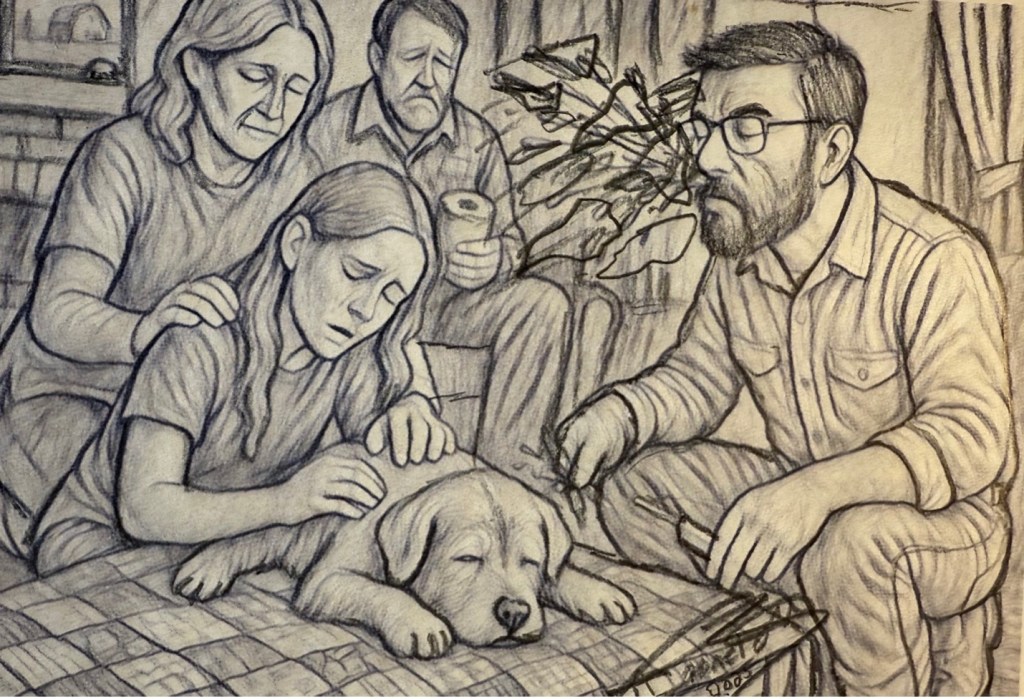
When I arrived, Millie lay on a patchwork quilt in the living room. The air carried the faint scent of lavender and something softer—grief, maybe, or memory. The mother knelt close, stroking Millie’s ears with the kind of tenderness only time can teach. The father stood off to the side, swallowing hard. And the teenage daughter cradled Millie’s head in her lap, her face pale, her eyes fixed on the dog that had always been there.
I gave the sedative first. Then I waited. When they were ready, I knelt to complete the procedure.
And that was when it happened.
Without a word, the daughter leaned forward, overwhelmed, and—suddenly—vomited. Not beside me. Not near me. But squarely onto the right side of my face.
It trickled down the side of face. It was warm. It was immediate. And it was one of the more unforgettable moments in my career.
I stayed steady. I finished the injection with calm hands and soft words. Millie passed quietly, unaware of the chaos that had just unfolded inches away. Her final moment was peaceful, surrounded by the people who had loved her all her life.
Then came the silence.
The mother gasped.
The father sprang into action with a roll of paper towels.
The daughter, mortified, buried her face in her hands. “I’m so sorry,” she whispered through tears. “I didn’t mean to. I didn’t know it was going to happen.”
But I wasn’t upset. Not even close.
Grief isn’t neat. It doesn’t come dressed in black with tidy handkerchiefs. It arrives as it is—raw, unfiltered, and unpredictable. It breaks down barriers and spills out in tears, trembles, and, sometimes, the most undignified forms of emotion.
I wiped my face, offered a reassuring smile, and said what I knew to be true: It’s okay.
Because veterinary medicine isn’t just about the animals. It’s about being present for the people who love them. It’s about showing composure during someone else’s heartbreak. It’s about honoring the bond—even when it plays out messily.
Millie was loved. She left this life wrapped in warmth and memory. And if part of that moment meant I walked away needing a change of clothes, so be it.
The human-animal bond is a powerful thing. It’s loyal and imperfect, wild, and wholehearted. It teaches us how to love, how to let go—and how to stand steady, even when the unexpected shows up in the most unforgettable ways.
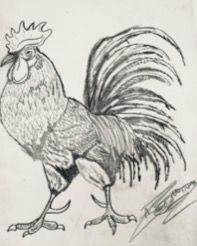
Let me tell you a tale from my younger days, Of a rooster who earned both my fear and my praise. A bantam, no taller than half of a boot, But with swagger and spite in a feathered red suit.
Dad fetched him from a fella down In Carbon County’s dusty town. He came boxed up, all calm and neat, Just cardboard, holes, and cockerel feet.
At first, he seemed gentle, serene as a dove— A fine little fowl you could cuddle and love. But the moment he met his fine harem of hens, Something snapped in that bird—he abandoned all pretense.
Like a match to dry sagebrush, his fury was lit, And the coop turned to chaos the moment he hit. His spurs, curled like scimitars, gleamed in the light— A warrior’s weapons, prepared for a fight.
His tail was a pennant of shimmering flame, And the devil himself might have whispered his name. He detested red clothing—it triggered his wrath, And he’d charge with precision, no mercy, no math.
A blur of intent, a flash from below— And he’d peck at your shins like a foe in a show. His breath, I imagined, was sulfur and smoke, His crow like a curse that the underworld spoke.
He’d launch from the shadows with lightning-quick speed, A poultry torpedo on two little feet. But beneath all the fury and fury alone, There was something uncanny, uniquely his own.
A pride, a defiance, a boldness unshaken— The spirit of something not easily taken. And truth be told—though he left me in pain, Though he bloodied my ankles and scrambled my brain— I still look back fondly on that feathered pest, Who fought like a lion with puffed-out red chest.
So, here’s to dear Chester, that rooster possessed— May he roost up in heaven (or hell if it’s best). For no barnyard’s complete, in this world or the next, Without a small beast who keeps everyone vexed.
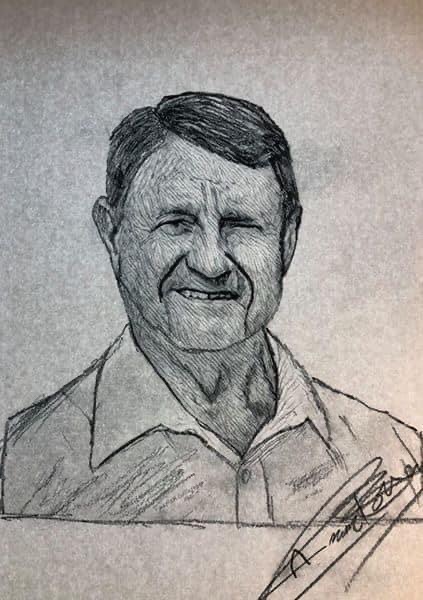
Some people walk into your life like a summer breeze—gentle, unnoticed at first, until you realize the whole atmosphere changed when they arrived. Dr. Rick DeBowes didn’t just step into the veterinary profession—he transformed the terrain.
I first came to know Rick not by him being a professor, but by his presence. He doesn’t lead with credentials (though he holds plenty), nor does he boast of his accomplishments (though they are many). Instead, he listens. He leans in. He notices. He makes you feel like you are the most important person in the room. And in doing so, he lifts the entire room.
Rick is, by any measure, a brilliant surgeon. Board-certified. Professor. Innovator in equine orthopedic care. But it wasn’t a scalpel or textbook that made him a legend—it was vision.
He saw a profession full of gifted, dedicated individuals… burning out.
He saw classrooms filled with future veterinarians… unsure of their own worth.
He saw colleagues hiding pain behind polite smiles.
So, he did something about it.
In 2004, alongside Dr. Kathleen Ruby, Rick founded what would become the Veterinary Leadership Experience (VLE)—a transformative program that flipped the script on veterinary training. Where most conferences offered facts and formulas, VLE offered something rarer: reflection, vulnerability, and the courage to grow not just as a clinician, but as a human being.
At VLE, Rick didn’t just teach leadership. He modeled it. Servant leadership. Quiet strength. Emotional intelligence. He handed out paddles not to steer the boat, but to remind us that we each play a part in moving the profession forward.
I’ve seen Rick comfort students in tears. I’ve seen him speak truth to power with a smile that disarms and a message that cuts to the core. I’ve seen him show up—not just when it’s easy, but when it matters.
For me personally, Rick has been a mentor, a friend, as constant as the North Star. He has faced some of life’s most daunting trials—first with a major heart surgery, and then with an invasive battle against abdominal cancer. Yet through it all, he has stood unwavering, meeting each challenge head-on with a rare blend of courage and calm. Where others might falter, he has shown only grace—patient in pain, steady in uncertainty, and quietly determined to keep moving forward. His resilience has not just carried him through but inspired those of us lucky enough to walk beside him.
He reminds me that greatness in our field isn’t measured by the number of degrees on the wall or initials after a name—but by the people we lift, the teams we build, and the hearts we tend to along the way.
Veterinary medicine needs visionaries. It needs wisdom. But most of all, it needs people like Rick DeBowes—who aren’t afraid to challenge the old ways, to sit with the hurting, and to remind us that leadership isn’t about being in charge. It’s about choosing to care when nobody’s looking.
Thank you, Rick, for helping us become better doctors. And more importantly… better people.
It was colder’n sin on a Tuesday night, Snow blowin’ sideways, not a star in sight. The kind of night where fences snap, And smart folks curl up in a heated nap.
But me? I was slidin’ down a rutted track In a truck that shook like a bad haystack, Headed for a ewe out past Cottonwood Creek Who’d been tryin’ to lamb for near half the week.
Her eyes said trouble, her belly said soon, And I was prayin’ I’d beat the moon. The barn was lit by a single bulb, It had a haunted look — real cold and old.
She was down and sweatin’, flat on her side, One little hoof just pokin’ outside. So I scrubbed up quick and dove right in, Sayin’, “Alright girl, let’s begin.”
Now lambin’s not fancy, it’s wet and wild, You’re part mechanic, part midwife, part child. I fished for a leg, got turned just so, Then gave a pull — real smooth and slow.
Out he flopped like a lump of clay, Soggy and squeaky, but here to stay. He blinked at me with a look that said, “Is this the world? Feels cold and dead.”
But mama, bless her, she took control, Talkin’ to him deep down in her soul. She licked and nudged and huffed and puffed, Got him standin’ — wobbly, but tough.
He found her udder like he’d read a map, Took his first meal with a satisfied nap. And me? I just stood there, cold and soaked, Smellin’ like straw and feelin’ kinda choked.
‘Cause I’ve patched up bulls and doctored cats, Taped up dogs and wrestled lots of brats, But there’s nothin’ that hits like that first breath, That shoves back hard from the edge of death.
So yeah, I drove home through a blizzard’s bite, Heater blowing cold air, truck leanin’ right. But I grinned like a fool in the rearview mirror — ‘Cause life won that round. And I got to steer.
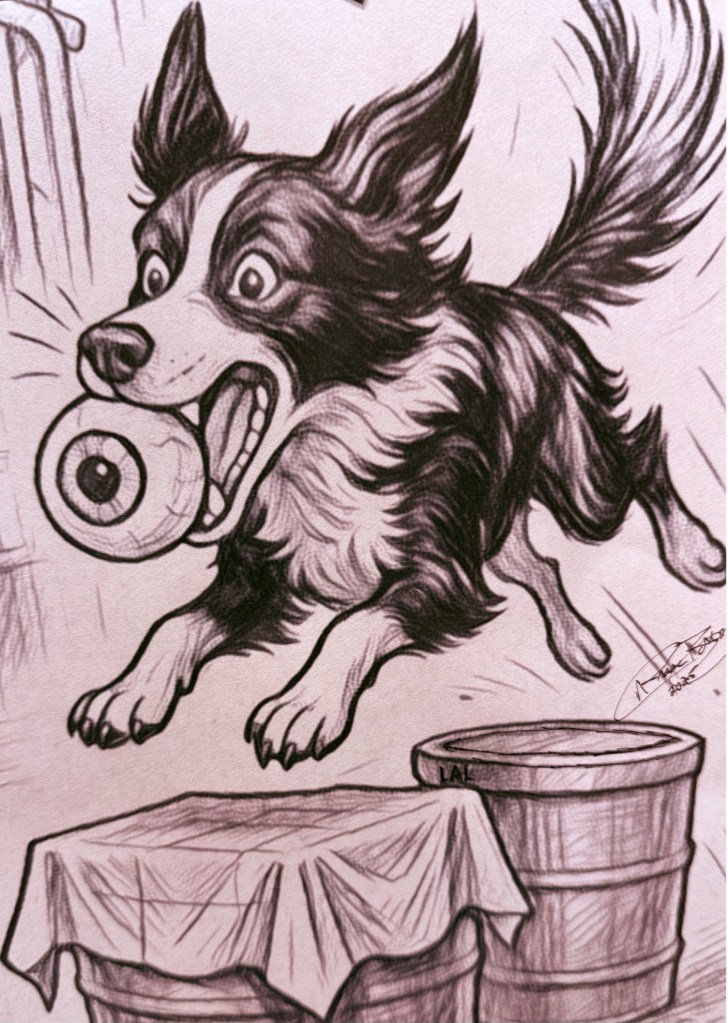
The job was an enucleation—a surgical removal of an eye. Not a terribly uncommon procedure in large animal practice, but still a delicate one. We had the cow safely in a squeeze chute, and I did my best to maintain sterility in a place where “clean” usually just means “hasn’t been actively stepped in today.” I scrubbed up, gloved in, and worked with care. The tumor was extensive, but the removal went smoothly. I gently extracted the diseased globe and placed it on a sterile drape I had thoughtfully spread across two upended barrels.
It looked… professional. Almost elegant, in a gross kind of way.
I turned back to the cow to begin suturing the incision. I had maybe three stitches in when, like a flash of black-and-white lightning, a border collie launched into my surgical field. This dog, who had been loitering at a respectful distance until now, suddenly leapt up, planted himself on top of the barrels, grabbed the freshly removed Hereford eyeball, swallowed it whole, and hit the ground running—all in one smooth, horrifyingly efficient motion.
I blinked. The client blinked. The dog did not blink. Probably because it had just eaten something that used to blink.
“Well,” I said, calmly tying another suture, “I guess we won’t be sending that to pathology.”
The owner started to apologize, but immediately we both started laughing. What else could we do? The eye was gone. The cow was patched up. And the dog—miraculously—suffered no ill effects aside from probably some very strange dreams.
Let it never be said that large animal medicine is boring. Sometimes it’s bloody. Sometimes it’s bovine. And every so often, it’s downright eye-opening.
The snow fell thick in Castle Dale, A hush across the land— And in that frozen morning light, I watched my father stand. He crossed the field, a silent form, With purpose in each tread, And left behind a trail of prints Where lesser feet might dread.
I bundled up and followed him, My legs too short, too slow. But found my way by planting steps In footprints in the snow. Each hollowed-out impression there Was more than just a mark— It carved a path of steadiness Through cold and bitter dark.
My father’s strength was not just bulk, Though strong he surely was— He’d swing a hammer, split a post, Or lift with no applause. One nail, one swing, a room in awe— I watched with wide-eyed grace, And thought the gods of thunder must Have borrowed from his pace.
Yet more than strength, it was his care That built the man I knew. He’d help a neighbor without ask, And never claim the due. A bed for one who had no rest— No sermon, no acclaim— Just quiet acts of kindness done Without the need for fame.
Each child had their yearly camping time— A fire, a tent, a fishing pole. a stream. We’d eat our Pringles by the coals, And talk and laugh and dream. He’d take us where we chose to go, No matter what he faced— And somehow made us each believe That we could not be replaced.
The world is swift, and fathers drift, But mine was like the sun— A constant blaze of quiet good Who showed up, and got things done. No medals line his weathered walls, No speeches praise his name— But every inch of who I am Is stamped with his acclaim.
A statue on his dresser reads What time has made more true: A father is a simple word— A daddy sees you through. And now, as I make prints of mine, In soil, snow, or sand, I find I still am following The footprints of that man.
It was a still summer evening—the kind that gently wraps around your shoulders like a well-worn quilt. The sun, slow and sure, crept behind the mountains west of Emery, Utah, casting its final light across the sky in a hush of gratitude. Crimson melted into orange, orange into violet, and the heavens blushed with color as if remembering something beautiful.
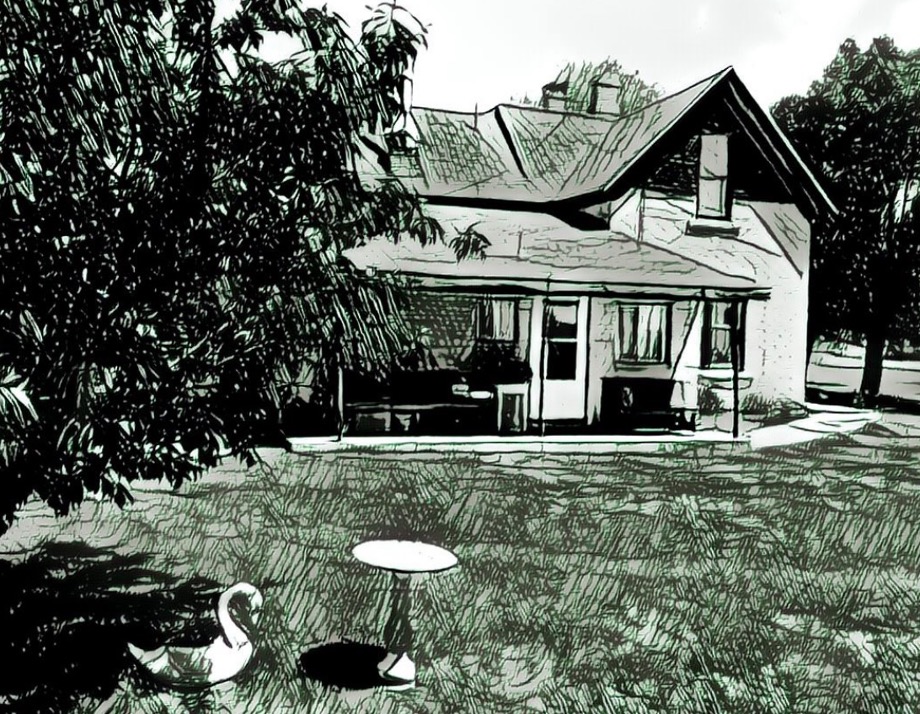
I stood barefoot on the lawn outside the old adobe brick house—my grandparents’ house—on the corner of 200 North and Center Street. The cottonwoods towered above me, their leaves whispering secrets I’ve known since childhood. Their scent—rich, earthy, and sweet—mingled with the breeze, alive with memory.
To the south, the garden still grows in my mind’s eye: corn, cucumbers, zucchini, peas, and potatoes, with bright marigolds planted just so. It wasn’t just a patch of cultivated earth. It was a canvas of care, painted by my grandparents’ hands with quiet diligence and deep affection. The air smelled of soil and cut grass, of salt grass and blue clay, tinged with the trace of baking bread, lilacs by the back fence, and coffee on the stove. These were the smells of Emery. The smells of home.
Just north of town, where Muddy Creek winds its quiet way, lies a hidden oasis—a sacred corner of the earth where my grandfather, Hugh Peterson, once worked the land. That soil knew his boots. That breeze carried his voice. And though he and Grandma Shonna are gone now, I still feel them there—in the hush of the cottonwoods, in the warmth of the bricks, in the very soul of that home.
A single photo—humble and still—can hold so much more than it shows. A stretch of lawn. A front porch. A weathered birdbath and a ceramic swan. But if you look closer, you can see birthday parties and Sunday dinners, afternoon naps, and children catching grasshoppers in the garden. Every element tells a quiet story of love, care, and homegrown charm.
But the true magic began once you stepped inside.
The green shag carpet clung faithfully to the stairs, each tread worn smooth by decades of footfalls—bare feet in summer, stocking feet in winter, little feet bounding upward in search of cousins and comfort. The walls, painted and paneled, held the warmth of years gone by. In the kitchen, a calendar held notes written in my grandmother’s steady hand, her script as familiar to me as the sound of her voice. Every family member’s birthday and anniversary were handwritten.
Upstairs, the bedrooms waited in gentle stillness. A bed made with floral sheets and hand-stitched quilts. A cedar chest stacked with books and records. Pictures lined the walls of the bedrooms and staircase. The scent of linen and wood and time. It was a room filled with softness, where silence felt like comfort and love rested in every fold of the blanket.
And then there was the living room – drenched in golden sunlight, filtered through lace curtains that swayed with even the slightest breeze. The rust-orange carpet was bold and unapologetic, layered with the footsteps and laughter of decades. The furniture—perfectly mismatched—held stories of its own. The leopard-print armrests on grandma’s chair, handmade afghans, a sunflower pillow, a golden rocking chair with sunken cushions. A wooden clock ticked gently on the wall. The television, rarely watched, sat below framed portraits, porcelain figurines, and plaques bearing quiet declarations of faith. It wasn’t décor. It was devotion.
This house, this corner of Emery, was my Eden.
It was not fancy, but it was full—of sacrifice and sweetness, of sweet rolls and Saturday chores, of country music on a dusty AM radio, of Grandpa’s humor and wisdom and Grandma’s radiant kindness. The house had a heartbeat. You could feel it in the hush of the morning, in the creak of a step, in the hum of the Stokermatic furnace, and in the warmth of the people who made it home.
Even now, years later, if I feel worn down or a little lost, I return here—not in person, more often in memory. I climb those stairs in my mind. I walk barefoot across the rug. I stand again in the living room’s golden light, and for a moment, I am whole.
This home taught me how to love. How to slow down. How to belong.
If you ever need to remember what really matters, take a quiet drive through Emery, Utah. Stop at the corner of 200 North and Center Street. Stand beneath the cottonwoods. Let the wind carry their voices. Step onto the porch. Listen closely.
You’ll know what I mean.
Because love never leaves the place it made its home.
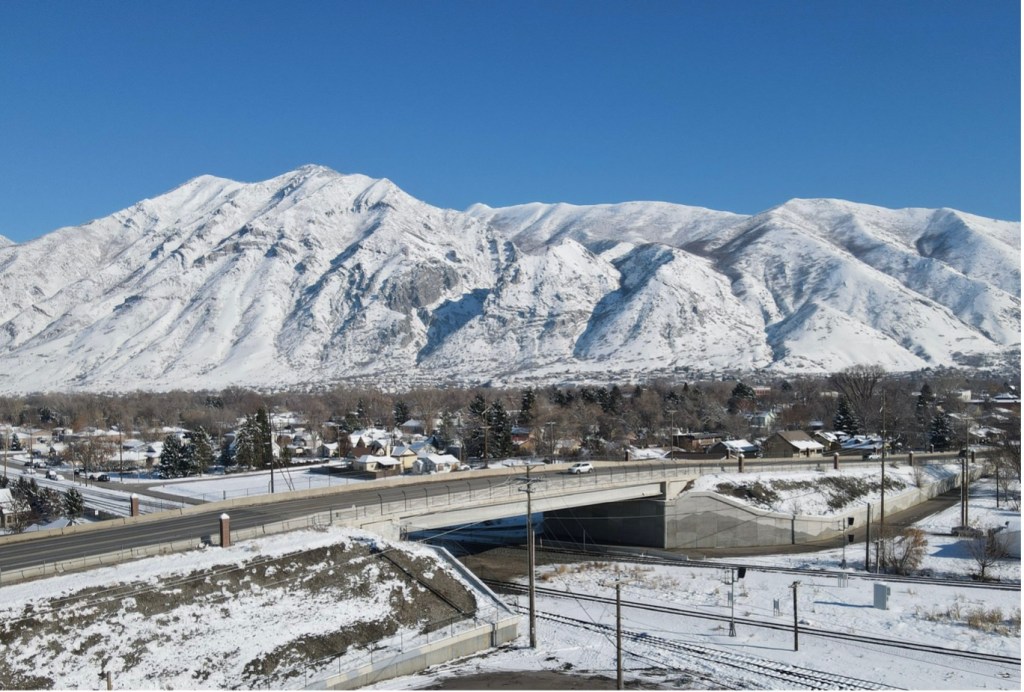
Just south of Salt Lake, a stone’s gentle throw, Past orchards and valleys where spring breezes blow, Nestled up tight ‘neath the Wasatch’s rise, Sits a town brushed with color and framed by blue skies.
They call it “Art City”—a fitting old name, Where murals and galleries shimmer with fame. But art here’s not trapped behind velvet and glass— It’s felt in the sunsets and smelled in the grass.
The foothills lean near like an old friend’s embrace. Trails like Hobblecreek Canyon will quicken your pace. Climb up its ridges where bold eagles fly, And taste heaven’s hush ‘neath a high-alpine sky.
Fifth Water awaits with a sulfur-kissed breeze, Where warm pools steam softly among mossy trees. Through Diamond Fork Canyon the turquoise streams glide, With waterfalls spilling where still dreams reside.
Just west lies Utah Lake’s shimmering span— A fisherman’s morning, a sunbather’s tan. Take out a kayak and paddle the bay, Or just let the breeze steal your burdens away.
The museum holds stories from far and from near, Native Americans, cowboys, and visions sincere. Utah’s own brushstrokes hang proud on the wall— A mirror of people, both the humble and tall.
When twilight creeps in with its lavender hue, And headlights dance soft on the roads winding through, You’ll smell something savory, hear laughter and song— At Strap Tank they’re pouring, and you might stay too long.
Main Street meanders like pages well worn, With galleries, diners, and boots slightly torn. If on a Wednesday you’re down this way, Don’t miss Magleby’s all-you-can-eat buffet.
La Casita—over forty years on Main has stood, Built on beans, tacos, and brotherhood. With calloused hands and a dear friend’s grace, The Muzquiz name still warms the place.
So, if you’re just passing or seeking to roam, There’s more than a postcard to take back home. For here, in this valley where art meets the land, Is a place built by heart, by soul, and by hand.
Of all the days I hold most dear, One rises bright and warm and clear. No spring bloom, nor harvest moon— Can touch the light of the sixth of June.
For that’s the day the world first knew The spark of light God placed in you. With tiny hands and fragile frame, You came to us—and life became.
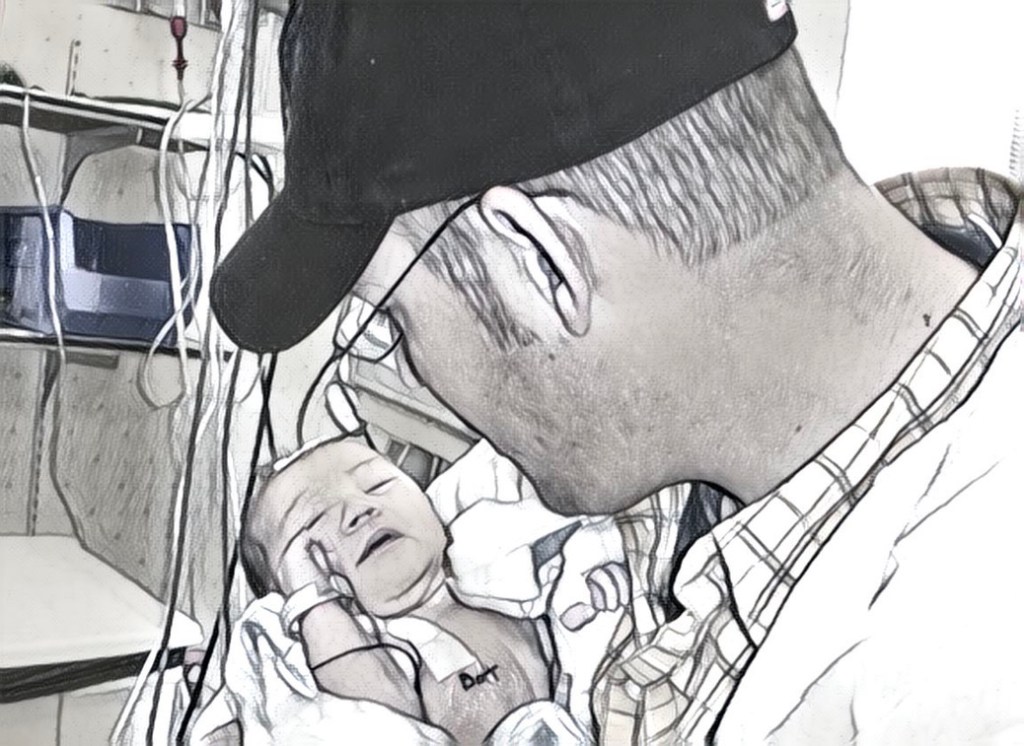
That morning, joy and fear entwined— Your heartbeat small, your soul divine. Wires and tape, a NICU bed, Yet still you shone. Still tears were shed.
I held you close—your breath, your skin— And felt a fire start within. A father’s love, both fierce and new, A vow unspoken: I’ll fight for you.
Each night I sang a cowboy tune, A lullaby beneath the moon. “Daily Bread” became our song, Of love that lasts your whole life long.
And now you rise—so strong, so bright— A daughter, sister, beacon light. You face the world with open hands, A heart that loves, a soul that stands.
You’ve weathered storms, and still you smile, With faith that stretches every mile. You lift, you serve, you give your best— Now, you’ve left the nest, but not my chest.
So go, dear Kaycee, shine and roam, And make the hearts of strangers home. I’ll cheer you on, though skies may gray— My thoughts will follow you every day.
For twenty years I’ve watched you grow, From NICU lights to sunsets’ glow. The years have flown, but still I swoon— For I love, most of all, the sixth of June.


 DocBott