My Take Tuesday: Christmas
Growing up my family had some wonderful christmas traditions. I vividly remember each Christmas. I particularly remember the activities we had on Christmas Eve and Christmas Day each year.
Santa Claus will not leave any presents if you are awake when he comes. Each of us knew that for certain, yet the natural curiosity and excitement of Christmas made it difficult for us to fall asleep.
My dad was aware of this, and each Christmas Eve he would take us out for an activity to wear us out physically in the hopes that it would help us sleep soundly that evening. I remember each Christmas Eve we would go on hikes in the nearby hills or we would play a competitive game of basketball. Our endless energy would be spent, in part on these activities.
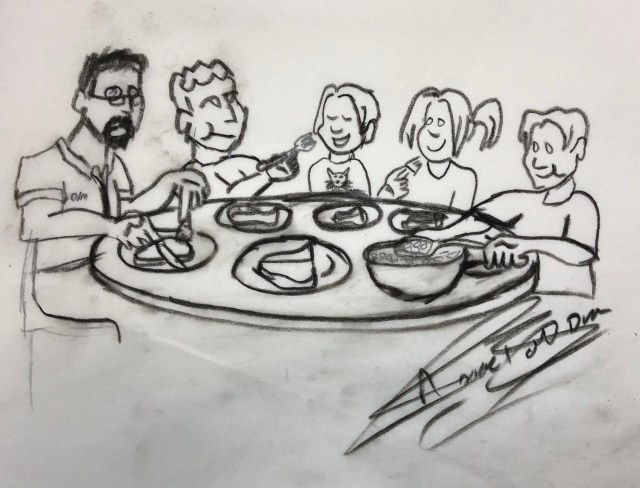
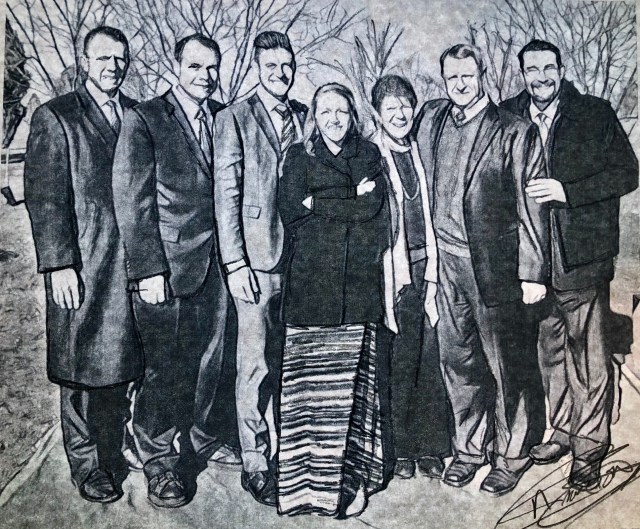
After the Christmas Eve activities, we would have a Bott family Christmas party. My fondest memories of this happened at my parents house. Uncle Chris and Aunt Diane would bring their kids. Jeannie, Jerry and Jeffry would also always come. We would laugh and sing and would have a wonderful meal. The highlight of the night was always opening White Elephant gifts. The gifts were classic gag gifts and were absolutely hilarious. Many gifts made yearly returns to the exchange. One would learn to decipher the weight and size of packages to avoid receiving these gifts. I remember in high school I had to work one Christmas Eve. I was so sad to have to miss the family party. I remember longing to be with my family on that particular Christmas Eve.
Christmas morning began early. My siblings and I were well accustomed to waking up at 5 AM to feed the animals and milk the cows. Sleeping in on Christmas just didn’t make much sense. We would wait in our bedrooms until dad came to lead us out. He would cover our eyes and lead us to the other side of the dark living room. Once we were all together, Mom and Dad would turn the lights on. We each had a spot for our presents. We would rush to these locations. We were allowed to only ask for 3 things for christmas, and we would first look for those items we wanted so badly.
Following this, we would head across the street to feed the animals and milk the cows. Even on Christmas this task was necessary. We would complete it as fast as possible, for the day was just beginning.
Upon returning to the house, we would eat breakfast. I remember Egg Nog always being there. We would also have fresh oranges and cereal.
In today’s skeptical fast-paced world, our busy lives often keep us from enjoying the simplest of life’s pleasures. One of my favorite Christmas traditions is to read an old newspaper entry that was written more than a century ago.
Eight-year-old Virginia O’Hanlon wrote a letter to the editor of New York’s Sun in 1897, asking the direct question, “Please tell me the truth; is there a Santa Claus?”
The response by Francis Pharcellus Church has since become history’s most reprinted newspaper editorial:
“VIRGINIA, your little friends are wrong. They have been affected by the skepticism of a skeptical age. They do not believe except they see. They think that nothing can be which is not comprehensible by their little minds. All minds, Virginia, whether they be men’s or children’s, are little. In this great universe of ours man is a mere insect, an ant, in his intellect, as compared with the boundless world about him, as measured by the intelligence capable of grasping the whole of truth and knowledge.
Yes, VIRGINIA, there is a Santa Claus. He exists as certainly as love and generosity and devotion exist, and you know that they abound and give to your life its highest beauty and joy. Alas! how dreary would be the world if there were no Santa Claus. It would be as dreary as if there were no VIRGINIAS. There would be no childlike faith then, no poetry, no romance to make tolerable this existence. We should have no enjoyment, except in sense and sight. The eternal light with which childhood fills the world would be extinguished.
Not believe in Santa Claus! You might get your papa to hire men to watch in all the chimneys on Christmas Eve to catch Santa Claus, but even if they did not see Santa Claus coming down, what would that prove? Nobody sees Santa Claus, but that is no sign that there is no Santa Claus. The most real things in the world are those that neither children nor men can see. Nobody can conceive or imagine all the wonders there are unseen and unseeable in the world.
You may tear apart the baby’s rattle and see what makes the noise inside, but there is a veil covering the unseen world which not the strongest man, nor even the united strength of all the strongest men that ever lived, could tear apart. Only faith, fancy, poetry, love, romance, can push aside that curtain and view and picture the supernal beauty and glory beyond. Is it all real? Ah, VIRGINIA, in all this world there is nothing else real and abiding.
No Santa Claus! Thank God! He lives, and he lives forever. A thousand years from now, Virginia, nay, ten times ten thousand years from now, he will continue to make glad the heart of childhood.”
May each of us take a moment to enjoy the simple things today. As long as there is a sunset, there will be always be moments of joy and gladness for each of us.
I recollect with fondness the traditions my family shared. The presents are gone. The shoes and clothes are all worn out, but the memories remain. The true meaning of Christmas is, after all, about love. Our Christmases were centered around family. We were together. How grateful I am for that. A quick trip down memory lane rapidly brings back the joy and love we felt each christmas while growing up in Castle Dale.
And that is my take!
N. Isaac Bott, DVM



 My Take Tuesday: Why Reindeer?