The Parsimonious Pyometra

FullSizeRender 62

My Take Tuesday: The Parsimonious Pyometra

Apart from preventing unwanted pregnancy, routine spaying of female dogs has been historically recommended for two reasons: 1) Reduce the incidence of mammary cancer, and 2) Prevent the female from developing pyometra later in life. This is caused by a bacterial infection of the uterus resulting in a potentially fatal infection.

The word pyometra can be divided into two root words: Pyo meaning pus and Metra referring to the uterus. A pyometra starts after a dog goes through a heat cycle, usually within about 2 to 5 weeks. A pyometra develops due to repeated prolonged exposure of the estrogen-primed uterus to progesterone (estrogen increases the number of progesterone receptors in the endometrium). Female dogs are prone to uterine disease due to the unique nature of cycling in this species. As infection develops in the uterus, the uterus fills with pus. The most common bacteria isolated in these cases is E coli. The uterus with a pyometra can be huge! I have surgically removed an infected uterus weighing over 11 pounds from a 56 pound Golden Retriever.

The clinical signs associated with this disease are anorexia, depression, drinking and urinating more frequently, abdominal distention, and sometimes a vaginal discharge is noted. Vomiting and diarrhea may also be present, especially late in the course of the disease. If any of these clinical signs are noted in your pet – immediate veterinary consultation is imperative.

Females that develop pyometra have an underlying condition called cystic endometrial hyperplasia. Most intact females older than 5-6 years have some degree of this. The vast majority of cases are treated by removing the infected uterus and ovaries. This surgery is very difficult and much more expensive than a traditional spay. There are many more post-operative complications that may arise that are not associated with a routine spay.

These include:

Peritonitis – infection of the abdomen

Disseminated intravascular coagulation – a clotting disorder that is often fatal

Sepsis – occurs when chemicals released in the bloodstream to fight an infection trigger inflammation throughout the body. This can cause a cascade of changes that damage multiple organ systems, leading them to fail, sometimes even resulting in death.

It is simple to avoid this. Females not intended for breeding should be spayed at a young age. Females used for breeding should be closely monitored by both the owner and the veterinarian.

If you are hesitant to spay your pet because of the cost of the routine surgery, you must consider the cost of an emergency pyometra surgery also. Such a surgery is at least 3-5 times higher than what a routine spay would be.

At Mountain West Animal Hospital, we discuss both the benefits and detriments of routine spays and neuters and strive to help you make the best decision for the health and well-being of your individual pet. You can count on us as a trusted partner in the care of your four legged family member.

And that is my take.

N. Isaac Bott, DVM
Doc, whatever she has, I’ve got the same thing too!

FullSizeRender-3


My Take Tuesday: “Doc, whatever she has, I’ve got the same thing too!”

Animals and people dictate what happens every day for me. Simple routine appointments can turn out to be complex once the unpredictable yet potent potion of human personality is added to the mix.

A few months back an elderly woman came in to the clinic. Her cat had been suffering for weeks with non-stop itching. As I examined the cat I noticed that this itch was insatiable. The poor cat had scratched and irritated nearly every inch of its body in an effort to satisfy the intense itch. The scratching was so intense, that nearly her entire body was covered with bleeding sores.

A diagnosis of mites was made after taking a skin scrape and looking at it under a microscope. This particular mite is elusive and difficult to find even for the most experienced veterinary dermatologists. However, it is highly contagious.

As I began speaking with the owner about the severity of the diagnosis and the need for immediate treatment, I could tell that her mind was wandering. She was clearly not focusing on what I was saying. I politely asked if I had said something that did not make sense or if she had any questions. Often, the open ended questions will allow a client to discuss their concerns, however, I was not prepared for what happened next.

“Doc, do you think I have what she has?”, her voice was inquisitive. “Excuse me?”, I replied, “What do you mean?” Before I could say another word, this elderly woman dropped her pants. Literally right to the floor. Her legs were covered in large red lesions. They actually looked like checker boards. I learned that day, albeit involuntarily, what “granny panties” look like.

I am easily embarrassed, and when this happens my face turns a deep red. I stammered, “I…. I’m… a… I am sorry ma’am, you will have to go to your doctor for that”. The beet-red shade on my face persisted even after I exited the room.

As crazy as this may seem, I have had worse things happen while going about my daily appointments. However, those are saved for another My Take Tuesday.

My job is never boring. The two legged creatures that come in keep it from ever being so.

And that is my take.

N. Isaac Bott, DVM
My First Surgery


My Take Tuesday: My First Surgery

I was raised on a small farm in Castle Dale, UT. We raised Guernsey milk cows, Suffolk sheep and many varieties of chickens and pheasants. My daily chores included feeding the chickens and gathering the eggs.

One day after school, I walked into the barn that housed the chickens. The barn was divided into three equal rooms. The first room is where we would store stacked straw bales. The second and third rooms were where the chickens and pheasants were kept.

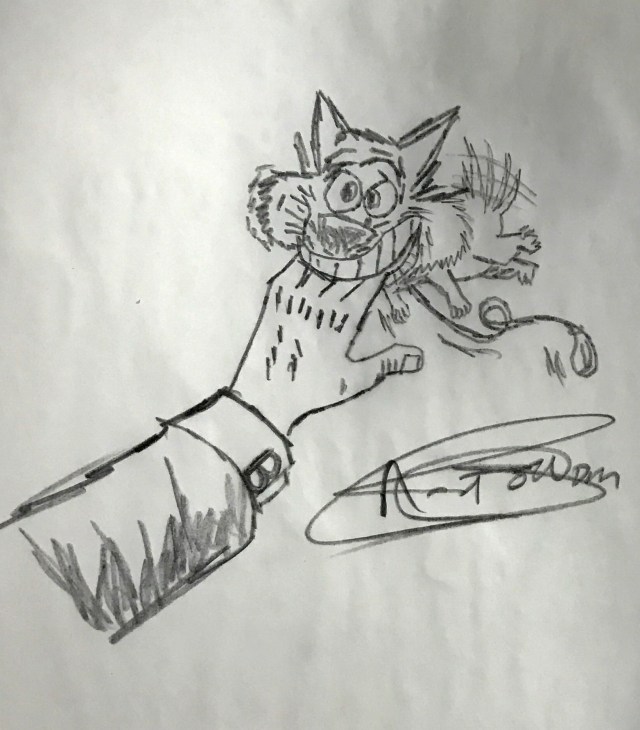
On this particular day, I found our calico cat nestled with her newborn kittens. She was lying right next to the straw stack, on the ground near the chicken coop door. There were seven in all. As an 8 year old, and still to this day, new babies of any kind are an exciting experience. I dropped down and began counting the tiny kittens. I was so thrilled! As I handled the small kittens, I noticed that something wasn’t quite right. The umbilical cord from one of kittens was wrapped tightly around a leg of each of the kittens. If I picked one kitten up, the entire litter would follow as if they were chained together. I tried to remove the cord with my fingers, but it was far too tight. Even as a little kid, I knew that something had to be done.

In Castle Dale at this time, we did not have a veterinarian. The only veterinary services available were on Thursdays when a veterinarian would travel from Richfield. It was early afternoon, so my dad was not going to be home from work for a couple of hours. I had to figure something out for myself.

I reached in my pocket and pulled out my Swiss Army knife. It was one that had a myriad of blades, nearly all of them never used, and a tooth pick and small set of tweezers in the handle. I opened the smallest cutting blade and bent down. I very carefully cut the umbilical cords from each of the kittens. I used some iodine to keep the procedure as clean as possible.

The procedure was a success. All of the kittens survived.

Fortunately, I no longer use my Swiss Army knife for surgeries. Although my surgical skills have been refined and perfected, I still have the curiosity and passion that that 8 year old displayed. I love being a veterinarian. The satisfaction I felt that day long ago is repeated every time I am able to help save a life.

I look back on my first surgical experience with fondness. It was one of the important milestones in my path to becoming who I am today.

And that is my take!

N. Isaac Bott, DVM

Pictured is Dr. Bott with kittens in 1988

The Red Handkerchief

My Take Tuesday: The Red Handkerchief

As a veterinarian, I all to often find myself in precarious situations.

Upon graduating from veterinary school in 2009, I moved back home here to Utah. My first job out of school was right here in Utah County.

It was not unusual for me to be called to attend a dozen or more lame and injured cows on a particular day. You might arrive to find them in a paddock with no sorting pen and therefore no means of restraining them for treatment. What are you going to do? Unfortunately, farmers often have the attitude that you’re the vet, they’ve called you out to do the job, so they expect you just to get to it. Often these cattle facilities left much to be desired. A few broken palates, some bent powder river panels and a welded together squeeze chute constitute pretty decent working conditions.

Usually some unsatisfactory compromise could be sorted out which would reinforce the fact that you were not half as good as their old vets.

Max was no exception. He stool 6’1″ and was as skinny as a bean pole. He always had a runny, drizzly nose, and he kept a red handkerchief in the front pocket of his bib overalls. Max didn’t want a new young vet working on his cows. He was used to the old school way, and had no reason to change.

I was greeted on one of these farm visits by this familiar refrain: “We used to use old Doc SoandSo. Have you heard of him? Best dairy vet in the county. Of course, you’re new and not used to dealing with dairy cows down here are you?”

Perhaps I am unduly sensitive, but being told you’re second best before you’ve even begun is either irritating or depressing—depending on how your day has been. This day tipped more toward the irritating side.

Suzy was the name of his milk cow. She was a tall Holstein crossbreed cow. On this particular day, Miss Suzy stood in the knee deep pasture staring at us as we entered the field. She was swollen up like an engorged wood tick. The left side her stomach protruding so far that she was as wide as she was long. The diagnosis, even from afar was obvious. She was bloated.

Bloat is a digestive disorder characterized by an accumulation of gas in the first two compartments of a ruminant’s stomach (the rumen and reticulum). Production of gas (primarily carbon dioxide and methane) is a normal result of fermentation processes. The gas is usually discharged by belching (erutication) but, if the animal is unable to remove the excess gas, pressure builds up in the rumen-reticulum exerting pressure on the diaphragm which prevents the animal from inhaling, and bloat occurs. The most common type of bloat is frothy bloat where gas builds up in a foam or froth above the rumen contents and the normal belching is inhibited.

Imagine a 40 gallon tub of partially digested green stomach contents. The pressure of this stomach is such that when it is alleviated, it is similar to popping a balloon, this disgusting smelly concoction will spew in a fashion similar to the Old Faithful Geyser.

Before we could even isolate her in the corner to begin treatment, Max decided he needed to blow his nose. As he pulled out his bright red handkerchief, he flipped it with his wrist and positioned it to evacuate his proboscis. Suzy caught sight of this red temptation and came charging full speed – like a freight train – straight for us. She was bellowing and blowing snot in a fit of rage.

In a situation like this, it doesn’t matter how quick you are. The only relevant assessment of speed is how fast you are in relation to the other person in the pasture. I figured I could beat Max to the gate, but would feel guilty in so doing.

I braced myself for the impact. Max yelled, “Hey Now!”

Suzy collapsed just steps before she reached us. The massive pressure caused by the bloat had cut off her air supply. She lay in a heap in front of us.

The treatment for bloat in a case like this is to relieve the pressure as fast as possible. An incision in made through the left side of the abdomen and the rumen is decompressed. In a situation like this, you only have a few seconds to act. My surgical instruments were in my tool box over by the gate. I knew there wasn’t time to retrieve them.

I reached in my pocket and pulled out my Old Timer pocket knife. I made a quick incision with the sharp point. Immediately, air began spewing out. It sounded like removing a valve stem from a car tire. It whistled as the massive stomach returned to normal size. Shortly thereafter, Miss Suzy was back on her feet and back to her normal self.

As I prepared to leave, Max commented, “Hey Doc, I guess you are alright after all.”

Max then pulled out the red handkerchief and blew his nose as he inquired, “How much do I owe you?”

And that is my take!

N. Isaac Bott, DVM

Baby Chicks

IMG_6221


My Take Tuesday: Baby Chicks

I love springtime in Utah County! The grass is leaving behind its dormant brown state and turning dark green, the flowers are blooming as if to welcome the longer days and the beautiful season filled with the sound of birds chirping and new life coming into the world. I love baby animals! From lambs to foals, from reindeer calves to baby chicks, Spring is filled with hope for the future.

I recall days long ago in Castle Dale, UT. While growing up, we would receive day old chicks during the third week of April. I would await this day with all of the excitement a small child could muster.

In the basement of my parents house, my dad made a make shift brooder. This was made of a large cardboard box lined with newspaper and a heat lamp placed at just the right height to provide the needed warmth for the freshly hatched chicks. They would crowd around the light bulb and nestle tightly together as they slept. There was a constant chorus of peeping.

In a sense, I was a student as I sat and watched the starlings each morning. I learned through deliberate, diligent observation. I faithfully fed and watered the hatchlings each morning and night. I carefully placed fresh newspaper in the box with each feeding. I closely observed how they would eat selectively, picking out shiny pieces of corn before consuming the finely ground mash. As they drank, they would take just a few drops in their mouth and then lift their head upwards, pointing their beaks, and would swallow each drop of water. I learned how to tell if a chick was ill or otherwise isolated, and I would tend to these with as much care as possible. I remember crying as some of the chicks didn’t make it. These experiences were my first real exposure to the frailty of life and the sting of death.

As the chicks grew and matured, I was allowed to go to the chicken coop to collect eggs. One by one, I set them in my basket, the brightest white with the deepest red, the palest green alongside the softest brown.

When I was a child, I frequently dreamed that I could fly. It felt so natural to come down the stairs as if on wings, swooping out the door, joining the wild birds and eagles that soar above Castle Valley. In one dream, I coasted over our chicken coop, and peered through windows of protective wire. I saw the hens, the roosters, the pheasants and the chukars all waking and stretching their wings, as if they wanted to fly alongside me.  I woke up grounded, wishing the freedom of flight could be as easy for me.

I find that in today’s chaotic world, the simplest things are forgotten and over looked. The beauty of a sunrise, the fresh dew on a summer’s morning, the sound of a mountain creek, and the clean smell in the air after it rains: these simple things are there constantly, but we have to take the time out of our busy lives for deliberate and diligent observation. No matter our circumstances, no matter our challenges or trials, there is something each day to embrace and cherish.

Often, our mind conflates the world and our own interpretation of it without much thought. We simply assume that the way we see is the way it is. And once that way is verbalized, put into specific words with specific meanings, it becomes all the more difficult to parse. The challenge, is to recognize and appreciate all of the little moments of joy that come along and to enjoy this unpredictable journey of life.

When I am faced with a problem or challenge, I try to approach it like a young observant child. After all, the world never stops teaching us if we have the humility of a beginner’s mind and the generosity to share it with others. This is all we need to do.

Everything else is inconsequential.

And that is my take!

N. Isaac Bott, DVM

The Most Difficult Part of My Job

18301672_814794602018449_551480192654118401_n


My Take Tuesday: The Most Difficult Part of My Job

Death and dying are uncomfortable subjects. For some, it stirs up painful memories of past losses. For others, it is a reminder of our mortality or the mortality of those we love.

As I tend to the animals in my care, I will lose patients to death despite my best efforts. Often at these times, I am exposed to the emotions of the families who have loved them. For some, there are dramatic outbursts; for others, emotions will be put on hold for private moments.

As different as people are, so are their reactions. No right or wrong. I always try to respect and accept the fact that we all grieve and express grief in our own way and in our own time, and I try my best to be there to support my clients through this most difficult time.

I have to deal with death on a daily basis. Many of these are pets that need to be euthanized. It is among the most difficult aspects of my job. I see the sadness in family members eyes when they have to say good bye to their family member. I often tear up when the strong bond between the family and pet is obvious.

I cannot feel their pain. I did not have the years of interaction with their family member. I didn’t see the unique personality they are talking about. I only have treated this pet on a few occasions and our interactions usually lasted only a few minutes.

What I can show is empathy. My professional familiarity with death means I also know a great deal about grief — my own, of course, and also that of the families whose pets I have looked after throughout their lives.

Dealing with this on a daily basis for many years is difficult. Many veterinarians suffer from severe burnout and fatigue, and sadly a 4x higher suicide rate when compared to the general public.

Veterinarians encounter death frequently, along with some moral issues human doctors never face. Consider the client I need to counsel and help to choose between a costly operation for their pet or paying their mortgage — or worse, a beloved patient I operate on who, despite good care, still dies. Or another case where horrific animal abuse is evident.

When these stresses combine with long working hours and on-call pressures, it’s easy to see how anyone could melt down.

I try to hard to focus on the goodness of people who save animals, instead of the evil of those who hurt them. This helps tremendously. I count myself so fortunate to have the clients that I do. They are loyal and caring. They are kind. I take the trust they have in me very seriously and I do my best every day to be the very best veterinarian I can be.

The loss of a pet should not be taken lightly and it is not something most people get over quickly or easily – although many may think there is a social stigma not to grieve for animals as we do for humans. The fact is that the bond that is formed between people and their pets is in many cases even stronger than some of the bonds between people.

Although I do not fully understand the love you have for your pet, I do care about your feelings and try my best to show this with each interaction I have. This is particularly true when dealing with these difficult end of life decisions. If you have had to go trough this, my heart aches for you.

Losing a pet is tough. I mourn your loss.

I also strongly believe that the bond between human and animal continues, across the rainbow bridge, between this life and the next.

And That is My Take
N. Isaac Bott, DVM

Skunked

29571374_994766220687952_1159440274495842689_n

My Take Tuesday: Skunked

A couple of weeks ago, a Boy Scout troop stopped by the clinic at the end of the day for a tour. As I showed them around and answered their questions, I couldn’t help but reminisce about my time as a boy scout.

The year was 1995.

Boy scout troop 306 of the Castle Dale 1st Ward embarked on a week long 50 mile hike during the month of July. The hike began on a Monday at Ferron reservoir and ended on Saturday at Indian Creek Campground in the beautiful Manti Lasal National Forest.

As a 14 year old kid, I was just like most of the other boys in my troop: wholly naive and completely unaware of my ignorance. My sense of adventure far outweighed sound logic and I was prone to encounter trouble because of my mischievous nature. My little brother Caleb and my best friend Zac were my partners in crime and were witnesses to myriads of situations that shaped our imaginative Boy Scout days working on merit badges, monthly camp outs and high adventure events that eventually led to each of us earning ours the rank Eagle Scout. These experiences consequently helped make us into the men we are today.

On the second night of this long hike, we made camp at a place called Cove Lake. This beautiful lake is just a few miles from the scenic skyline drive and is nestled in a large grove of Douglas Fir and Ponderosa pines.

As Boy Scouts do, we set out to set up camp and explore the lake. We soon found out that we were not the only species inhabiting the camp on this particular night. We shared the campsite with one of the most widely distributed mammals in North America, Mephitis mephitis, or the common stripped skunk. The fecund creatures were everywhere. As we floated around the lake on a makeshift raft, we could see dozens of them around the waters edge.

We clearly had a dilemma. Almost immediately, the skunks began ransacking our tents and food supply. These smelly stripped critters were endlessly curious about the bipedal invasive species that had entered their territory.

Passive in nature, skunks will avoid contact with humans and domestic animals; however, when challenged they are amply prepared to protect themselves.
If a skunk feels threatened, it will give a warning which includes hissing, stomping of feet, and elevation of the tail. Failure to heed the warning signs will result in the unlucky aggressor being sprayed with the skunk’s anal gland secretions. Skunks are highly accurate in their aim and can spray 7 to 15 feet away!

A dozen rambunctious boys were immediately perceived as a threat by the striped beast. They seemed to coordinate the invasion of the camp, approaching from all directions.

A scout watching the skunk rodeo spoke to me, “Hey Isaac, if you hold a skunk by its tail it can’t spray you.”

The notion had some truthiness to it, after all, if it can’t plant its feet it likely wouldn’t be able to empty its scent glands.

Without any further thought, I reached out and grabbed the nearest skunk by the tail. I lifted it directly in the air and held it suspended with my arms straight out.

The little guy simply twirled slightly and lined his backside to my face and fiercely sprayed with all that he had.

It went directly in my mouth and up my nose. It covered my entire face and some even got in my eyes.

I immediately began vomiting uncontrollably. By eyes burned and my vision became blurry.

What a lesson! Take my word for it, a skunk can certainly spray when it’s feet aren’t off the ground. This equivocated logic is dangerous.

As Mark Twain once observed, “It ain’t what you don’t know that gets you into trouble. It’s what you know for sure that just ain’t so.”

The odeur fetide that I experienced is actually a thick, volatile, oily liquid that obtains its pungency from sulfur-based thiols. There in nothing that smells worse than skunk spray inside your nose!

It took weeks before I stopped smelling skunk.

Frantically, I raided the food tent in search of cans of tomato juice. I found 8 cans and a can opener. I then took a tomato shower. I scrubbed my head in it, my whole body was covered in tomatoes. You haven’t lived until you take a shower in tomato sauce.

The rest of the week proved to be much less adventurous. I was forced to sleep in my own tent and I walked behind everyone else along the trails.

Now when I see a skunk, I give it plenty of space. And I tell everyone that I can that contrary to popular myth, a skunk can spray even when being held off the ground by its tail!

And that is my take!

N. Isaac Bott, DVM

Up A Tree

IMG_9088

My Take Tuesday: Up A Tree

In the early spring, when the ice and snow begin to disappear, most of the fields in Utah County are a muddy disgusting mess. A farmer would be wise to avoid calving their cattle during this time. A clean environment required for calving is impossible to find in a swampy, muddy field.

Dwane is not a typical farmer. To him, this is the perfect time of year for calving. His solution to the muddy disgusting mess in his pasture was simple: A four wheeler.

Each morning he would ride around the cow pasture to check on his pregnant stock. On this particular day, had spotted one cow calving and could see the infant’s nose and one foot exposed. Circumstances such as this require help from DocBott.

“Hey Doc, I need some help with one of my cows,” Dwane stated matter-of-factly, “She is kind of a wild one, so I don’t dare work on her by myself.”

I know better than to get myself into a situation like this. There is no way it can end well. Unfortunately, as it often goes, I gave in and headed towards Dwane’s place in Palmyra.

Dwane sat, on his Honda four wheeler at the gate. Every inch of the machine was covered in dark brown mud. As I looked into the field, I could see a few cows standing literally knee deep in mud.

“What a mess!”, I exclaimed, “Dwane, you really need to get a barn if you are going to calve out this time of year.”

“Yeah, I know,” he replied, “But you know how beef prices are this year.”

He did have a point, unpredictable and forceful influences that have negligible affect on most businesses, can dramatically alter the beef industry. From changing product demand, rising input costs and market fluctuations, to weather patterns and even consumer nutrition and lifestyle trends, farmers and ranchers must balance a long list of variables in order to be successful. The beef industry is not for the faint of heart.

“Where is she?,” I asked.

“Hop on, Doc, I will take you to her”

Out in the center of the field, along side a large cottonwood tree, the big Angus cow was comfortably sitting. As we approached her on the four wheeler, the wide eyed cow jumped up on her feet. Almost instantly, out popped the calf.

“Wow!” Dwane explained, that was easier than I thought it would be.

“It sure was,” I replied.

We should have just kept driving on the four wheeler at this point. The mother and newborn were both apparently healthy. There was no reason to stay, except that Dwane felt this was an opportune time to put a tag in the calf’s ear while we were near.

We dismounted and quietly approached the new born calf. Dwane reached down and quickly placed the tag in the left ear of the calf. The small calf let out a quiet but deliberate “moooooo”.

No sooner had the calf opened its mouth, the cow charged. She hit Dwane squarely in the chest. He immediately flew backwards towards the tree. He quickly jumped up and raced behind the tree, trying to use its massive trunk as a shield from the raging bovine.

I raced behind the tree as she bellowed and snorted. I looked at Dwane and he looked at me. We both knew there was only one way out – and that was up! We both climbed as fast as we could. Our mud covered rubber boots slid as we tried to climb the massive tree.

A large low hanging branch provided support as we held on and climbed on top of the life saving perch.

“Are you ok?” I asked

“Yeah,” Dwane replied between gasps, “I thought we were both dead!”

“Me too!” I agreed.

Fortunately, we have cell phones in today’s world, if not for that, Dwane and I would have had to stay in the tree for who knows how long.

“Just look for a four wheeler and a savage cow circling a tree,” I heard Dwane say as he grinned.

As we rode out of the pasture, he commented, “Hey Doc, I think I just might get that barn after all.”

“That sounds like a great idea,” I agreed, “I ain’t much of a tree climber!”

And that is my take.

N. Isaac Bott, DVM
The Interview

29101173_417912325297728_8334493778716764234_n


My Take Tuesday: The Interview

The day was February 14, 2005. I sat nervously in the reception area of Bustad Hall. In front of me was a paper with an essay question, the question dealt with Bovine spongiform encephalopathy (BSE) and its implications on the current cattle market. My understanding of the disease at the time was very limited. I began my essay talking about the devastating effect that mad cow disease had on beef exports from the United States.

Upon completion of my essay, I walked down the hall to a conference room. I sat at a table and a panel of 4 people then interviewed me for a spot in the Washington State University College of Veterinary Medicine class of 2009.

The odds were stacked against me. I was applying as a non-resident. Statistically, my chances of being accepted were only around 7%. My palms were sweating as the questions came. First we talked about my mediocre grades in Chemistry. After struggling with the first semester of Organic Chemistry, I repeated the class with much better results. I discussed the difficulty of Ty Redd’s O-Chem class and the hundreds of hours I spent studying and reviewing the material. A grade of a B in this class was a huge relief for me. Although it fell short of an elusive A, I was confident that this arduous class had prepared me for the rigorous academic curriculum encountered during veterinary school. I was confident that Southern Utah University had prepared me well for professional school.

Questions followed about current events, ethical situations, animal welfare and why I wanted to be a veterinarian.

I remember leaving the interview relieved it was over, but very much unsure of my performance.

Two weeks later, I received a call from the associate dean of the veterinary school at WSU. He extended to me an offer of admission to veterinary school. I remember the excitement I felt after hanging up the phone. I cried when I called home to tell my family the good news. So much hard work and time had gone into this.

Little did I know that veterinary school would prove to be more challenging than I had ever anticipated. The next 4 years were filled with successes and failures, triumphs and defeat. But such is life. Nothing of significance comes without hard work and the presentation of incommodious circumstances. In the end, I successfully completed the program and received my Doctor Of Veterinary Medicine.

I remember the day of my interview so well. In fact, the feelings of anxiety crept back to me this past month. I was privileged to conduct the interviews of over 30 prospective veterinary students at the School of Veterinary Medicine at Utah State University. Over two long days, we met with each candidate and asked questions very similar to the ones I was asked during my interview. I know the feeling they felt must have paralleled my own as I sat in their seat many years ago.

This profession contains some of the finest people I have ever met. We are a group of very diverse backgrounds and interests, united with the commonality of a love for medicine, surgery, animals and communication with their owners.

Looking back, I cannot imagine being anything other than a veterinarian. I love what I do.

And That is My Take.

N. Isaac Bott, DVM

Reflection

My Take Tuesday: Reflection

The wind howled, its lonesome lullaby piercing my ears as I turned up my coat collar. The desolate country lay still, with its towering stone cliffs and sage brush interrupted only occasionally by small clumps of cedar trees. The trail I was climbing was built by the CCC project (Civilian Conservation Corps) in the 1930’s during the Great Depression. The winding trail jots back and forth in a switchback as it leads to the south end of Trail Mountain.

I stood in awe as I gazed at the clear smooth reflective surface of Joe’s Valley Reservoir. The water was as smooth as glass and the towering mountains seemed to peer back from the water.

I have so many childhood memories of hiking this trail with my family, of fishing in the lake below and of family reunions with loved ones who are no longer here.

This is home. There is something about Emery County that heals my soul. This is my constancy and my serene sanctuary where I can reflect and recharge.

At its simplest, reflection is about careful thought. But the kind of reflection that is most valuable is more nuanced than that. The most useful reflection involves the conscious consideration and analysis of beliefs and actions for the purpose of learning. Reflection gives the brain an opportunity to pause amidst the chaos, untangle and sort through observations and experiences, consider multiple possible interpretations, and create meaning. This meaning becomes learning, which can then inform future mindsets and actions.

A reflective period need not be a time to be unduly harsh with ourselves, but rather to be lovingly honest. Firm yet forgiving. After all, endless rumination and self-recrimination keeps us trapped in a past we cannot change, and no one benefits from this. An attitude of self-forgiveness can liberate us from old patterns or ways of being that we likely adopted for a reason, but that do not serve us nor adequately reflect who we are and who we’d like to be.

Taking time to reflect will most certainly help you recharge. It will help you refocus and it will bring feelings of gratitude and purpose that are otherwise never experienced.

Try it. You will not regret it.

If you need a spot, there is a place along the CCC trail high above the world’s most beautiful reservoir just west of Castle Dale, Utah.

And at is My Take!

N. Isaac Bott, DVM