Black Friday

My Take Tuesday: Black Friday

It was a beautiful Friday in late November. The animals were standing, by the thousands, crowded in the isle. The primitive fight or flight instinct had clearly pushed towards the fight response on this particular day. This mammal known as man is best avoided on the day after Thanksgiving. In years past, I stood in these massive lines just to get a good deal, after all, nothing says “America” like fighting over a TV at Walmart.

This particular Black Friday, however, was spent driving to and from farms in Utah County tending to a variety of sick animals. What began as a perfect day, quickly took a turn for the worst.

The Mare’s name was Dollar. She was a beautiful sorrel. She had recently given birth to a healthy young filly. Shortly after foaling, she developed severe lameness in all four of her feet. Her condition quickly deteriorated and she was barely able to walk when I arrived. To make matters worse, Dollar had developed severe colic, a term referring to abdominal pain in horses. Her intense pain was caused by gut spasms and every few minutes she would suddenly drop to the ground and roll.

Upon arrival, I performed a thorough physical examination. I then administered a mild intravenous sedative and passed a tube through her nose and into her stomach. I then pumped in a half-gallon of mineral oil.

The next treatment in a case like this is to administer a non-steroidal anti-inflammatory to help with the pain. The two most common drugs that veterinarians use in this case are Phenylbutazone (commonly called Bute) and Banamine.

For me on this particular day, I reached for a bottle of Banamine. With the needle in my right hand and the syringe in my shirt pocket, I held off the jugular vein with my left hand. Dollar didn’t flinch as I quickly slipped the needle into her vein. With dark blood slowly dripping out the needle hub, I reattached the syringe and steadied my hand against her neck. Just then, a gut spasm hit, Dollar jumped up and staggered sideways. I quickly sidestepped in an effort to remain in a position where I could inject the medicine.

Without warning, and before I had injected any appreciable amount of Banamine, she reared up on her back legs. I retracted the needle immediately and instinctively stepped backwards. The momentum of her rearing up and me pulling back made me momentarily lose my balance. I pulled my right arm abruptly to the side of my body to avoid falling over. As I did so, the large bore 18 gauge needle plunged over an inch and a half straight into the right side of my abdomen. The needle entered about 6” to the right of my navel and 3” below my last rib. I felt intense pain as the needle cut through my skin, subcutaneous fat, and abdominal muscle. The hub of the needle was nestled flush against my brown Carhartt Jacket. During my split-second of inattentiveness approximately 2 mls of Banamine was injected directly into my abdominal cavity.

Immediately, I grimaced in pain. The owner of the mare looked at me as I pulled the bloody needle from my abdomen. “Are you ok?,” he inquired, “Did you just stab yourself?”

“I sure did,” I groaned.

The pain was incredible. It was so severe, that I actually laid right down in the stall and waited for the stinging to subside. It felt as though some one was burning with a branding iron.

After nearly a half an hour, I was able to stand up and walk back over to the mare and administer the Banamine properly. I then climbed in my truck and immediately headed to the doctor’s office.

There are some veterinary drugs which are fatal when injected into humans; fortunately for me Banamine isn’t one of them. Although it relieves pain when administered intravenously in horses, I learned that day that when administered outside a vein, the effects are the total opposite.

It stung far worse than any insect sting or abdominal pain I have experienced.

“You what?”, The doctor blurted out, “How much did you inject?”

My physician is unique. His father is a veterinarian. He was raised at a veterinary clinic and spend his youth helping his father in a general mixed-animal practice. Fortunately, he knew exactly what Banamine was and what he needed to do to treat me.

Afterwards, he laughed as he reminded me, “Hey Doc, keep that needle pointed away from you next time!”

I most certainly learned a painful lesson that Back Friday.

And that is my take!

N. Isaac Bott, DVM

Frank The Turtle

26910980_395756347513326_3777037215725280296_o.jpg

My Take Tuesday: Frank The Turtle

Third grade seemed to be a particularly creative time during my childhood. I remember sitting quietly in Mrs. Wikersham’s class at Castle Dale Elementary. As part of our routine, we would recite a poem each day. Most of the poems were short and simple and easy to remember. I still remember most of them verbatim. One of my favorites was about a little turtle, and it went like this:

“There was a little turtle. 

He lived in a box. 

He swam in a puddle.

He climbed on the rocks. 

He snapped at a mosquito. 

He snapped at a flea. 

He snapped at a minnow. 

And he snapped at me. 

He caught the mosquito. 

He caught the flea. 

He caught the minnow. 

But he didn’t catch me!”

I remember Mrs. Wikersham’s facial expressions vividly as she would teach us hand actions that went along with this poem.

A snapping turtle? It was something I could only dream about as a sheltered kid in a small town.

I recently thought about Mrs. Wikersham’s class after receiving an unusual call.

Frank the turtle needed an examination and a health certificate before flying to a warmer state. His owner called and explained that she could not find a veterinarian that would look at her turtle before her afternoon flight.

I really don’t know much about exotic pets, I somewhat reluctantly agreed to see her and provide the needed travel paperwork.

I entered the exam room to see the cutest little turtle imaginable. His innocent eyes peered up at me as I held him in my hands. I quickly looked him over and filled out the needed paperwork.

I handed the paperwork to the client and wished her safe travels. I then reached down to pat Frank on the top of his shell. Without warning, Frank snapped the tip of my right pointer finger.

Immediately, pain shot up my hand and continued all the way up my arm.

“Ouch!!!” I exclaimed, “That really hurts!”

Bewilderment filled my eyes. I didn’t see this coming. Frank, it turns out isn’t quite as sweet as he appears.

He might have snapped at that mosquito and caught that flea,

But in the end, Frank the turtle also caught me!

And that is my take!

N. Isaac Bott, DVM

The Dinner Guest

My Take Tuesday: The Dinner Guest

“Hey Doc, we would love to have you over for dinner on Sunday. We will be having some ribeye steaks and banana cream pie.”

Hearing two of my favorite foods in the same sentence excites me. Who could turn down such an invitation? John and Laura were very loyal clients and were a pleasure to be around.

“I would love to!”, I excitedly responded.

“Great! We will eat at 7”, John instructed, “you can come a little early and have some root beer and see that new shed I am building.”

“I’ll be there”, I promised.

On Sunday evening I pulled into the driveway at exactly 6:45. John was waiting for me at the gate. He held a large frosted mug of root beer in his hand.

“Here it is Doc, fresh made.”

I grabbed the mug and took a sip. The sweet vanilla taste satiated my senses.

“Now, that is good!”, I exclaimed.

John then proceeded to show me around the yard. Most of my time with John and Laura was spent on the ranch. It was a nice break to be able to see their home. The yard was perfectly manicured, as is expected from a master farmer and crop producer. The smell of the blooming purple lilacs reminded me just how beautiful this time of year is.

“Come on in Doc,” Laura continued, “dinner is on the table.”

As I entered the kitchen, the table was covered in a smorgasbord of deliciousness. Fresh potatoes, olives, bread, ribeye steak and banana cream pie awaited.

We sat down and began to eat. We laughed and joked as we finished the delicious meal.

“Hey Doc, there is another piece of steak here, would you like some more?”, John asked.

“I sure would,” I replied as I began cutting the fresh ribeye.

“Do you like it Doc?”, John inquisitively asked.

“Yes sir!” I replied

“Good. You remember that old cow that had mastitis and was prolapsed? You said we couldn’t sell her so we butchered her instead.”

News like this is never good to receive between bites.

Instantly, my voracious appetite disappeared.

All I could think in about was that nasty prolapsed cow. That cow that was now in my stomach.

“Can I have another glass of root beer?”, I politely asked, as I finished the steak.

After all, John and Laura are salt of the earth people.

However, this is the only time I will ever eat steak at their house.

And that is my take!

N. Isaac Bott, DVM
Halloween

IMG_2759

My Take Tuesday: Halloween

I love this time of year! The cool fall breeze, the crisp chill to the air, the brilliant gilded glory of the golden aspen and cottonwood leaves, the smell of the first fire in a wood burning stove, and the taste of hot apple cider. It takes me back to days of long ago. I think about my childhood, pumpkin pie, Halloween carnivals at Castle Dale Elementary, and the magic in a young boy’s hopes and dreams.

Nostalgia can be like a fun-house mirror, so any claims that “back in my day, we went trick-or-treating until midnight with no parental supervision,” while kids these days are forced to make do with half an hour of highly supervised trick-or-treating before sunset, are surely a slight distortion.

Still, it seems like the tradition of going door-to-door demanding candy is not quite what it used to be. Over the past couple of years, as Halloween has come and gone, large “trunk or treating”  events  (in which community members circle up their cars, fling their trunks open, decorate them, and fill them with candy, and then have their kids make the rounds in a parking lot) have slowly replaced the door to door adventures I so fondly recall. 

I remember one year especially well. The late October wind was serene and tranquil as the bold orange sun faded into the seemingly empty autumn evening sky west of Ferron, Utah. Crisp shades of red, yellow, and orange from fallen leaves, formed a thin layer over the brown lawns of the neighborhood.

I set out with my friend Jake Bulkley on an epic trick-or-treat adventure in the small town of Ferron, Utah. I remember walking along 500 South carrying brightly colored plastic buckets filled with what seemed like endless supplies of Sour Patch Kids, Candy Corn and Reese’s Cups. We felt like we had a successful candy haul until Jake’s younger sisters arrived home carrying pillowcases filled to the brim with candy. They followed the same route, but somehow ended up with ten-fold the amount of candy. Jake and I still laugh to this day about our mischievous fall adventures we had while attending San Rafael Junior High.

Halloween for me is still filled with unpredictable adventures. As a veterinarian, I encounter more black cats than the average person. October 31st is always a busy day at Mountain West Animal Hospital. Although this is a fun holiday for us, Halloween can be precarious for our four-legged family members. Keeping our pets safe is a year-round job, requiring special attention during the holidays and special occasions. Pets chew up and eat things humans never would think of consuming. Here are a few pointers to keep your pets safe this Halloween:

1. Don’t feed your pets Halloween candy, especially if it contains chocolate or xylitol (a common sugar substitute found in sugar-free candies and gum); or chocolate. 

2. Make sure your pet is properly identified (microchip, collar and ID tag) in case s/he escapes through the open door while you’re distracted with trick-or-treaters;

3. Keep lit candles and jack-o-lanterns out of reach of pets;

4. If you plan to put a costume on your pet, make sure it fits properly and is comfortable, doesn’t have any pieces that can easily be chewed off, and doesn’t interfere with your pet’s sight, hearing, breathing, opening its mouth, or moving. Take time to get your pet accustomed to the costume before Halloween, and never leave your pet unsupervised while he/she is wearing a costume;

5. Keep glow sticks and glow jewelry away from your pets. Although the liquid in these products isn’t likely toxic, it tastes really bad and makes pets salivate excessively and act strangely;

6. If your pet is wary of strangers or has a tendency to bite, put him/her in another room during trick-or-treating hours or provide him/her with a safe hiding place;

7. Keep your pet inside. This is the easiest way to keep them safe.

Have a safe and fun Halloween!

And that is my take!

N. Isaac Bott, DVM
 

A Scar

My Take Tuesday: A Scar

You can definitely see it if you look close enough, each time I extend my left hand with my palm down. It runs nearly perpendicular to the axis of my index finger.

Scars are a physical reminder of our own survival. They tell a story about places that you’ve been. They are tangible roadmaps to life’s lessons learned.

Every time I notice the scar on my finger, my mind travels back to my senior year of veterinary school in 2008. My best friends from veterinary school, Dan and Travis, were with me on this wild adventure.

It was a beautiful November day in Emmett, Idaho. The crisp fall air and dark yellow leaves of the cottonwood trees reminded me why this was my favorite time of the year.

During my last year of veterinary school, an entire month was spent at the Caine Veterinary Teaching Center in Caldwell, ID. This provided hands on training in a variety of agricultural species. Our days were spent on massive dairy operations, in the classroom and at livestock auctions.

On this particular day the sale yard was full. Cattle of every breed, gender and size were being sold and sorted through the sale barn.

My tasks were simple: 1) Vaccinate the females between 4-10 months of age. 2) Diagnose pregnancy in adult females. 3) An occasional bull calf would also need to be castrated.

Often cattle are sold because of their disposition. Wild, aggressive and flighty cattle are difficult to handle. Studies have shown a lower pregnancy rate among beef cattle that are flighty. Farmers are quick to cull cows that exhibit these traits. Therefore, wild and crazy cattle are prevalent at a livestock auction. Extreme care must be taken to avoid injury.

Facilities to process cattle make all of the difference for a veterinarian. It is very dangerous to attempt to process cattle in a rickety old squeeze chute. Unfortunately, too many sale barns have cattle handling facilities that leave much to be desired.

A black Angus calf entered the chute. I had castrated many calves before this and was very comfortable with the procedure. To facilitate castration, I entered the squeeze chute behind the calf. I reached down and made an incision. The calf immediately jumped and kicked. His right hind leg hit my right hand with incredible accuracy. The knife, still held securely in my right hand, plunged downward. The blade entered the index finger of my left hand, right between the first and second knuckles. The blade sank deep, and only stopped as it hit the bone in my finger.

The pain was immediate. I quickly exited the chute, holding my left hand tightly. Blood poured down my hand and dropped on the ground. The professor asked, “What happened?”

“I cut myself,” I responded.

As I stepped away from the squeeze chute, I glanced down at my finger. The open wound gushed blood. I immediately became light headed and nearly fainted as I stumbled to the truck.

I wrapped my finger tightly and headed to the nearest urgent care clinic. The throbbing pain seems to peak with each heartbeat.

After a couple hours and a few sutures, I was back at the sale yard. The remainder of the day went smoothly.

I will forever carry a reminder of that November day in Emmett, Idaho. Although time tends to color our memories optimistically, I still remember the painful lesson I learned that day.

Such is life. The ups and downs leave us battered and scarred. But with time, things get better. The pain won’t always be there and someday we will look back at each scrape and scratch and be reminded that scars are beautiful.

And that is my take!

N. Isaac Bott, DVM
Veterinary Technicians

My Take Tuesday: Veterinary Technician Appreciation Week

Being in the veterinary industry is hard work. Every day in filled with ups and down, happiness and sadness, and life and death situations. We end each workday exhausted and worn out emotionally.

Since our patients cannot speak for themselves, we spend a great deal of time communicating with their human owners. To an extent we’re treating owners as much as patients. This requires a level of genuine empathy and professionalism that few people possess.

Behind every good vet is a team of hard-working, caring individuals invested in the task of helping people help their pets. I am fortunate to be surrounded by a wonderful team of veterinary technicians at Mountain West Animal Hospital.

If you’ve ever experienced an emergency with your pets’ health or safety, you know how meaningful it is to have a knowledgeable and compassionate technician to care for them!

Veterinary technicians are the unsung heroes of your pet’s veterinary care team. Without these devoted profesionals, my office would be a sea of chaos and confusion. These highly trained individuals do everything from greeting clients and answering phones to restraining pets, drawing blood, assisting with surgical procedures, and cleaning cages.

I simply cannot get through the day without my dedicated team at Mountain West Animal Hospital. They provide the individualized care and compassion that make my clinic so unique.

Most people do not realize the emotional toll this job can take. They don’t see us crying after we euthanize a patient we have treated for years. They don’t see the hard work that goes on behind the scenes. They don’t know what it’s like caring for a pet who is suffering near death and the triumph of pulling it back from that edge and going on to live several more years. They don’t see the abuse that walks in our doors either in the form of a mistreated or neglected pet.

They don’t know about the scars and scratches, bumps and bruise, sore muscles and back pain. They don’t know about the blood, diarrhea and vomit that they daily clean up.

There are many heroes that never stand in the spot light, never hear the roar of the crowd and never receive the recognition they deserve.

Pictured are three of my heroes. They are my right hand and my left. They work in a high-stress environment, putting in long hours, caring for ill and anxious pets, cleaning messes, and putting themselves at risk of physical harm. They do this because they care. They care about each of our clients and their four-legged family members.

This week is National Veterinary Technician Appreciation Week. Please join me in thanking these girls for the wonderful work they do at Mountain West Animal Hospital.

They are amazing!

And that is my take!

N. Isaac Bott, DVM
Up a Tree

My Take Tuesday: Up A Tree

In the early spring, when the ice and snow begin to disappear, most of the fields in Utah County are a muddy disgusting mess. A farmer would be wise to avoid calving their cattle during this time. A clean environment required for calving is impossible to find in a swampy, muddy field.

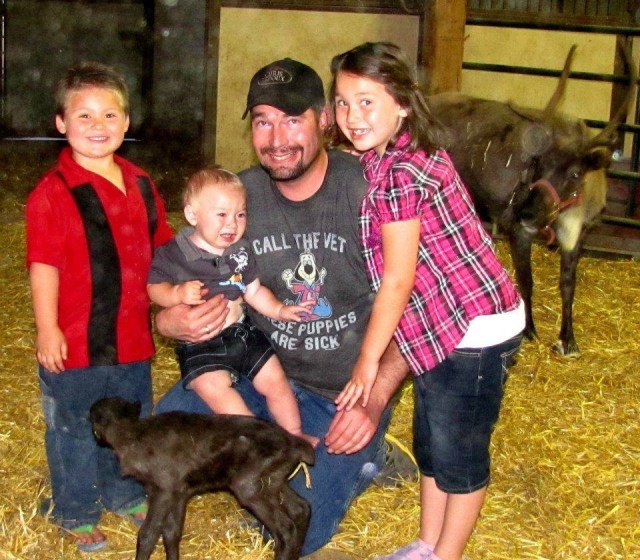
Dwane is not a typical farmer. To him, this is the perfect time of year for calving. His solution to the muddy disgusting mess in his pasture was simple: A four wheeler.

Each morning he would ride around the cow pasture to check on his pregnant stock. On this particular day, had spotted one cow calving and could see the infant’s nose and one foot exposed. Circumstances such as this require help from DocBott.

“Hey Doc, I need some help with one of my cows,” Dwane stated matter-of-factly, “She is kind of a wild one, so I don’t dare work on her by myself.”

I know better than to get myself into a situation like this. There is no way it can end well. Unfortunately, as it often goes, I gave in and headed towards Dwane’s place in Palmyra.

Dwane sat, on his Honda four wheeler at the gate. Every inch of the machine was covered in dark brown mud. As I looked into the field, I could see a few cows standing literally knee deep in mud.

“What a mess!”, I exclaimed, “Dwane, you really need to get a barn if you are going to calve out this time of year.”

“Yeah, I know,” he replied, “But you know how beef prices are this year.”

He did have a point, unpredictable and forceful influences that have negligible affect on most businesses, can dramatically alter the beef industry. From changing product demand, rising input costs and market fluctuations, to weather patterns and even consumer nutrition and lifestyle trends, farmers and ranchers must balance a long list of variables in order to be successful. The beef industry is not for the faint of heart.

“Where is she?,” I asked.

“Hop on, Doc, I will take you to her”

Out in the center of the field, along side a large cottonwood tree, the big Angus cow was comfortably sitting. As we approached her on the four wheeler, the wide eyed cow jumped up on her feet. Almost instantly, out popped the calf.

“Wow!” Dwane explained, that was easier than I thought it would be.

“It sure was,” I replied.

We should have just kept driving on the four wheeler at this point. The mother and newborn were both apparently healthy. There was no reason to stay, except that Dwane felt this was an opportune time to put a tag in the calf’s ear while we were near.

We dismounted and quietly approached the new born calf. Dwane reached down and quickly placed the tag in the left ear of the calf. The small calf let out a quiet but deliberate “moooooo”.

No sooner had the calf opened its mouth, the cow charged. She hit Dwane squarely in the chest. He immediately flew backwards towards the tree. He quickly jumped up and raced behind the tree, trying to use its massive trunk as a shield from the raging bovine.

I raced behind the tree as she bellowed and snorted. I looked at Dwane and he looked at me. We both knew there was only one way out – and that was up! We both climbed as fast as we could. Our mud covered rubber boots slid as we tried to climb the massive tree.

A large low hanging branch provided support as we held on and climbed on top of the life saving perch.

“Are you ok?” I asked

“Yeah,” Dwane replied between gasps, “I thought we were both dead!”

“Me too!” I agreed.

Fortunately, we have cell phones in today’s world, if not for that, Dwane and I would have had to stay in the tree for who knows how long.

“Just look for a four wheeler and a savage cow circling a tree,” I heard Dwane say as he grinned.

As we rode out of the pasture, he commented, “Hey Doc, I think I just might get that barn after all.”

“That sounds like a great idea,” I agreed, “I ain’t much of a tree climber!”

And that is my take.

N. Isaac Bott, DVM

The Saga of the Saiga

28514414_978626105635297_7870975775670707448_o.jpg

My Take Tuesday: The Saga of the Saiga
 
They look like something you would read about in a Dr Seuss book. From their long exaggerated proboscis to their loud nasal roars; this species is truly unique. Their bulbous noses, which hang over their mouths, give these antelope an almost comical appearance. The nose is flexible and can be inflated, helping them to breathe warm air in the freezing winters and filter air in the arid summers as they sprint with their heads down in a cloud of dust. Over the past few years, they have made a comeback in their native home of Kazakhstan. But this all changed recently and now they are in grave danger.
 
There was almost something biblical about the scene of devastation that lay across the wide-open fields in the wilderness of the Kazakhstan steppe. Dotted across the grassy plain, as far as the eye could see, were the corpses of thousands upon thousands of saiga antelope. All appeared to have fallen where they were feeding.
 
The saiga – whose migrations form one of the great wildlife spectacles – were victims of a mass mortality event, a single, catastrophic incident that wipes out vast numbers of a species in a short period of time. These Mass Mortality Events are among the most extreme events of nature. They affect starfish, bats, coral reefs and sardines. They can push species to the brink of extinction, or throw a spanner into the complex web of life in an ecosystem.
 
When this event occurred in 2015, over 200,000 (more than half the total population) died due to a mysterious illness. This mass die off baffled both veterinarians and scientists as they scrambled to identify the cause. The culprit was identified as a bacteria called Pasteurella multocida. This bacteria normally lives harmlessly in the tonsils of some, if not all, of the antelope. It is thought that an unusual rise in temperature and an increase in humidity above 80% in the previous few days had stimulated the bacteria to pass into the bloodstream where it caused haemorrhagic septicaemia, or simply put – blood poisoning.
 
Mass mortality events are not unusual for saiga antelopes, with a case occurring as recently as 2010 with 12,000 dead animals. However, the scale of the current event is unprecedented relative to the total population size. Often these mass mortality events occur in the birth period, when Saiga females come together in vast herds to all give birth within a peak period of less than one week.
 
Sometimes the answer to saving a species involves exportation, sequestration and assisted reproductive technologies to enhance genetic diversity. In my opinion, this is key to save the saiga antelope.
 
The saiga antelope is truly unique. They existed at the same time as the sabertooth and wooly mammoth. They are a relic of the past.
 
I hope we can save this species. They are truly remarkable!
 
And that’s my take!
N. Isaac Bott, DVM
Reflection

My Take Tuesday: Reflection

The wind howled, its lonesome lullaby piercing my ears as I turned up my coat collar. The desolate country lay still, with its towering stone cliffs and sage brush interrupted only occasionally by small clumps of cedar trees. The trail I was climbing was built by the CCC project (Civilian Conservation Corps) in the 1930’s during the Great Depression. The winding trail jots back and forth in a switchback as it leads to the south end of Trail Mountain.

I stood in awe as I gazed at the clear smooth reflective surface of Joe’s Valley Reservoir. The water was as smooth as glass and the towering mountains seemed to peer back from the water.

I have so many childhood memories of hiking this trail with my family, of fishing in the lake below and of family reunions with loved ones who are no longer here.

This is home. There is something about Emery County that heals my soul. This is my constancy and my serene sanctuary where I can reflect and recharge.

At its simplest, reflection is about careful thought. But the kind of reflection that is most valuable is more nuanced than that. The most useful reflection involves the conscious consideration and analysis of beliefs and actions for the purpose of learning. Reflection gives the brain an opportunity to pause amidst the chaos, untangle and sort through observations and experiences, consider multiple possible interpretations, and create meaning. This meaning becomes learning, which can then inform future mindsets and actions.

A reflective period need not be a time to be unduly harsh with ourselves, but rather to be lovingly honest. Firm yet forgiving. After all, endless rumination and self-recrimination keeps us trapped in a past we cannot change, and no one benefits from this. An attitude of self-forgiveness can liberate us from old patterns or ways of being that we likely adopted for a reason, but that do not serve us nor adequately reflect who we are and who we’d like to be.

Taking time to reflect will most certainly help you recharge. It will help you refocus and it will bring feelings of gratitude and purpose that are otherwise never experienced.

Try it. You will not regret it.

If you need a spot, there is a place along the CCC trail high above the world’s most beautiful reservoir just west of Castle Dale, Utah.

And at is My Take!

N. Isaac Bott, DVM

Yo Quiero Bite You

My Take Tuesday: Yo quiero bite you!

Often “the question” comes up during a routine appointment. Curiosity is naturally sparked with my response.

The question is, succinctly put, “Doc, what breed of dog bites you the most?”

The answer is unequivocally the chihuahua. Of the dozens of bites that I have received, a vast majority came from chihuahuas.

Chihuahuas are comical, entertaining, and loyal little dogs, absolutely brimming with personality – often a quirky and eccentric personality unmatched by any other breed.

Some of my sweetest patients are chihuahuas. They are affectionate and loving.

But every once in a while, a mean one comes along.

While a bite from a Chihuahua isn’t going to inflict the same damage as a bite from a larger dog like a pit bull or boxer, it can still leave a painful wound that’s prone to infection. There’s an old myth that a dog’s mouth is cleaner than a human’s mouth, but this isn’t a true. Whenever a pet bites, there is significant risk of infection.

While Chihuahuas are not naturally more aggressive than any other breed, they seem to be prone to react with aggression out of fear. Veterinarians are often the target of such aggression, simply because dogs are fearful of unfamiliar people and situations.

As a recent graduate, I was learning how to diagnose, treat and cure the routine cases that present daily. I had only been a veterinarian for about a month when I learned my lesson.

It was a routine appointment. Annual vaccinations and a wellness exam were needed. As I entered the room, Chispa, sat on the table glaring at me. As I reached down to auscult the heart and lungs, Chispa absolutely went ballistic. Within 5 seconds, she had peed and soiled all over the table top. Instinctively, I reached for a muzzle. As I attempted to place the muzzle on her, she absolutely lost it.

Just like a loud clap of thunder that follows a flash of lightning; when I am bit by a dog, imprecations are sure to follow.

Chispa sunk her needle like teeth into my right hand and bit me again and again.

Before I could even mutter the phrase, “Oh S#*!”, this little devil had bitten me three times.

Her only goal seemed to be to inflict as much damage as possible to the man in a white coat that was reaching for her.

Blood poured down my hand. I sat stunned. I have fast reflexes; after all, I dodge bites and scratches on a daily basis.

What was different about this experience? Perhaps it was in the name. “Chispa ” is a Spanish word meaning “spark”. Certainly, the fiery personality and name fit this small canine.

The rapidity of the attack taught me a lesson. I am much more careful now when dealing with seemingly innocent small pets. I do my best to reduce the fear and anxiety that accompanies a visit to the veterinarian.

And I am especially careful with pets that have incendiary names such as Diablo, Fuego, Demonio and, believe it or not, Fluffy.

And that is my take!

N. Isaac Bott, DVM