Best of Utah Valley 2022

My Take Tuesday: Best of Utah Valley 2022

Mountain West Animal Hospital has once again been voted the Best Veterinary Center in Utah Valley for 2022. This is our 9th consecutive year receiving this honor. 

This recognition comes thanks to a wonderful and dedicated team. I simply cannot get through the day without the extraordinary help of each one of them. They provide the individualized care and compassion that make our hospital so unique

Our veterinary technicians, Katie and Carol, are the unsung heroes of your pet’s veterinary care team. They take radiographs, perform dental cleanings, monitor anesthesia, fill prescriptions and a myriad of other tasks.  Jordan, our office manager, runs the ins and outs of the day-to-day operations. Her job is so important, and she does a wonderful job showing kindness and empathy to all. 

Without these devoted professionals, my office would be a sea of chaos and confusion. They are my right hand and my left. They work in a high-stress environment, putting in long hours, caring for ill and anxious pets, cleaning messes, and putting themselves at risk of physical harm. They do this because they care. They care about each of our clients and their four-legged family members.

Our doctors are each unique and are dedicated to the profession. Dr. LeMonds works tirelessly to treat and diagnose difficult cases. She provides excellent care to each patient that she sees and communicates the complex nature of medicine in a manner that clients are able to understand. Dr. King also helps at the clinic when scheduling permits. His kind demeanor is endearing to clients and his presence provides a sense of comfort that helps in the difficult end of life decisions that require extreme care and empathy. 

Mountain West Animal Hospital was built in 1977. We have been serving the Springville community for nearly 45 years. Our founder, Dr. Harold J. Davis built this clinic and business with a solid foundation of honesty, a friendly atmosphere and the practice of quality veterinary medicine and surgery. Dr. Davis continues to work each Wednesday at the clinic, and his service is so appreciated. 

Looking back at our heritage, we are proud to espouse the values that Dr. Davis first envisioned. Although the building has changed colors and we are constantly updating our technology, the business remains the same. Our mission is to provide the best possible veterinary care for our patients by maintaining and utilizing state of the art facilities and equipment, and by employing and developing a well-trained competent and caring staff. We are dedicated to providing friendly, compassionate service to our clients in an atmosphere of professionalism, respect and concern. We want your experience with us to be a good one. 

We are deeply grateful to have been voted Best of Utah Valley once again in 2022. 

Thank you, Utah Valley, we’re truly honored!

And that is my take.

N. Isaac Bott, DVM

Frank the Turtle

My Take Tuesday: Frank The Turtle

Third grade seemed to be a particularly creative time during my childhood. I remember sitting quietly in Mrs. Wikersham’s class at Castle Dale Elementary. As part of our daily routine, we would recite a poem each day. Most of the poems were short and simple and easy to remember. I still remember most of them verbatim. One of my favorites was about a little turtle, and it went like this:

“There was a little turtle.

He lived in a box.

He swam in a puddle.

He climbed on the rocks.

He snapped at a mosquito.

He snapped at a flea.

He snapped at a minnow.

And he snapped at me.

He caught the mosquito.

He caught the flea.

He caught the minnow.

But he didn’t catch me!”

I remember Mrs. Wikersham’s facial expressions vividly as she would teach us hand actions that went along with this poem.

A snapping turtle? It was something I could only dream about as a sheltered kid in a small town.

I recently thought about Mrs. Wikersham’s class after receiving an unusual call.

Frank the turtle needed an examination and a health certificate before flying to a warmer state. His owner called and explained that she could not find a veterinarian that would look at her turtle before her afternoon flight.

I really don’t know much about exotic pets, I somewhat reluctantly agreed to see her and provide the needed travel paperwork.

I entered the exam room to see the cutest little turtle imaginable. His innocent eyes peered up at me as I held him in my hands. I quickly looked him over and filled out the needed paperwork.

I handed the paperwork to the client and wished her safe travels. I then reached down to pat Frank on the top of his shell. Without warning, Frank snapped the tip of my right pointer finger.

Immediately, pain shot up my hand and continued all the way up my arm.

“Ouch!!!” I exclaimed, “That really hurts!”

Bewilderment filled my eyes. I didn’t see this coming. Frank, it turns out isn’t quite as sweet as he appears.

He might have snapped at that mosquito and caught that flea,

But in the end, Frank the turtle also caught me!

And that is my take!

N. Isaac Bott, DVM
My Take Tuesday: Hazel and the Skunk

My Take Tuesday: Hazel and the Skunk

As a teenager growing up in the small town of Castle Dale, I looked forward to summers at the end of each school year. Summer meant freedom from both homework and sitting at a school desk. 

For me, a perfect summer day would have to include vanilla ice cream, snow cones and strawberry shortcake. The tranquil Castle Valley evenings provided frequent opportunities to cook hot dogs, hamburgers and steaks on the grill, corn on the cob on the stove, and juicy Green River watermelon slabs with each meal. 

Summertime also meant hard work. Apart from the irrigating and farm chores, there were a number of elderly widows in Castle Dale that would hire my siblings and I to mow their lawns each week during the summer. 

Hazel was my favorite. Her small house stood just north of the new recreation center in Castle Dale. Hazel was like family to me. Her friendly demeanor and kindness were manifest each and every time I mowed her lawn. 

She had a small but verdant lawn that surrounded her small gray house. Along the south end of her property, huge trees stood as sentinels protecting the house from the frequent Castle Valley wind. The deep green leaves of the tall trees overlooked a perfectly manicured garden with straight rows of Swiss chard, chives, radishes, peas, carrots, spinach and lettuce. 

Her lawn was difficult to mow. The frequent flowers and bushes required extreme care and precision with the lawn mower and edger. I would frequently graze her chives and the onion smell would instantly give away my error. 

“On no, you hit my chives!” she would say. I anticipate that she planted larger quantities each year knowing that some would certainly fall prey to my mower. 

After finishing the mowing, Hazel would prepare red punch and cookies. I would sit on a couch in her living room as I savored the snacks week after week. Hazel would ask about how my life was going, and she would tell stories of her Seely and Livingston pioneer ancestors that helped settle Utah and build the iconic Salt Lake Temple. 

Hazel loved cats. She had a cat door that would lead out to the back yard from her kitchen. She would place a large bowl of cat food in the center of the kitchen and the cats could enter and leave as they please. 

On this particular day, Hazel commented about how much cat food she had been going through. She noted that she would have to fill the cat dish 3 or 4 times a day and that each time she entered the kitchen, the bowl would be empty. 

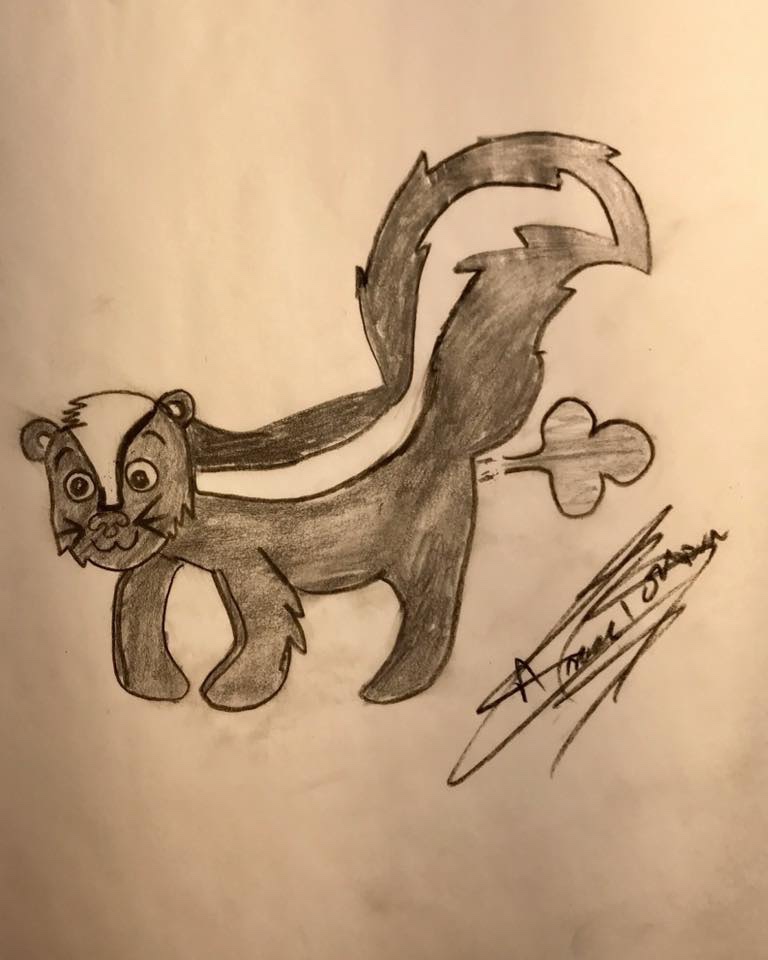
As I sat on the couch, I had a clear view of the cat bowl in the kitchen. As Hazel spoke, from the corner of my eye I noticed some movement near the bowl. As I turned my head and looked into the kitchen, the biggest skunk I had ever seen wobbled over to the food bowl and began gorging. 
“Hazel!” I exclaimed. “That is not a cat, it is a big fat humongous skunk!” 

“My laws!” she gasped. “Get it out of here!” 

As I jumped up, the startled skunk made a dash for the door. Its overweight body condition inhibited it from any appreciable speed. The large belly nearly dragged on the ground as it meandered away. As it leaped for the cat door, the front half of the body exited perfectly, however, its back half didn’t quite make it. As the obese animal heaved its back end though the door, it simultaneously and voluminously sprayed the contents of its scent glands in my direction. This wallop of its defense mechanism filled the entire kitchen. 

If you haven’t experienced the mephitic smell of a skunk from up close, the odeur fétide is actually a thick, volatile, oily liquid that obtains its pungency from sulfur-based thiols. There in nothing that smells worse than skunk spray inside your nose! 

Hazel and I exited out the front door. We propped open the kitchen door and placed a fan on the floor to help air out the house. We laughed about it for hours. 

Hazel passed away shortly after Memorial Day in 2003. I sure do miss her. 

Each and every summer day brings back the fond memories of Hazel, the obese skunk, and the all-you-can-eat Mephitis buffet. 

And that is my take!
N. Isaac Bott, DVM
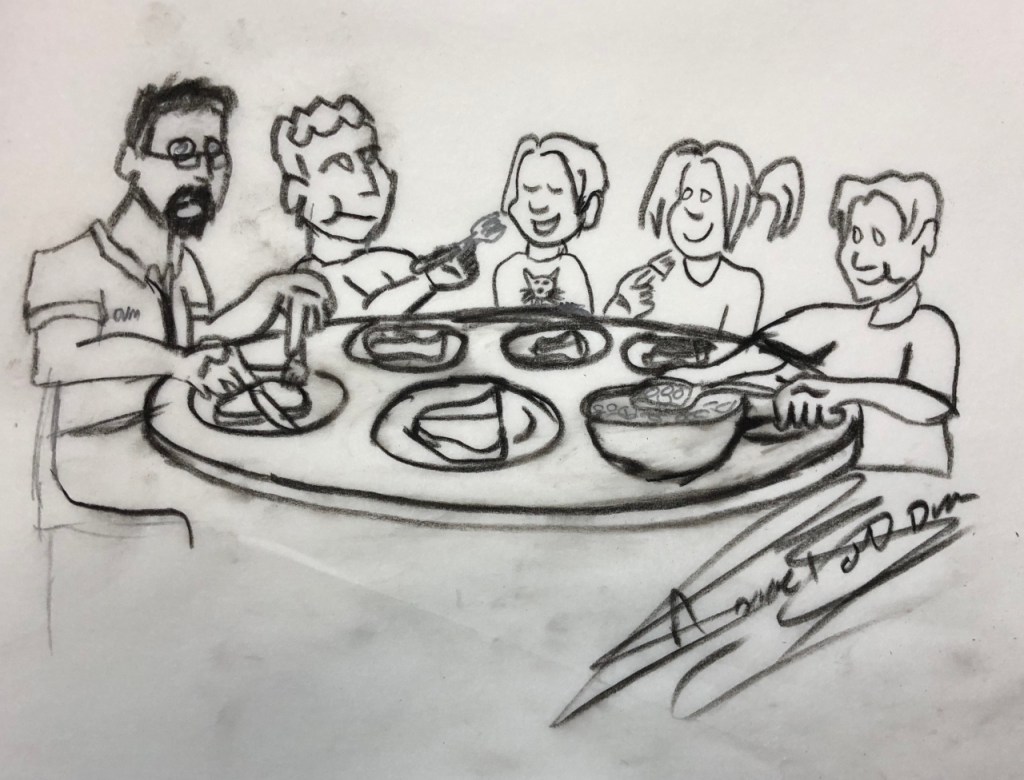
Hazel and the Skunk

My Take Tuesday: Hazel and the Skunk

As a teenager growing up in the small town of Castle Dale, I looked forward to summers at the end of each school year. Summer meant freedom from both homework and sitting at a school desk.

For me, a perfect summer day would have to include vanilla ice cream, snow cones and strawberry shortcake. The tranquil Castle Valley evenings provided frequent opportunities to cook hot dogs, hamburgers and steaks on the grill, corn on the cob on the stove, and juicy Green River watermelon slabs with each meal.

Summertime also meant hard work. Apart from the irrigating and farm chores, there were a number of elderly widows in Castle Dale that would hire my siblings and I to mow their lawns each week during the summer.

Hazel was my favorite. Her small house stood just north of the new recreation center in Castle Dale. Hazel was like family to me. Her friendly demeanor and kindness were manifest each and every time I mowed her lawn.

She had a small but verdant lawn that surrounded her small gray house. Along the south end of her property, huge trees stood as sentinels protecting the house from the frequent Castle Valley wind. The deep green leaves of the tall trees overlooked a perfectly manicured garden with straight rows of Swiss chard, chives, radishes, peas, carrots, spinach and lettuce.

Her lawn was difficult to mow. The frequent flowers and bushes required extreme care and precision with the lawn mower and edger. I would frequently graze her chives and the onion smell would instantly give away my error.

“On no, you hit my chives!” she would say. I anticipate that she planted larger quantities each year knowing that some would certainly fall prey to my mower.

After finishing the mowing, Hazel would prepare red punch and cookies. I would sit on a couch in her living room as I savored the snacks week after week. Hazel would ask about how my life was going, and she would tell stories of her Seely and Livingston pioneer ancestors that helped settle Utah and build the iconic Salt Lake Temple.

Hazel loved cats. She had a cat door that would lead out to the back yard from her kitchen. She would place a large bowl of cat food in the center of the kitchen and the cats could enter and leave as they please.

On this particular day, Hazel commented about how much cat food she had been going through. She noted that she would have to fill the cat dish 3 or 4 times a day and that each time she entered the kitchen, the bowl would be empty.

As I sat on the couch, I had a clear view of the cat bowl in the kitchen. As Hazel spoke, from the corner of my eye I noticed some movement near the bowl. As I turned my head and looked into the kitchen, the biggest skunk I had ever seen wobbled over to the food bowl and began gorging.

“Hazel!” I exclaimed. “That is not a cat, it is a big fat humongous skunk!”

“My laws!” she gasped. “Get it out of here!”

As I jumped up, the startled skunk made a dash for the door. Its overweight body condition inhibited it from any appreciable speed. The large belly nearly dragged on the ground as it meandered away. As it leaped for the cat door, the front half of the body exited perfectly, however, its back half didn’t quite make it. As the obese animal heaved its back end though the door, it simultaneously and voluminously sprayed the contents of its scent glands in my direction. This wallop of its defense mechanism filled the entire kitchen.

If you haven’t experienced the mephitic smell of a skunk from up close, the odeur fétide is actually a thick, volatile, oily liquid that obtains its pungency from sulfur-based thiols. There in nothing that smells worse than skunk spray inside your nose!

Hazel and I exited out the front door. We propped open the kitchen door and placed a fan on the floor to help air out the house. We laughed about it for hours.

Hazel passed away shortly after Memorial Day in 2003. I sure do miss her.

Each and every summer day brings back the fond memories of Hazel, the obese skunk, and the all-you-can-eat Mephitis buffet.

And that is my take!

N. Isaac Bott, DVM
Tempus Fugit

My Take Tuesday: Tempus Fugit

This week marks 13 years since my graduation from veterinary school. I can’t believe how fast time has flown by!

Over the course of the past thirteen years, I have many accomplishments that I am proud of. It has been a most remarkable journey.

It seems like just last week when I was saying farewell to some of my dearest friends and colleagues. Members of my class have traveled all over the world and have already left an impressive mark on the field of veterinary medicine. Many have completed residences and internships.

Some are clinical pathologists, oncologists, zoo veterinarians, cow calf specialists, internal medicine and equine specialists, mixed animal practice owners, epidemiologists and USDA food supply veterinarians. I am fortunate to have spent my veterinary school years surrounded by such exceptional people.

Looking back at my journey, I could not have dreamed of the adventures and opportunities that awaited me in my first decade of veterinary practice. It has been an exhilarating ride. I have been knocked down several times during this journey. With each failure, I have tried to get back up, dust myself off and move forward. Hard time times have come before, and they are bound to come again. When they come, I grit my teeth, bow my head and ride straight into the wind. Each struggle has been followed by myriads of opportunities. One cannot fully appreciate the highs of life without experiencing the lows. As Ernest Hemingway aptly observed, “Night is always darker before the dawn and life is the same, the hard times will pass, every thing will get better and sun will shine brighter then ever.”

Timing and chance have tremendous bearing on each of our lives and careers. I have had successes and experiences that were not in my wildest dreams when I graduated. I have performed veterinary work in 8 countries, 27 US states, performed reproductive work on 39 different species, performed over 65,000 small animal examinations and have helped build a successful veterinary practice. I have also published 8 scientific papers and just recently authored my first textbook chapter.

I cannot think of a profession that is more rewarding. I have had the opportunity to travel to many faraway places to share some of the successes I have had with today’s veterinary students. I very much enjoy the opportunity to do this. I always encourage students to be different and to follow their hearts. My advice to them is to always seek self-discovery and self-improvement. There is very little satisfaction when comparing oneself to others. So much time is wasted when trying to be better than someone else. The true test of success is measured when looking at your own improvement and progress. Are you better than you used to be? If you focus on being your best-self your potential is unlimited. When using others as a comparison, there will always be someone bigger, better or stronger.

Each of us are unique. Look at your thumb. Your thumbprint is a testament to your uniqueness. Your individual thumbprint is different than any of the billions of individuals that are alive today. No one ever has, or ever will have the same thumbprint. Your identity is as unique as your thumbprint. Your perspective and personality are not shared by any other person. These traits are arrows in our quiver of individual contribution. Why is it so difficult to acknowledge this? Self-awareness is the key to harnessing and honing this uniqueness in an effective fashion. As we become self-aware, we are able to visualize, assess, nock, draw back and place a precise arrow in the bullseye of our desired target.

Thank you to my many mentors who have guided me and made me what I am today.

I look forward with optimism at the journey ahead. I have found my passion. I love what I do.

And that is my take!
N. Isaac Bott, DVM
The Fragility of Life

My Take Tuesday: The Fragility of Life

Just west of Castle Dale, Utah, the sky above Horn Mountain turns a beautiful cinnamon on clear summer nights as the sun sets over the place that I call home. These summer nights smell of freshly cut grass and alfalfa, of roses and cottonwood trees, of sagebrush and lilacs.

If you are heading west along Bott Lane, just past the tall poplar trees, lies a piece of ground that was homesteaded by my great-great grandfather. This piece of land has passed from generation to generation, from fathers to sons, and has always remained in my family.

On the east side of this piece of land, a silhouette of a Ford Tractor and a Hesston Hydroswing Swather were visible on many beautiful summer evenings during my childhood. On the tractor, sat my uncle Jerry Bott.

Jerry was a giant of a man. He stood over 6’4”. His gentle demeanor and kind heart were his most precious of character traits. His soft voice and carefully chosen words were never cross or unkind. At least two times every day, I would be able to greet my uncle as I would enter his house before milking our cows. He became my constancy, my anchor, as I grew from a small child into the man I am today.

On this particular night almost 30 years ago, in 1990, my uncle Jerry was cutting the first crop of hay. The tall grass makes this cutting the most difficult on the equipment. Constant attention must be given to the rotating wheel and hay knives that were prone to clogging.

This time of year, hen Ringneck pheasants are on their nests. They sit so still that even the loud rumbling of a tractor and the ground tremors of the hay cutter leave her undeterred. Occasionally, these hens are injured or killed as they sit on their eggs. The nest, whether it be full of chirping hatchings or incubating eggs, is left to the merciless predators from the air and the nearby fortress of trees and Russian Olives that run along Cottonwood Creek.

As the sun faded behind the towering cliffs of Horn Mountain, I stood on my parents’ lawn, looking eagerly at the approaching two-toned tan GMC Sierra. My hero was coming home for the night.

As Jerry exited his truck, he held under his arm a brown paper grocery bag. His long stride headed towards me instead of his house across the street.

As he approached, he called my name.

“Isaac,” his low and gentle voice called, “I have something for you.”

He handed me the brown paper bag.

Inside, a green towel was wrapped gently around 8 medium sized olive-colored eggs.

“These are pheasant eggs,” he continued, “and they need to be cared for.”

“Isaac, I know that you will do a good job at taking care of them.”

I looked in the sack as Jerry walked back across the street and into his house.

“How do you hatch pheasant eggs?”, I wondered as I entered my parent’s house.

My incubator was nothing special, just a Styrofoam box with a small heater inside. Knowing that peasant eggs incubate for 23 days, I set the temperature and humidity and carefully laid the eggs inside.

I faithfully turned the eggs three times a day for three weeks.

Somehow, the incubation was successful, and the eggs all hatched out. The tan chicks had dark brown stripes that ran parallel along their backs.

I was overjoyed when I told my uncle Jerry about my accomplishment.

“Uncle Jerry,” I exclaimed, “I did it! The eggs hatched!”

“That is great!”, he responded, “Isaac, I knew you could do it.”

His response and validation filled my system with light and my soul with joy.

The world with all of its power and wisdom, with all the gilded glory and show, its libraries and evidence, shrink into complete insignificance when compared to the simple lesson of the fragility and value of life that my uncle Jerry taught me that warm summer evening.

Over the years, uncle Jerry often repeated this encouragement as I navigated the brambles and thorns of life. When I graduated high school, then college and eventually veterinary school, his reassurance illuminated my understanding of my potential and his unwavering love and support. He gently counseled me, “Isaac, find your passion. Cultivate it. Work hard and be the best that you can be. And then share it with the world.” 

There are days that change the times and there is a time to say goodbye. My sweet uncle Jerry passed away in late 2016. His loss left a tear in the eye and a hole in the heart of all my family members.

There is a place beyond the clouds, in the cinnamon sky to the west of Castle Dale, where a precious angel resides.

Somethings never change. Yet, there are things that change us all. This experience changed me.

My uncle Jerry’s lesson, from long ago, was not lost on me.

Each and every day, I remember the immense value of life, as I attend to my four-legged patients.

As lives are saved and others are lost, I remember how important it is for someone to take initiative and to tend to the responsibility to care for the helpless and to speak for those without a voice.

This is a lesson my dear uncle Jerry so effectively showed me how to apply and live, and it is a responsibility I take most sacredly.

And that is my take.

N. Isaac Bott, DVM

The Llama que se llama Lloyd

My Take Tuesday: The Llama que se llama Lloyd

It was a typical Sunday afternoon; I was taking advantage of the quiet afternoon by sitting down on the couch. The phone startled me just as I was getting to the good part of one of my favorite movies.

I hit pause as I picked up my cell phone and gave my usual salutation, “Hello, this is Dr. Bott.”

“Hey Doc! I need you to come check on my llama. He’s gone absolutely berserk!”

I could hear panic in her voice as she continued, “He just ate my blouse from the clothesline. Yesterday, he spit right in my eye. He keeps biting Susie and Dolly, thems my other llamas, and he keeps attacking anyone that enters his pen!”

The potent potion of human personality makes taking calls like this very unpredictable, and my experience has shown that some of the most colorful of souls happen to also have llamas.

She continued, “I tried using lavender oil to calm him, but he bit my finger!”

“Oh my!” I replied.

Over time, the term “berserk” has been used rather freely to describe llamas or alpacas that deviate from the expected behavioral norm.

I could tell this client was truly terrified of the llama and needed immediate assistance.

My next questions were precise, “Is your llama male?”

She replied, “Ya’ darn tootin’ he is.”

I quickly followed up with, “Is he castrated?”

“No, we ain’t got around to it.”

In my experience, nothing will calm a crazy macho llamoid like castration. When possible, castration should be performed before the male attains puberty.

As I drove south on I-15, I reviewed in my mind the condition known as berserk llama syndrome or berserk male syndrome (as it is more pronounced in males). It is a psychological condition suffered by human-raised llamas and alpacas that can cause them to exhibit dangerously aggressive behavior towards humans. The term has been overused, however, and is sometimes inappropriately applied to llamas with aggressive personalities that are not truly “berserk”. The condition is a result of the llama imprinting on its human handlers to such a degree that it considers them to be fellow llamas. Imprinting can be caused by bottle feeding and by isolation from other llamas.

Male llamas suffering from this condition become dangerous when this behavior is directed toward humans. This behavior can be so aggressive that these males sometimes have to be euthanized.

As I turned down the road onto the farm, a large white llama could be seen running the perimeter of the pen. His vocalization, a high shrill mixed with a gurgling, guttural sound, pierced the solitude in the cab of my pickup. It was immediately obvious, that Lloyd the Llama was very upset.

Lloyd had distinctively long hair, known as fiber in llamas and alpacas, around his face. If it weren’t for his long banana shaped ears, he could easily be confused for an alpaca.

Llamas are pseudo-ruminants – they chew their cud similar to cattle. The spit that llamas produce is actually ingesta from their first stomach compartment. This foul-smelling stuff is very unpleasant. Because of my previous llama adventures, I know that it tastes horrible, and it stings when it hits your skin or eyes.

As I approached the fence to meet Mrs. Jones, I heard the unmistakable ‘Pffffffffft” that accompanies a huge ball of llama spit. Before I could react, the large gob of green nastiness spattered across my face.

Imprecations are sure to follow something like this, even from the calmest of veterinarians.

“We need to sedate Lloyd,” I explained to Mrs. Jones, “We should look at his teeth and also castrate him while he is asleep.”

Mrs. Jones had no problem with my proposed battle plan. As she stated, “Maybe he will calm down if we chop his balls off!”

For some reason, I always have giggled when a grown up speaks like this. I smiled as I filled my syringe with the Camelid Cocktail of Anesthesia.

Administering an intramuscular injection on Lloyd proved to be no easy task. Both Mrs. Jones and I received another round of llama spit and multiple kicks from his agile hind legs.

Soon Lloyd sat down and peacefully fell asleep.

As I opened his mouth, I noticed the nidus of his outbursts. His premolars, known in this species as fighting teeth, were actually growing into the sensitive skin inside his cheek.

The fix was simple, the fighting teeth were removed. As per Mrs. Jones request, he was also castrated.

Lloyd woke up a new llama. He calmly allowed Mrs. Jones to lead him back into his pen.

“That’s my boy!” She exclaimed as Lloyd rubbed his face gently on her check.

It was no short of a miracle. Lloyd wasn’t berserk, he was simply in pain.

My job as a veterinarian would be so much easier if I could have the luxury of simply asking, “Where does it hurt?”

Even though animals can’t talk, they certainly can communicate with us if we are willing and observant enough to listen.

I will never forget this important lesson that I learned from Lloyd the Llama.

And That is My Take!

N. Isaac Bott, DVM

The Most Difficult Part of My Job

My Take Tuesday: The Most Difficult Part of My Job

Death and dying are uncomfortable subjects. For some, it stirs up painful memories of past losses. For others, it is a reminder of our mortality or the mortality of those we love.

As I tend to the animals in my care, I will lose patients to death despite my best efforts. Often at these times, I am exposed to the emotions of the families who have loved them. For some, there are dramatic outbursts; for others, emotions will be put on hold for private moments.

As different as people are, so are their reactions. No right or wrong. I always try to respect and accept the fact that we all grieve and express grief in our own way and in our own time, and I try my best to be there to support my clients through this most difficult time.

I have to deal with death on a daily basis. Many of these are pets that need to be euthanized. It is among the most difficult aspects of my job. I see the sadness in family members eyes when they have to say goodbye to their family member. I often tear up when the strong bond between the family and pet is obvious.

I cannot feel their pain. I did not have the years of interaction with their family member. I didn’t see the unique personality they are talking about. I only have treated this pet on a few occasions and our interactions usually lasted only a few minutes.

What I can show is empathy. My professional familiarity with death means I also know a great deal about grief — my own, of course, and also that of the families whose pets I have looked after throughout their lives.

Dealing with this on a daily basis for many years is difficult. Many veterinarians suffer from severe burnout and fatigue, and sadly a 2.7x higher suicide rate when compared to the general public.

Veterinarians encounter death frequently, along with some moral issues human doctors never face. Consider the client I need to counsel and help to choose between a costly operation for their pet or paying their mortgage — or worse, a beloved patient I operate on who, despite good care, still dies. Or another case where horrific animal abuse is evident.

When these stresses combine with long working hours and on-call pressures, it’s easy to see how anyone could melt down.

I try hard to focus on the goodness of people who save animals, instead of the evil of those who hurt them. This helps tremendously. I count myself so fortunate to have the clients that I do. They are loyal and caring. They are kind. I take the trust they have in me very seriously and I do my best every day to be the very best veterinarian I can be.

The loss of a pet should not be taken lightly, and it is not something most people get over quickly or easily – although many may think there is a social stigma not to grieve for animals as we do for humans. The fact is that the bond that is formed between people and their pets is in many cases even stronger than some of the bonds between people.

Although I do not fully understand the love you have for your pet, I do care about your feelings and try my best to show this with each interaction I have. This is particularly true when dealing with these difficult end of life decisions. If you have had to go through this, my heart aches for you.

Losing a pet is tough. I mourn your loss.

I also strongly believe that the bond between human and animal continues, across the rainbow bridge, between this life and the next.

And that is My Take

N. Isaac Bott, DVM

The Value of a Mentor

My Take Tuesday: The Value of a Mentor

During the last year of most veterinary school programs, time is set aside for students to spend away from the veterinary school immersed in clinical practice in what is known as a preceptorship. At Washington State University, this is a four-credit (four-week) guided preceptorship experience.

I didn’t have the luxury of visiting the list of clinics that provided a mixed-animal (a clinic that treats large and small animals) preceptorship because of my chaotic schedule of rotations at the veterinary school. Instead, I sat in an office and read over a binder of information about the possible selections. A new clinic had just been added to the book that was offering a guided preceptorship for the first time.

The name of the clinic was Mt. Spokane Veterinary Hospital. It was located north of Spokane, in Mead, right off Newport Highway. I had a gut feeling that this would be the best place for me to complete my preceptorship. I would be the very first student preceptor at the clinic.

Of all of the training I have received during my career as a veterinarian, I count the four weeks spent at Mt. Spokane Veterinary Hospital as the most influential and consequential in where I am today.

I found the team at the hospital very welcoming and nurturing. Every team member made me feel welcome from day one. I quickly learned of the flow of the hospital and began assisting in appointments and surgeries.

Drs. Randy Scott and Luther McConnel were very generous with their time. Having a student dampens the efficiency of the clinic as it requires much time and patience. Busy veterinary practices can be extremely intense to the exclusion of student education. I found their practice to be the exact opposite. The case load was vast and diverse, but they took the time to make sure I felt involved and that I was learning about the routine cases that rarely present to veterinary school teaching hospitals.

Veterinary school does not provide much surgical experience. We learn anatomy and have extensive classroom training on tissue handling and surgery, but actual hands-on surgery is something that is typically acquired away from the veterinary school.

During my month working with Dr. Scott, I had the opportunity to tweak and refine my surgical skills. Dr. Scott never criticized me, rather he gave me pointers on how to hold surgical instruments and how to precisely use a scalpel and place suture knots. He did this in a manner that was constructive and not condescending. He created an environment of learning. He saw something in me that I did not see. He taught me to trust my skill and my ability as I entered the real world as a practicing veterinarian. He became a trusted mentor.

Dr. Randy Scott is a truly unselfish person who helped me with little in return. He was genuinely altruistic. He built my confidence, encouraged me to grow, and patiently watched me fall and regain my balance. He saw something in me that I didn’t even know I possessed.

The word “mentor” as applied to such a person has its roots in Greek mythology. In the Odyssey, Mentor was a character who advised and protected Odysseus’ son Telemachus. A 1699 novel called Les Aventures de Télémaque (“The Adventures of Telemachus”), introduced a character named Mentor who served as Telemachus’ tutor. Mentor was the hero of the story, and turned out to be Minerva, the goddess of wisdom, in disguise. The modern usage of the term “mentor” seems to have arisen from that book.

A great mentor wants you to succeed, and he or she will actively support your success with words and action. The great mentor will never be envious or feel threatened by your growth; he or she will congratulate you on your triumphs and help you recover from your setbacks. The generous mentor will make connections or offer resources that could be useful to you whenever he or she can. Most important, a generous mentor believes in your potential, and communicates that to you freely and with hope. The generous mentor supports you to become the person you want to become.

How grateful I am for the mentorship I received under Dr. Randy Scott. Looking back at all the opportunities I’ve had as veterinarian have pivoted on the training I received from him. My first veterinary work on deer, elk and moose all began during my time at his clinic. I would have never had the courage to work with reindeer without this essential knowledge base. My surgical skills, from the way I hold my suture and my needle drivers, to the way I perform orthopedic surgery, all began and were nurtured under his mentorship. He taught me that what we did was small and beautiful- but that the animals we helped were precious.

Over the years, I have remained close with Dr. Scott. He has even stopped in to visit my veterinary hospital in Springville. He has done so much for me and taught me so much about science, about life, about everything. My biggest fear has always been in letting him down. I work my hardest so that he can be proud of me and to show him that his trust in me was not wasted.

The true test of one’s character comes when there exists no sphere of recognition potential, no roar and support of a crowd and no chance of fame or fortune. Being simply motivated by the genuine desire to help others, never entertaining the thought of self-interest, is the defining characteristic of a good mentor.

If you are lucky, and few of us are, at some point in your life you acquire a good mentor. Timing and chance aligned in my life and I was able to find one. I will forever count this mentor as a cherished and dear friend.

And that is my take,

N. Isaac Bott, DVM

Pictured is Dr. Randy Scott and I at Mountain West Animal Hospital

The Itch Is On!

My Take Tuesday: Allergies – The Itch Is On!

Spring is a beautiful time of year in Utah County! As winter loses it overpowering grip, new life emerges. The smell of flowers, fresh green grass and the sound of birds chirping will invoke feelings of happiness in those yearning for warmer weather.

During springtime, a dichotomy of sorts is presented. While I love this time of year immensely, its arrival brings in the annual ritual of sniffling and sneezing, a runny nose and itchy eyes. Atopy, the genetic predisposition to allergies, has plagued my family for generations. We all have severe allergies to grass, alfalfa and flowers.

While growing up, a rosebush outside my bedroom window would bloom beautifully this time of year. This rosebush brought me seasonal misery and debilitating symptoms and endless nights of wheezing, sniffing and itchy red eyes. I hated that rosebush! I remember having such severe attacks, that I would lay in bed with a cold washcloth over my eyes, unable to sleep or do anything productive. On the worst of these nights, I scribbled a journal entry at the height of allergy season that simply read, “Today more allergies, oh I hate them.”

I have sympathy for my veterinary patients that suffer from allergies. All to frequently, they present in complete disarray. Instead of the runny noses, itchy eyes, sneezing or wheezing allergies mean to many people, pet allergies typically show up as scratching, chewing, rubbing, head-shaking or severe ear infections. Often dogs present with bleeding paws and open sores all over their body. These lesions are caused by continuous scratching. This insatiable itch drives them crazy. Every waking hour they spend trying to scratch the itch away.

Allergies are by far the most common illness I see as a veterinarian. It is sad to see pets suffering so. When pets suffer, they are at least as miserable as we are — and likely much more.

With each case, we try to provide suggestions specific to your pet, your region and your season, but in general, you can help your pet a great deal with an allergy-prevention regimen in the home.

Concurrently, you can limit the amount of dust and other irritants pets sweep up in their coats by vacuuming and using electrostatic cleaning products (such as Swiffers) on floor surfaces as well as using room or whole house filtration systems. And while you may have heard that frequent shampooing strips the skin of essential oils, veterinary dermatologists now recommend bathing pets at least every week (up to everyday for extremely at-risk, allergic pets) during the spring and summer to help wash allergens off the coat and skin before they can be absorbed and trigger an allergic reaction. Spray-on products or wipes for a dry bath will often do the trick and may be a great deal easier than bathing for some dogs and almost all cats.

Often, it’s not just about airborne allergens or parasites: Pets suffer from food allergies as well. Allergy reactions to pet food are usually caused by proteins, and can include beef, egg, milk or cheese products, soy or even fish. If food allergies are suspected, your veterinarian will guide you through food-elimination trials to find the culprit and recommend a diet that’s both nutritionally complete and contains pre-digested proteins. If your dog suffers from a food allergy but still needs to take medications, Greenies Pill Pockets Allergy Formula capsules may help. These are little pouches, made from peas and duck that facilitate medication administration by providing a yummy pocket for a pill.

Please don’t let your pets suffer. Schedule an appointment and let’s work together to provide the life free of pain and suffering that each of your four-legged family members deserve.

With modern veterinary options and a world of new products to help, the pet with allergies can be managed better than ever before. And that means you and your pet will both sleep better, after you’ve stopped the itch.

And that is my take!
N. Isaac Bott, DVM