Don’t Worry Doc, She is a Tame Cow

My Take Tuesday: Don’t worry Doc, She’s a tame cow

“Is the cow where you can catch her?,” was my first question.

Preston was a longtime client and on this particular day he had a cow that was having difficulty calving.

Responses to this question can vary. On this particular occasion the gentleman stated, “Don’t worry Doc, she is a tame cow. I raised her on a bucket.” He then gave a caveat, “Besides, she is too sick to run.”

“I really do not like trying to pull a calf without restraining the cow. I don’t want to get hurt,” I replied.

“We could even tie her up to one of the pillars in the barn,” he continued.

Now clearly, this should have raised a red flag. A 1800 pound snorting bovine is not to be taken lightly. The thought of working on her without a squeeze chute was ludicrous. Just think of the danger I would be subjecting myself to. A well placed kick could easily end my career.

“Can you please help me out, Doc?”, he begged.

Veterinarians all have a soft spot. We like to help people, and often we do so placing our own health and wellbeing on the back burner.

“I guess I could stop by,” I replied, “But please be sure to have a good rope handy.”

“You got it Doc!,” He promised.

When I arrived, Preston had the cow tied up to the center pillar of the barn. The massive beam was actually an old telephone pole.

The cow stood, chewing her cud as if nothing was amiss. A foot was clearly sticking out from the back end of the cow. From the appearance and position of the foot, I could immediately tell it was a back leg.

Delivering a breached calf is no easy feat. The size of the calf would make it impossible to turn around, and the best option was to attempt to pull the calf as it presented. The test for delivery of a calf in the backwards presentation but normal position and posture differ because the fetus should be first rotated 45-90 degrees by crossing the legs before attempting delivery to take advantage of the widest diameter of the cow’s pelvis.

Most experts say you should not apply more force than that of two strong men pulling by hand. But, if you’re alone in assisting a difficult birth, a calf jack can help generate the necessary force. Luckily I had my calf jack with me.

A calf jack is a long pole with a adapter that sits against the backside of the cow, just below the birth canal. There is a handle and jack that move along the entire length of the pole. OB chains are attached to the calve’s legs and then are attached to the jack. Extreme care must be taken to not apply too much pressure while using a calf jack. The health of the calf and mother could easily be compromised if the instrument is used improperly.

I attached the chains to the jack and gently began to tighten the slack. As I applied traction, the cow went crazy! She began to jump and kick and swing her head. I jumped back as fast as I could. She bellowed and began kicking her back legs in the air as if she were a rodeo bull.

The calf jack was firmly attached and stuck out straight nearly 6 feet from her rear end. This device became a formidable weapon and this cow knew exactly what to do. She was able swing it with extreme accuracy.

And boy did she ever swing it!

My OB bag was the first victim. It went flying through the air spreading instruments all over the barn. My water bucket next was launched vertically, covering all of us with fetal fluid and blood tinged warm water.

In a swift motion, the cow pivoted on her front feet, swinging her back end in an abrupt 180 turn. My back was turned to her when this happened and it caught me completely off guard. The calf jack, still sticking straight out from her backside, struck me about 2” below the back of my knees. This caused me to do a partial backflip. I landed on the soft bed of straw head-first.

“Preston!,” I shouted, “I thought you said she was tame!”

“Well, Doc, I ain’t never hooked one of those on her before!” he replied, with a look of bewilderment in his eyes.

Together we grabbed a large panel and placed it along side the raging bovine. She immediately calmed down and I returned to my job.

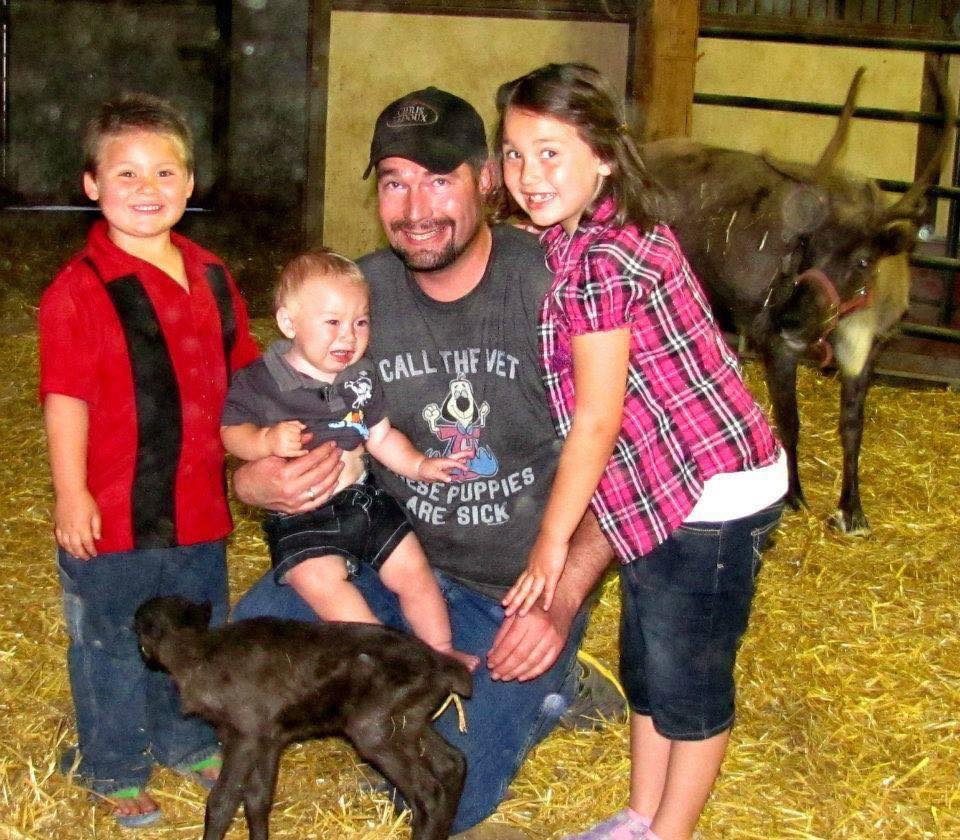
The calf was born alive! It was a precocious solid black bull calf with a stripe of white extending down his forehead. It weighed nearly 120 pounds!

“Good job Doc!” Preston exclaimed, “I was a little worried there for a minute!”

“So was I,” I replied, “So was I.”

The pain in my calves finally set in as I walked back to my truck. I had a battle wound that took weeks to heal – a linear bruise left by the unforgiving calf jack stuck to the backside of a most formidable and sinister cow.

And that is my take!

N. Isaac Bott, DVM

The Universal Human Animal Bond

My Take Tuesday: The Universal Human Animal Bond

A few years ago, I had the opportunity to spend several weeks in Mexico working as a veterinary ambassador. It was an incredible experience.

The first week, we traveled to the outskirts of a city called Queretaro. We sat up a set of tents and hosted an animal wellness clinic. We spent an entire day vaccinating dogs and cats.

The next two days were spent in Guadalajara. Here we also set up vaccine clinics. Over the three day period we vaccinated the pets of over 1,800 families. We spent time with each individual and answered questions about the pets they had and educated them on preventive care and how to assure a long and happy life for their 4 legged family members. These are among the longest days I have had as a veterinarian. It was exhausting to speak to so many people. However, the exhaustion was insignificant compared to the happiness I experienced by helping in these activities.

When we look at veterinary medicine on a global basis, people everywhere are attached to their pets and want their pets to be healthy. In the villages where we held our clinics, people couldn’t imagine putting their dogs on a leash; they would consider that cruel. If they want their dogs to walk somewhere, they pick up the dog’s front legs and walk them on their hind legs. The dogs are amazingly patient with this practice.

Lines each day extended around the block. Hundreds of people stood in line for hours under the hot sun to receive the services we were providing. Dozens of children brought their beloved pets, often in a grocery bag or carried safely in their arms, to be vaccinated and dewormed. They showed the same love towards their pets as anyone I have ever seen back home. The Human-Animal Bond is the same across borders – it is the same in the hearts of people everywhere. The happiness I experienced while performing these vaccine clinics was inexplicable.

It is commensurate with service to experience reciprocity. What effort we exert is returned many fold. I find the satisfaction of such service to be rewarding beyond comparison.

Veterinary medicine is a unique profession. What motivates us is the important services that we provide. There has to be a love of service and of reaching the hearts of the people who own the pets. I concur with what Dr Seuss conveyed through the character the Lorax, “Unless someone like you cares a whole awful lot, nothing is going to get better. It’s not.”

At Mountain West Animal Hospital, we care. We value life. We are advocates for those who have no voice. We believe that all animals have the right to a life free of pain and suffering. Everything we do is centered around this principle. We strive to provide the care that pets need and deserve.

And that is my take.
N. Isaac Bott, DVM
The Tale of the Tail

My Take Tuesday: The Tale of the Tail

While growing up on a small farm in Castle Dale, my usual day began at 5:00 AM. My family owned 2 Guernsey milk cows. Their names were Mahana and Mokey. Dairy cows are milked either two or three times a day on most dairy farms. We elected the twice daily milkings which we spaced out evenly in a 24 hour time frame. My older brother and I would take turns milking each of them. I would milk Mahana in the morning and Mokey in the evening.

Although born as twins, each cow had distinct capricious personalities. Dealing with Mokey was a roll of the dice. She was unpredictable and instantly agitated. She was able to place a forward kick from her rear right leg precisely in the milk bucket or the center of my shin as she desired. Her eyes bulged out the side of her head, she always had a wild look and seemed to be able to track every move I made before it happened.

Mahana was docile and aware of her surrounding at all times, she could transition from tranquility to rage in a split second. She seemed to be swooshing her tail constantly. Her tail would connect against the side of my face. Although frequent bombardment from flies would initiate this torture, she quickly learned that her tail was a weapon capable of inflicting pain and discomfort. She would constantly whip my face with the coarse hairs at the end of her tail, which was analogous to a lashing from a bullwhip. Accumulations of feces and mud made on the distal end of her normally soft tail hair would transform her tail into a rigid and most dangerous weapon. After enduring this month after month, I decided that it was time to do something about it. The tail needed to be controlled and contained… But how?

Tail docking was out of the question, although an inconvenience for me, her tail was important for her, particularly during the warm months of summer when flies and other biting insects abound.

My first idea was to shave the dangerous hair off the end of the tail. This would clearly remove the most painful part of the ordeal. I used an old pair of electric clippers and shaved the tail.

That afternoon, I sat down on the milking stool and began the normal routine, assuming my intervention would be successful. Almost immediately, her tail came flying towards me. Unable to duck out of the way I just leaned into it. The shaved tail landed across my cheek and left a large welt. It felt like I had been slapped with a stiff garden hose. The pain was considerably greater than that caused by the tail hair. I realized that I had unknowingly created an even more formidable weapon.

My second idea was to develop an anchor to which I would tie the tail. This would prohibit the tail from reaching my face. I searched for an object to which I could anchor her tail to. I found a cinderblock that seemed to fit the part.

Having been a boy scout for years, I knew how to tie a good knot. I used orange bailing twine to tie the secure knots connecting the tail to the cinderblock anchor. There was no way the knot was going to come undone.

Many may wonder just how strong a cow’s tail really is. How much weight can it lift? Well, that day I learned a painful lesson, and I can attest that a cow’s tail can indeed easily lift and swing a cinderblock.

The solution to the problem was simply anchoring the tail to the back leg of the cow. Ironically, it took a cinder block to lead my simple mind to the even simpler solution.

And that is my take!

N. Isaac Bott, DVM

The Joy That Pets Provide

My Take Tuesday: The Joy That Pets Provide


There is something miraculous that happens when people hold an animal in their arms. Dogs, especially, are truly empathetic; they can sense when people are emotionally distressed, and they respond with unconditional love and support. It’s a remarkably healing experience. They have evolved to become acutely attuned to humans and our behavior and emotions. Recently, studies have begun to scientifically explore the benefits of the human-animal bond. The American Heart Association has linked the ownership of pets, especially dogs, with a reduced risk for heart disease and greater longevity. Also, pet owners over age 65 make 30 percent fewer visits to their doctors than those without pets.


One of the reasons for these therapeutic effects is that dogs (and cats) fulfill the basic human need to touch. Even hardened criminals in prison have shown long-term changes in their behavior after interacting with dogs, many of them experiencing mutual affection for the first time. Stroking, hugging, or otherwise touching a loving animal can rapidly calm and soothe us when we’re stressed or anxious. The companionship of a pet can also ease loneliness, and most dogs are a great stimulus for healthy exercise, which can substantially boost your mood and ease depression.


Children and adults alike can benefit from playing with pets, which can be both a source of calmness and relaxation, as well as a source of stimulation for the brain and body. Playing with a pet can even be a doorway to learning for a child. It can stimulate a child’s imagination and curiosity. The rewards of training a dog to perform a new trick, for example, can teach kids the importance of perseverance. Caring for a furry friend can also offer another benefit to a child: immense joy.


The world would be a better place if we could all, even for a brief moment, experience this pure and immense joy that pets provide.


And that is my take.
N. Isaac Bott, DVM
Playing Possum

My Take Tuesday: Playing Possum


Fall has arrived in the Rocky Mountains. The beautiful red and yellow mountainsides that surround Utah Valley are a sign of the changing weather. The olive-green leaves of the quaking aspen groves are quickly changing to orange and brilliant yellow.


I love this time of year! The cool, crisp, fall air, the warm evenings and cold mornings signal the arrival of October. I enjoy the first day that is just chilly enough for a flannel shirt and the taste of a cup of hot apple cider, and the smell of wood-smoke beginning to billow from the chimneys.


There is much to accomplish before winter sets in. It is a busy time for me as a veterinarian. Sheep, goats, reindeer and elk breeding seasons require traveling all over the country as I provide assisted reproductive techniques on farms and ranches from Alaska to Arizona, and from Texas to Oregon.


Local farmers are bringing their cattle and sheep home from summer ranges and are preparing their horses for winter.


A recent farm call brought me to the beautiful grass pastures south of Salem, Utah. The owner, a friend of mine, met me at the beautiful wooden fence at the entrance to his pasture. A large Percheron draft horse was undergoing a routine hoof trim and the farrier was having some difficulty. This massive animal would not allow its left hindlimb to be trimmed.


I administered an intravenous sedative as soon as I arrived at the farm. This sedative works almost instantaneously. The huge draft horse’s head tilted downwards as his lower lip began to sag. Typically, this allows for quick non-painful procedures to be performed without protest from the horse.


The farrier attempted to lift the left rear limb after the sedative kicked in. Immediately, the horse angrily slammed down its massive hoof in a stubborn response. Because of the danger of such a large animal kicking and injuring all involved, I quickly made the decision to administer general anesthesia and to lay the animal down on the soft grass of the beautiful pasture.


Ketamine is commonly used in horses. It is of the cyclohexamine class of anesthetics. It is effective at rendering the animal motionless. The difficulty is safely getting a 2000 pound horse to lay down and get back up afterwards without injuring itself or landing on me. It is terrifying to stand next to an animal over 8 feet tall as it falls to the ground asleep. I take extreme caution in where I stand, how I place my hands on the halter, and how I am going to get to safety if something goes wrong.
As I administered the ketamine in the massive jugular vein, the large animal smoothly slumped and laid down as it entered a deep sleep. I positioned myself on the neck of the sleeping giant, as the farrier and my friend began the process of trimming the problematic hoof.


A group of curious pasture mates began to form in a circle around us as we worked. These inquisitive horses couldn’t figure out why this large Percheron, the alpha and bully of the herd, was sleeping in the middle of the day.


A sorrel gelding flared his nostrils as he sniffed the face of the napping equine. I reached out and touched his nose to assure him everything was alright.


Suddenly, without warning, this gelding stomped his right front hoof directly on the face of the sleeping horse. My fingers were just centimeters away from the hoof hammer as it came down. I gasped in bewilderment at what had just happened.


Suddenly, I felt the giant underneath me move. Within a second, the large Percheron went from being sound asleep to standing up and alert. This rapid motion gave me little time to respond. I was flung like a rag doll from atop the neck of this huge animal. The soft grass broke my fall as I came crashing down.


The three of us looked at each other in disbelief about what had just occurred. Fortunately, we were all safe and unharmed and the horse was unaffected by the stomp on its face.


Sometimes the unpredictable is best met with humor. A roar of laughter erupted as we replayed the sight of me flying headfirst through the air.


Even though Utah is not home to the mischievous opossum, there is a large Percheron draft horse in the pastures south of Salem that can play the part extremely well!


And that is my take!
N. Isaac Bott, DVM


The Courage to Change Course

My Take Tuesday: The Courage to Change Course

In late September of 2011, a major typhoon hit the Philippines. Torrential rainfall flooded the streets and sustained winds exceeding 120 mph decimated everything in the path of the storm. Typhoon Pedring taught me an important lesson regarding the perils that Mother Nature can present.

I sat watching the sheets of rain falling down from the window of a small laboratory. I had spent the morning freezing water buffalo semen, an extensive process that takes several hours to complete. I made the decision to hurry and finish the job before heading back to the hotel. The storm was set to hit just about 4:00, just about the time the project would be complete. I thought it was worth the risk to just hurry and get things finished up. Little did I know that the massive storm was fast approaching and already bearing down on the small village.

As I peered out into the pouring rain, water quickly began to run down the streets. It was clear that the storm had arrived and that I had better get back to the hotel as soon as possible. I worried that perhaps I had made a foolish choice by remaining at the lab.
I flagged down a motorcycle taxi and gave him the address of the hotel. These taxis are popular in the Philippines. This unique form of transportation has a motorcycle in the front and two wheels in the back with a compartment containing a small seat that will hold two average sized Filipinos. My 6’2″ frame does not fit well in these taxis. I have to crouch down and lift my knees up to just fit in the seat. The ground clearance of the cab portion is only around 10 inches. The ride proved to be most uncomfortable.

As we headed down the street, the water continued to rise. The engine began to squeal as the driver desperately tried to maneuver through the fast-moving water. The water poured through the open door and across the floor of the compartment I was riding in. There was no way I could readjust my position, as my knees were nearly touching my chest. All of the sudden, the raging water picked up the motorcycle taxi and carried it swiftly down the street. The driver began to panic, the tires were no longer touching the ground and we were floating in the wrong direction and had absolutely no control of our direction of travel. I was stuck and was absolutely helpless.

The taxi slammed against a cement railing along the side of a very large bridge. We were just a few feet away from plunging over the edge to certain death. Thankfully, the driver was able to get traction and maneuver the taxi out of the precarious situation and we safely continued on to the hotel. I arrived, soaking wet, in shock and very much grateful to be alive. The rain continued to pour down for the remainder of the day. Over 24 inches fell within a 24-hour period.

As soon as the storm passed, I boarded a flight from Manila en route to Utah via Nagoya, Japan. As we cruised at 30,000 feet just north of the Philippine Islands, severe turbulence began to toss our plane around. An unassuming passenger that was unbuckled was thrust so hard from his seat that his head hit the baggage compartment. It was clear that something was not right.

In the chaos, the pilot announced the following, “We are approaching Typhoon Pedring and if we continue on this course, this storm will rip this plane apart.” People could be heard screaming following this announcement. I couldn’t believe that the pilot would even suggest that the plane was in danger of coming apart. Just when things couldn’t possibly get worst, a lightning strike hit the plane. The damage was minimal, thankfully, and the pilot was able to change course and get us safely to Nagoya and then on to the USA.

Looking back now, I am grateful that the experienced pilot had the wisdom to know his own limitations along with the capacity of the airplane. His judgement undoubtedly saved the lives of all on board.

In today’s society, there seems to be a misconception that quitting is failing.

We grow up categorizing each situation we encounter as being either a success or a failure.

Believe me, I’ve spent years of my life unwilling to quit things. Those who are stubborn will often go far — too far — to ensure it’s not a failure. But that is not always a smart choice. I submit that truly successful professionals often find that there is a time to reassess readjust, and if needed correct the course they are on.

Truly incredible individuals can vouch for this with stories of perseverance, resilience and success. I have also found that if you believe failure is the easy way out, quitting can often be far more difficult than continuing.

I recently read a book titled No Shortcuts to the Top. The book was written by Ed Viesturs. Ed has climbed Mount Everest six times and is the only American to have climbed all 14 of the world’s highest mountain peaks. Each of these mountains tower at least 26,000 feet above sea level.

On one climb Ed actually had to climb one mountain twice. The first time, he was forced to turn back just 300 feet from the top as he did not feel that he could honestly claim the summit. In the pages of his book, he vividly describes fatal errors in judgment made by his fellow climbers as well as a few of his own close calls and gallant rescues.

Nothing in life comes easily. Success requires hard work. This path to success if filled with difficult choices, triumphs and even devastating failure. However, these failures are opportunistic pathways that, if they are navigated carefully, will lead to future success.

As Hesiod, the Greek poet so eloquently put, ‘Badness you can get easily, in quantity: the road is smooth, and it lies close by. But in front of excellence the immortal gods have put sweat, and long and steep is the way to it, and rough at first. But when you come to the top, then it is easy, even though it is hard.”

I learned a lesson the hard way on a rainy day in the Philippines. Since then, if my instincts are telling me something, I know it is best to trust them and listen.

And that is my take.
N. Isaac Bott, DVM
Pictured is a view of a street during the severe flooding during Typhoon Pedring in the Philippines

The Attribute of Adaptability

My Take Tuesday: The Attribute of Adaptability

The Rocky Mountain elk (Cervus canadensis nelsoni) became the official State animal of Utah in 1971. Elk are also known as wapiti. Tis term originates from the Shawnee and Cree word ‘waapiti’, meaning ‘white rump’. Elk are members of the deer family and associate closely with the deer and moose of Utah.

Elk, no matter what time of year, are a remarkable sight. So large in stature, these animals have become an admired icon of the American West. Elk are amazingly adaptable and can live almost anywhere—forests, deserts, mountains, and plains. They eat a wide variety of plants. Their typical diet consists of grasses (year-round), woody plants (winter) and forbs (summer). This adaptability is unique and ensures the species survival.

As a child growing up near the Manti LaSal National Forest, I frequently encountered these animals in the wild. I remember camping in the crisp early fall. The tranquility of those nights is unparalleled. The silence was only occasionally broken by the phenomenon known as bugling. This distinctive vocalization begins deep and resonant and becomes a high-pitched squeal before ending in a succession of grunts. It is a sound that will hasten the heart rate of even the most seasoned of outdoorsmen. The noise echoes through the pines. Such an experience is breathtaking.

As a veterinarian, I am privileged to be able to work with a number of herds of elk. I very much enjoy this. Pictured is a herd of elk near Birdseye, UT.

This animal is a symbol of power and strength. It is also a symbol of ultimate freedom.

We can learn a lot from elk. If we were as adaptable as this species, we would thrive in any situation where we are placed. We would be unafraid, undaunted, valiant and courageous.

When I am confronted with changes in life, I always think of the majestic elk.

And that is my take.
N. Isaac Bott, DVM
September 11th

My Take Tuesday: 9/11

This Sunday marks 21 years since the fateful events of Sept. 11, 2001.

Alan Jackson’s poignant lyrics ask the simple question, “Where were you when the world stopped turning that September day?”

It was a beautiful morning in Trujillo, Peru. I was crammed inside of a small Tico model taxi. As we passed through the Monserrate neighborhood, I peered out the window at the solid brick buildings with their brilliant shades of brown and white. At this stage in my life, I was completing two years of service as a missionary for the Church of Jesus Christ of Latter-Day Saints. As we headed to the headquarters of the mission, the taxi driver turned up the radio.

After two years in Peru, I had mastered the Spanish language. This language is referred to in Peru as Castellano. I could sense urgency in the voice of the newscaster as the broadcast came across the radio. As he described the horrors that occurred that morning, he used the verb “clavar” (meaning “to nail”) in reference to the airplanes hitting the World Trade Centers. I remember the feelings of panic and despair that came over me after hearing the news.

Over the next few weeks, I would daily be approached by random people that could tell that I was from the United Sates. These wonderful people would express their heartfelt condolences about the tragic attack that occurred and about how Peru had experienced the horror of terrorism during the 1990’s.

Being on foreign soil was difficult on that day in 2001. I will forever be grateful for the kind hearts of the Peruvian people that reached out and made me feel comforted despite the uncertainty of what was going on back home.

At one extreme man is indeed a vicious killer. He has the capacity to destroy entire civilizations. He can spread the bloody dead and dying over miles of landscape without a touch of remorse. He can kill women and children for no better reason than that they worship a different god.

Yet this mammal called man will risk his life to save a stranger’s child, or to rescue a dog who’s fallen into the river, and to save a small helpless kitten in distress. I salute those engaged in this good cause and stand with them in this dangerous world.

May we never forget the lives lost and the sacrifices made by the first responders and military personal that responded without question to the events on that September Day.

And that is my take!

N. Isaac Bott, DVM

My Life: I Appreciate It

My Take Tuesday- My Life: I Appreciate It

In March of 1980, a busy young couple worked tirelessly as they went to school and managed an apartment just west of Old Main near the Utah State University campus. The mother worked tirelessly in doting support of her husband. The father went to school full time and also worked long shifts at a local cheese factory. Their first child, a boy, was just beginning to walk and life seemed to be going smoothly. These lean days of struggle brought this couple even closer together as they faced the brambles and thorns, challenges and difficulties most couples experience just starting out. Their dreams of the future were one step closer with each passing day.

Early one morning, the mother began to experience significant stomach pain. This sharp pain in the lower right side of her abdomen was unbearable. The worried young father rushed her to the hospital.

A diagnosis of appendicitis was made and emergency surgery was required. The skilled surgeon performed the appendectomy without any complications.

As the surgeon explored the abdomen during the surgery, he noticed that this young mother was pregnant. This was completely unexpected. The medications used for general anesthesia were not approved for use in pregnancy, in fact studies showed that they caused birth defects when used during the first trimester.

The doctor stepped out of the surgery room to speak with the young father. He told him that his wife was pregnant and that the anesthesia used posed significant risk to the heath of the baby. Birth defects and serious developmental problems were likely to occur. The likelihood of these complications was so great that the doctor recommended that the pregnancy be terminated.

The weight of the world was on the shoulders of this young couple. They were tasked with making such a difficult decision about the pregnancy and the potential outcome. Considering the future consequences of this decision must have been so stressful for each of them. The health of the young mother and the possible complications were carefully considered.

In the end, they chose to keep the baby and face the uncertainty of what was to come.

On September 4th, 1980, a healthy baby boy was born. The baby was free from any birth defects and the young mother did well following the scheduled caesarian section.

The child grew up normally and, along with his 4 siblings, has strived to contribute positively to this world.

I catch a glimpse of that baby born 42 years ago this Sunday, each morning when I look in the mirror.

How grateful I am that my parents made the choice continue with the pregnancy despite the risk. My very life was in their hands and, thankfully, they chose the path of uncertainty and risk.

My life has been filled with wonderful opportunities and experiences and I appreciate each and every day.

And that is my take!

N. Isaac Bott, DVM

The Dinner Guest

My Take Tuesday: The Dinner Guest

“Hey Doc, we would love to have you over for dinner on Sunday. We will be having some ribeye steaks and banana cream pie.”

Hearing two of my favorite foods in the same sentence excites me. Who could turn down such an invitation? John and Laura were very loyal clients and were a pleasure to be around.

“I would love to!”, I excitedly responded.

“Great! We will eat at 7”, John instructed, “you can come a little early and have some root beer and see that new shed I am building.”

“I’ll be there”, I promised.

On Sunday evening I pulled into the driveway at exactly 6:45. John was waiting for me at the gate. He held a large frosted mug of root beer in his hand.

“Here it is Doc, fresh made.”

I grabbed the mug and took a sip. The sweet vanilla taste satiated my senses.

“Now, that is good!”, I exclaimed.

John then proceeded to show me around the yard. Most of my time with John and Laura was spent on the ranch. It was a nice break to be able to see their home. The yard was perfectly manicured, as is expected from a master farmer and crop producer.

The smell of the blooming purple lilacs reminded me just how beautiful this time of year is.

“Come on in Doc,” Laura continued, “dinner is on the table.”

As I entered the kitchen, the table was covered in a smorgasbord of deliciousness. Fresh potatoes, olives, bread, ribeye steak and banana cream pie awaited.

We sat down and began to eat. We laughed and joked as we finished the delicious meal.

“Hey Doc, there is another piece of steak here, would you like some more?”, John asked.

“I sure would,” I replied as I began cutting the fresh ribeye.

“Do you like it Doc?”, John inquisitively asked.

“Yes sir!” I replied

“Good. You remember that old cow that had mastitis and was prolapsed? You said we couldn’t sell her so we butchered her instead.”

News like this is never good to receive between bites.

Instantly, my voracious appetite disappeared.

All I could think in about was that nasty prolapsed cow. That cow that was now in my stomach.

“Can I have another glass of root beer?”, I politely asked, as I finished the steak.

After all, John and Laura are salt of the earth people.

However, this is the only time I will ever eat steak at their house.

And that is my take!

N. Isaac Bott, DVM