Sheep and Stoicism

My Take Tuesday: Sheep and Stoicism

Sheep can be stubborn. I remember as a child trying to herd our small group of ewes to a nearby pasture. Although it was only about a hundred yards away, it didn’t go well. As I turned the sheep out, they all began running in every direction. There was pure chaos. I ended up covered in sheep snot, lying on my back looking up at the blue sky. The sheep were all over town. Not one of them ended up in the desired pasture.

Not long after this, my very wise great uncle, Boyd Bott, taught me an important lesson. The trick was simple: “You can’t herd sheep. You have to lead them.” It is a lesson I will never forget.

Taking a pail of grain and walking out in front of the sheep will yield an opposite response than that described above. The sheep will literally run after you and follow where ever you want them to go. Every time I had to move the sheep from this time forward, it was easy.

Sheep have a strong instinct to follow the sheep in front of them. When one sheep decides to go somewhere, the rest of the flock usually follows, even if it is not a good decision. Humans are the same way. In the bible, humans are often compared to sheep. I find this comparison very accurate. We are stubborn. We resist when we are pushed. We follow when we are lead.

There is no better way to learn patience than having a small herd of sheep. They require much attention, protection and care.

Next time you find your patience running thin, think of exercising oversight instead of compulsion. It will most certainly yield a better result.

And that is my take.
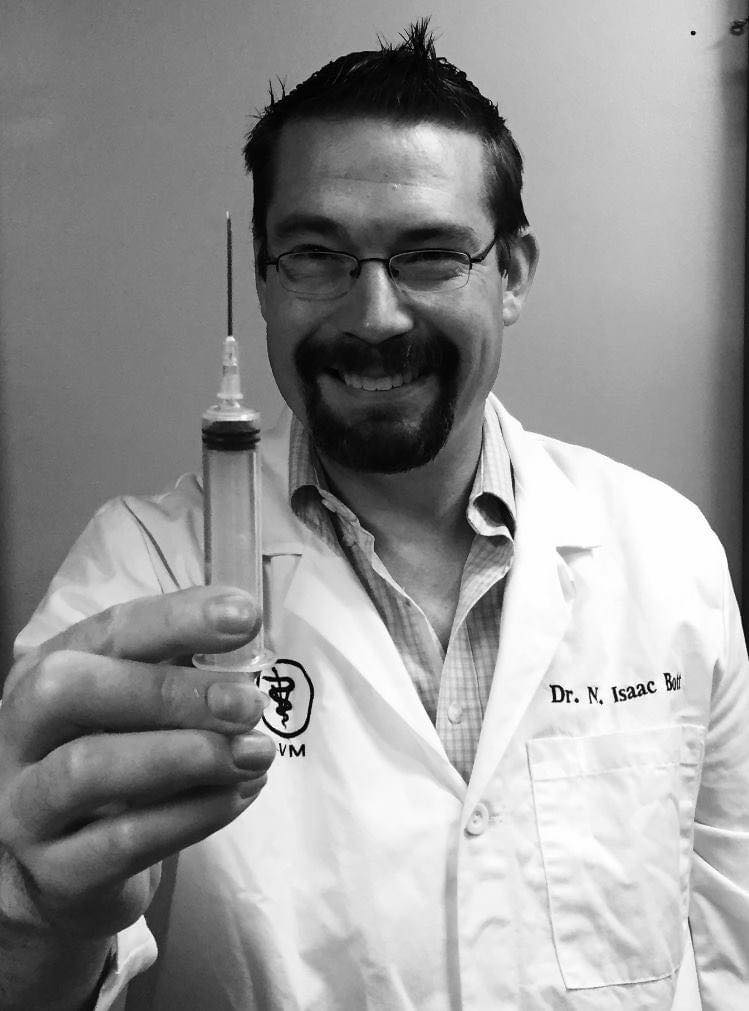
N. Isaac Bott, DVM
This photo is of Dr. Bott holding a newborn lamb on his family farm in 1985.

The Society for Theriogenology

My Take Tuesday: The Society for Theriogenology

Greetings from Oklahoma City! I am here to attend the annual conference of the Society for Theriogenology. This conference is an annual event that I have attended since 2007. Each year the meeting is held in a different city around the country. I eagerly await this conference each summer.

What is Theriogenology? Theriogenology is the branch of veterinary medicine concerned with reproduction, including the physiology and pathology of male and female reproductive systems of animals and the clinical practice of veterinary obstetrics, gynecology, and andrology. It is analogous to the OBGYN, Neonatologist and Andrologist of human medicine – all combined in a single broad specialization. From antelope to zebras, Theriogenologists work on all species of animals. It is a challenging, unique and rewarding discipline.

I became interested in theriogenology as an undergraduate at Southern Utah University. A professor and mentor named Dan Dail introduced me to this most unique area of veterinary medicine. I learned a lot from him. He entrusted me with a research project looking at the correlation of body condition scores and first service conception rates in heat synchronized beef cattle. His mentorship, along with this research contributed to my acceptance into veterinary school.

At Washington State University, I had the privilege of working extensively with Ahmed Tibary, a world renowned theriogenologist. He has made endless contributions in teaching, published books, chapters and scientific articles. His comparative approach taught me how to think and reason through difficult cases. He also entrusted me with the animals under his care. We published a significant amount of information on reproduction in alpacas. I remember with fondness my time working with him.

My theriogenology work has made me a better veterinarian. My clinical approach has been shaped and molded by the examples of so many mentors and teachers.

What drives me is the comparative medicine; that’s what makes my brain move. Whether I am in the clinic working on dogs or cats, or out working with bighorn sheep, elk, alpacas or water buffalo, I am doing what I love.

Upon a cabinet in the lobby of Mountain West Animal Hospital, a small statue sits. The statue depicts a bull named Nandi. Nandi is the white bull which symbolizes purity and justice in Hindu art and serves as the symbol of fertility in India. It is a Bos indicus bull anointed with gold and silver jewelry and its association in Hindu art and scriptures can be traced to the Indus Valley Civilization where dairy farming was the most important occupation. There are numerous temples in India dedicated solely to Nandi.

This statue was awarded to me after serving as president of the Society for Theriogenology in 2018. It is one of my most prized possessions. I am humbled by the opportunities that have come my way over the years as I have interacted with this unique group of veterinarians.

Kindness is a commonality among veterinarians who are reproductive specialists. They are approachable and humble. In a profession where arrogance often is the norm, they are a refreshing example of the best of the best. They are among the leadership at nearly every veterinary school in North America. They are leaving a lasting impression on the profession.

I am so proud to be a member of this group.

This is by far my favorite conference to attend. I look forward to learning from the best in the world this week and I can’t wait to apply what I learn at my own veterinary practice.

And that is my take.

N. Isaac Bott, DVM
“Doc, whatever she has, I’ve got the same thing too!”

My Take Tuesday: “Doc, whatever she has, I’ve got the same thing too!”

Animals and people dictate what happens every day for me. Simple routine appointments can turn out to be complex once the unpredictable, yet potent potion of human personality is added to the mix.

A few months back an elderly woman came into the clinic. Her cat had been suffering for weeks with non-stop itching. As I examined the cat, I noticed that this itch was insatiable. The poor cat had scratched and irritated nearly every inch of its body in an effort to satisfy the intense itch. The scratching was so intense, that nearly her entire body was covered with bleeding sores.

A diagnosis of mites was made after taking a skin scrape and looking at it under a microscope. This particular mite is elusive and difficult to find even for the most experienced veterinary dermatologists. However, it is highly contagious.

As I began speaking with the owner about the severity of the diagnosis and the need for immediate treatment, I could tell that her mind was wandering. She was clearly not focusing on what I was saying. I politely asked if I had said something that did not make sense or if she had any questions. Often, the open-ended questions will allow a client to discuss their concerns, however, I was not prepared for what happened next.

“Doc, do you think I have what she has?”, her voice was inquisitive. 

“Excuse me?”, I replied, “What do you mean?” 

Before I could say another word, this elderly woman dropped her pants. Literally right to the floor. Her legs were covered in large red lesions. The marks were evenly spaced like squares on a checkerboard. 

I am easily embarrassed, and when this happens my face turns a deep red. I stammered, “I…. I’m… a… I am sorry ma’am; you will have to go to your doctor for that”. The beet-red shade on my face persisted even after I exited the room.

I learned that day, albeit involuntarily, what “granny panties” look like.

As crazy as this may seem, I have had worse things happen while going about my daily appointments. However, those are saved for another My Take Tuesday.

My job is never boring. The two-legged creatures that come in keep it from ever being so.

And that is my take.

N. Isaac Bott, DVM
Skunked

My Take Tuesday: Skunked

A few months back, a Boy Scout troop stopped by the clinic at the end of the day for a tour. As I showed them around and answered their questions, I couldn’t help but reminisce about my time as a boy scout.

The year was 1995.

Boy scout troop 306 of the Castle Dale 1st Ward embarked on a week-long 50-mile hike during the month of July. The hike began on a Monday at Ferron reservoir and ended on Saturday at Indian Creek Campground in the beautiful Manti Lasal National Forest.

As a 14-year-old kid, I was just like most of the other boys in my troop: wholly naive and completely unaware of my ignorance. My sense of adventure far outweighed sound logic and I was prone to encounter trouble because of my mischievous nature. My little brother Caleb and my best friend Zac were my partners in crime and were witnesses to myriads of situations that shaped our imaginative Boy Scout days working on merit badges, monthly camp outs and high adventure events that eventually led to each of us earning the rank of Eagle Scout. These experiences consequently helped make us into the men we are today.

On the second night of this long hike, we made camp at a place called Cove Lake. This beautiful lake is just a few miles from the scenic skyline drive and is nestled in a large grove of Douglas Fir and Ponderosa pines.

As Boy Scouts do, we set out to set up camp and explore the lake. We soon found out that we were not the only species inhabiting the camp on this night. We shared the campsite with one of the most widely distributed mammals in North America, Mephitis mephitis, or the common striped skunk. The fecund creatures were everywhere. As we floated around the lake on a makeshift raft, we could see dozens of them around the water’s edge.

We clearly had a dilemma. Almost immediately, the skunks began ransacking our tents and food supply. These smelly striped critters were endlessly curious about the bipedal invasive species that had entered their territory.

Passive in nature, skunks will avoid contact with humans and domestic animals; however, when challenged they are amply prepared to protect themselves.

If a skunk feels threatened, it will give a warning which includes hissing, stomping of feet, and elevation of the tail. Failure to heed the warning signs will result in the unlucky aggressor being sprayed with the skunk’s anal gland secretions. Skunks are highly accurate in their aim and can spray 7 to 15 feet away!

A dozen rambunctious boys were immediately perceived as a threat by the striped beast. They seemed to coordinate the invasion of the camp, approaching from all directions.

A scout watching the skunk rodeo spoke to me, “Hey Isaac, if you hold a skunk by its tail, it can’t spray you.”

The notion had some truthiness to it, after all, if it can’t plant its feet, it likely wouldn’t be able to empty its scent glands.

Without any further thought, I reached out and grabbed the nearest skunk by the tail. I lifted it directly in the air and held it suspended with my arms straight out.

The little guy simply twirled slightly and lined his backside to my face and fiercely sprayed with all that he had.

It went directly in my mouth and up my nose. It covered my entire face, and some even got in my eyes.

I immediately began vomiting uncontrollably. By eyes burned and my vision became blurry.

What a lesson! Take my word for it, a skunk can certainly spray when its feet aren’t on the ground. This equivocated logic is dangerous.

As Mark Twain once observed, “It ain’t what you don’t know that gets you into trouble. It’s what you know for sure that just ain’t so.”

The odeur fetide that I experienced is a thick, volatile, oily liquid that obtains its pungency from sulfur-based thiols. There in nothing that smells worse than skunk spray inside your nose!

It took weeks before I stopped smelling skunk.

Frantically, I raided the food tent in search of cans of tomato juice. I found 8 cans and a can opener. I then took a tomato shower. I scrubbed my head and every inch until my whole body was covered in tomatoes. You haven’t lived until you take a shower in tomato sauce.

The rest of the week proved to be much less adventurous. I was forced to sleep in my own tent, and I walked behind everyone else along the trails.

Now when I see a skunk, I give it plenty of space. And I tell everyone that I can that contrary to popular myth, a skunk can spray even when being held off the ground by its tail!

And that is my take!

N. Isaac Bott, DVM

The Southeastern Utah Junior Livestock Show

My Take Tuesday: The Southeastern Utah Junior Livestock Show

Black smoke bellowed vertically, cutting through the blue Castle Valley sky. The news was difficult to process. The images were seared into my mind. On Monday night, June 24th, the stockshow barn at the Southeastern Utah Junior Livestock show was gutted by a raging inferno. Within minutes, the destruction was complete. 

This large red barn in Ferron, Utah occupies many of the ravines and ridges in the canyons of my memory. 

I exhibited lambs at my first show in the summer of 1988. Each summer of my childhood included a week inside this barn. I can still smell the wood shavings and hear the hustle and bustle of the show barn. I can taste the snowcones and cheeseburgers. I hear the voice of the auctioneer and the bid callers surrounding the arena yelling, “YEEEPPPP!” with each increasing bid. 

Life can change in an instant, leaving us standing alone, wounded, with only our memories to comfort us.  

During the past week, I have thought much about this tragedy. I have wondered why this stings so badly. What about this building is so difficult to let go?

Much of who I am today is because of this small community. This stockshow builds character, fosters discipline, educates youth about agriculture, and promotes sportsmanship. Caring for animals brings out the best in us. Whether it is a piglet, a lamb, a calf, a puppy, or a kitten, with events like these children learn what it feels like to have a living creature rely on them. This teaches responsibility in a way little else can. Caring for a pet creates a sense of empathy and a respect for life. It teaches commitment and consistency, builds self-confidence, and provides immense joy.

I remember as a 7-year-old, how attached I became to my own lamb during my first show.  I cried on the day of the sale as I hugged my lamb goodbye. 

One of the greatest values of this livestock show provides is the opportunity for youth to gain confidence by caring for something that is completely dependent on them. I remember a young child who was hesitant to enter a pen with the lamb he was preparing for the stock show that year. The previous year, he had been injured by a ram while feeding the sheep with his dad, causing him to develop a fear of sheep. Even standing near a pen of sheep made him shake with fear. 

Despite his fear, he had to confront it because without his care, the lamb would not be able to eat, drink, or have a clean and tidy living space. Gradually, this young boy grew more comfortable around livestock. I see a reflection of this timid boy every morning when I look in the mirror. 

This unforeseen event occurred just weeks before the stockshow was to take place. The committee that organizes this event was resolute in finding a way forward following this tragedy. Fortunately, this year’s show will still be held at an arena just 10 miles away in Castle Dale. 

I am sharing a photo from inside this barn from 1988. 

The smile on my face right now is just as big as I remember this exciting day. 

And that is my take!

N. Isaac Bott, DVM

Hazel and the Skunk

My Take Tuesday: Hazel and the Skunk

As a teenager growing up in the small town of Castle Dale, I looked forward to summers at the end of each school year. Summer meant freedom from both homework and sitting at a school desk.

For me, a perfect summer day would have to include vanilla ice cream, snow cones and strawberry shortcake. The tranquil Castle Valley evenings provided frequent opportunities to cook hot dogs, hamburgers and steaks on the grill, corn on the cob on the stove, and juicy Green River watermelon slabs with each meal.

Summertime also meant hard work. Apart from the irrigating and farm chores, there were a number of elderly widows in Castle Dale that would hire my siblings and I to mow their lawns each week during the summer.

Hazel was my favorite. Her small house stood just north of the new recreation center in Castle Dale. Hazel was like family to me. Her friendly demeanor and kindness were manifest each and every time I mowed her lawn.

She had a small but verdant lawn that surrounded her small gray house. Along the south end of her property, huge trees stood as sentinels protecting the house from the frequent Castle Valley wind. The deep green leaves of the tall trees overlooked a perfectly manicured garden with straight rows of Swiss chard, chives, radishes, peas, carrots, spinach and lettuce.

Her lawn was difficult to mow. The frequent flowers and bushes required extreme care and precision with the lawn mower and edger. I would frequently graze her chives and the onion smell would instantly give away my error.

“On no, you hit my chives!” she would say. I anticipate that she planted larger quantities each year knowing that some would certainly fall prey to my mower.

After finishing the mowing, Hazel would prepare red punch and cookies. I would sit on a couch in her living room as I savored the snacks week after week. Hazel would ask about how my life was going, and she would tell stories of her Seely and Livingston pioneer ancestors that helped settle Utah and build the iconic Salt Lake Temple.

Hazel loved cats. She had a cat door that would lead out to the back yard from her kitchen. She would place a large bowl of cat food in the center of the kitchen and the cats could enter and leave as they please.

On this particular day, Hazel commented about how much cat food she had been going through. She noted that she would have to fill the cat dish 3 or 4 times a day and that each time she entered the kitchen, the bowl would be empty.

As I sat on the couch, I had a clear view of the cat bowl in the kitchen. As Hazel spoke, from the corner of my eye I noticed some movement near the bowl. As I turned my head and looked into the kitchen, the biggest skunk I had ever seen wobbled over to the food bowl and began gorging.

“Hazel!” I exclaimed. “That is not a cat, it is a big fat humongous skunk!”

“My laws!” she gasped. “Get it out of here!”

As I jumped up, the startled skunk made a dash for the door. Its overweight body condition inhibited it from any appreciable speed. The large belly nearly dragged on the ground as it meandered away. As it leaped for the cat door, the front half of the body exited perfectly, however, its back half didn’t quite make it. As the obese animal heaved its back end though the door, it simultaneously and voluminously sprayed the contents of its scent glands in my direction. This wallop of its defense mechanism filled the entire kitchen.

If you haven’t experienced the mephitic smell of a skunk from up close, the odeur fétide is actually a thick, volatile, oily liquid that obtains its pungency from sulfur-based thiols. There in nothing that smells worse than skunk spray inside your nose!

Hazel and I exited out the front door. We propped open the kitchen door and placed a fan on the floor to help air out the house. We laughed about it for hours.

Hazel passed away shortly after Memorial Day in 2003. I sure do miss her.

Each and every summer day brings back the fond memories of Hazel, the obese skunk, and the all-you-can-eat Mephitis buffet.

And that is my take!
N. Isaac Bott, DVM

Community

My Take Tuesday: Community

It was a cold mid-February day on the Palouse. I had traveled to Pullman this day for an interview at Washington State University. My chances were slim. I was applying for a nonresident position in the College of Veterinary Medicine’s class of 2009. My palms began to sweat as questions were asked about my qualifications and application. Organic Chemistry. Yeah, I had received my lowest grade in this class during undergrad and knew that I would be asked about it. I did my best to answer the question in a satisfactory manner.

The next question was unexpected.

“Isaac, what purpose does a veterinarian serve in a community?”

I paused as I thought about this inquiry.

My mind returned to my teenage years when I served on the Youth City Council for the small town of Castle Dale, UT. This rewarding time allowed me to give back to the community that formed so much of who I am today.

My answer was as follows: “A veterinarian has the obligation to be an example and a good citizen. The amount of good accomplished through this entirely depends on the effort a veterinarian puts into the community. Effort is reciprocated many times over when someone donates their time and talents through community service.”

I promised that, if I were lucky enough to become a veterinarian, I would do my best to give back to the community that I reside and practice in.

They apparently accepted this answer and a few months later I began veterinary school.

I have done my best to keep the promise I made in that interview nearly 20 years ago. I have grown to love Springville, the surrounding Utah Valley community and enjoy running my own small business. I look forward to coming to work each day.

Several years ago, I began volunteering at local rescues and animal shelters through a variety of services. One service is providing low-cost vaccination and licensing clinics in local communities. We have been able to provide vaccines for over 1000 pets in Utah County this year alone. This requires us to close the clinic over a dozen Saturdays we would normally work. Despite this, we are extremely grateful for our understanding clients that remain loyal without this periodic Saturday availability.

I also have helped train Animal Control Officers and animal shelter employees from all over the state the technique of humane euthanasia. This requires both in-class and hands-on training to properly learn to administer intramuscular and intravenous injections.

These opportunities have been so rewarding for me! I very much enjoy getting to know all of the people that dedicate their lives to caring for those without a voice. The immense joy that I have felt volunteering my time has rejuvenated my passion for veterinary medicine and has helped my become a more patient, kind and caring person.

Last year, I was invited to speak at the annual conference for the Utah Animal Control Officer Association. An awards banquet was held in the evening of the opening day of the conference. I was completely surprised to receive the association’s 2023 Volunteer of the Year Award.

This award is something that I am very proud of. It has been such an honor for me to work with such wonderful people. From my team at Mountain West Animal Hospital to every single animal control officer and shelter employee, I thank you for your often overlooked efforts that you make every single day. Many of the lives you change are the animals that you care for. You make the world a better place and I salute you for it.

Volunteering your time to support a cause you are passionate about is something you will never regret. It will enrich your life, familiarize you with your community, and connect you to people and ideas that will positively impact your perspective for the rest of your life. Helping your community is an opportunity for you to grow as a person and to better understand how you fit into the world around you.

I am excited for the future and for further opportunities to be able to share my knowledge and expertise with this wonderful community. I am my happiest when I am helping others.

I encourage everyone to consider serving the community in your respective spheres of influence. It is something that will provide you with unparalleled contentment and sense of purpose.

And that is my take!

N. Isaac Bott, DVM

Father’s Day

Father’s Day

The giant snowflakes gently fell in perfect rhythm. Even though it was 6:00 AM, I could see clearly through the winter whiteness. This particular winter during the 1980’s in Castle Dale was incredibly harsh. Nearly 18” of snow had fallen over the past 24 hours. The field across the street from my parents house was covered in a thick blanket of white. I bundled up as I prepared to leave the house to do the morning farm chores.

My dad led the way as we headed across the street to the corals. The deep snow proved to be a challenge for my short legs. I jumped and lengthened my stride as I placed my feet inside my father’s footprints. As long as I followed his steps, the path seemed manageable

My dad is a giant of a man. I remember attending a Cub Scout pack meeting as a young boy. At this meeting, a plank was placed on the floor and a 16 penny nail was started in the center. A competition was held where all of the father’s in the room had a chance to hit the nail as hard as they could. Some were able to drive the nail in completely with 2 or 3 hits. When my dad’s turn came around, he buried the nail with a single swing of the hammer. I remember thinking how amazing that was! He could loosen old rusty bolts with a quick flick of his wrist, he could throw a bale of hay on top of a haystack and no one could use a shovel like him. In my eyes as a young boy, he seemed to be able to do anything. My dad has been my hero as far back as I can remember.

I remember a time where he had learned that a man living in town did not have a bed in his house to sleep on. My dad went and purchased a brand new bed with his own money and delivered it to this man that he didn’t even know. Years later, this man told me that this act was the kindest thing that anyone had ever done for him in his life. My dad taught me how to care for others less fortunate time and time again through his example.

Each summer, my dad would set aside time to take each of his five children camping with him individually. We would get to chose the destination of this one on one time. I remember the cold air and the damp grass. I remember the smell of the air. I remember eating Pringles and sitting by a campfire. I remember eating small boxes of Cocoa Krispies and catching fish.

Oh how I looked forward to my annual camping trip with dad! My favorite spot was in Upper Joe’s Valley. This overnight camping trip always provided an escape from the every day chores and busy summer days.

Despite working 7-5 every day, somehow dad would find the time in his incredibly busy schedule to take each one of us individually every single year. This was dad‘s way of showing us how much he cared. Although he loved each of us equally, during these outings we all felt very special. I remember every single trip and I cherish these memories.

I remember one particular time when I was working at the cemetery. The volume of work there had overwhelmed me. There was so much to do and I couldn’t get it done. Dad, after working all day at a thankless and stressful job, came to the cemetery and cut the individual daisy flowers off of the dozen or so bushes in the flower bed. This tedious process took several hours. I was thankful that night, but now looking back, tears come to my eyes. I know how tired and worn out I am after working all day. How did he have the energy to do all that he did?

In today’s world fathers come and go. Having a stable father is a rarity. My dad was always there to work with us. I remember many times going out to the farm with dad and being so stressed I couldn’t function, and after a few hours of digging ditch anything that was bothering me would disappear. Growing up, I was taught how to do good work and to be proud of my accomplishments. My dad did this, not by leaving a list of chores to be accomplished, but by working right there alongside us,

A statue on my dad’s dresser depicts a father with a small child sitting on his knee. The inscription reads, “Any man can be a father, but it takes someone special to be a daddy.” My daddy’s example was not lost on me. His unconditional love has inspired each of his 5 children to be the best that we can be

I have often wondered exactly what is the measure of a man? Is it the softness of his heart? Is it the hardness of his hands? Is it in the words he speaks or the legacy he leaves?

When the storms of life have blown and tossed me around, I have always been able to think about the example my dad set for me. He has walked the same path, has wished upon the same stars and he has worried about the same things. This brings me so much comfort. It helps me tremendously when I have to make tough decisions.

One of the most unfortunate things in my life is that it has taken me years to realize how essential my father’s role was to build my character, my ethics and most importantly, my happiness. His blood runs through my veins and his example is in my soul, and although my life has been a poor attempt to imitate his example, I am doing the very best I can.

This Father’s Day, I still find myself trying to follow my father’s footprints in the deep snow. He is my constancy and my mentor, my rock and my friend. He is my hero!

Thank you dad for your unconditional love. Thank you for your guidance. Thank you for teaching me how to work, to love and for teaching me how to treat others with kindness.

Happy Father’s Day!

N. Isaac Bott, DVM

The Charismatic Chameleon

My Take Tuesday: The Charismatic Chameleon

It was a beautiful spring morning on the Palouse. The beautiful rolling hills and contrasting colors make this region of the country so unique.

As I left my apartment, I took a moment to bask in bright sun of this gorgeous brisk spring morning, permeated with the scent of recent rain. Songbirds filled the air with music that would thrill the greatest maestros, and warblers and finches flashed their dazzling colors in the bushes outside my apartment.

I was an excited 4th year veterinary student just weeks from graduation. As I drove to the veterinary school, I reflected on the past 4 years. A flood of memories entered my mind as I smiled and felt a sense of accomplishment, these were some of the most difficult years of my life and the end was in sight.

This particular weekend, it was my turn to take the emergency call at the veterinary teaching hospital. I had spoken extensively with classmates about what exactly to expect to present throughout the weekend. Each indicated that many dogs and cats would likely present with a variety of ailments. I fully expected to see a variety of routine cases dealing with the perfidious parasites, bothersome bacteria and mysterious maladies that present daily in the life of a veterinarian.

I was not prepared for what was to follow.

Throughout the weekend, a variety of cases presented, none of which were dogs or cats, and none of which I would ever consider routine.

The first case was a hairless rat. This was followed by a parakeet with a broken and bleeding blood feather. A raptor presented with a wing injury and a duck with a fishhook stuck in its bill.

Still another anomaly followed as a boa constrictor presented with a prolapsed cloaca.

At this point in my education, I had virtually no experience with exotic animals. I am terrified of snakes and absolutely did not know the first thing to do with a prolapsed cloaca. I barely knew what a cloaca was!

Fortunately, an exotic animal clinician was a phone call away and she was able to talk me through each case. I learned a lot as I treated each animal and did my best to make each owner and pet comfortable.
Just when I thought I had everything under control, a young woman walked through the front doors of the hospital caring a white box. Small circular 1” holes were cut in each side of the cardboard box.

“I have a chameleon that is sick,” she nervously said with obvious fear and concern in her voice.

I placed my face against the box and peered through one of the small holes. A huge eyeball was all that I could see. Its unflinching stare was somewhat startling.

“He is huge!”, I exclaimed.

“No, he isn’t,” she replied, with her voice raising, “He is actually smaller than most.”

“I am sorry,” I replied, “I haven’t ever seen a real chameleon.”

“Oh great, go figure, not only do I have to deal with a student, but I lucked out and got one that clearly doesn’t know what he is doing!” She was clearly upset at this point, as she sighed and shook her head.
Assertiveness has its place, but it is not always a virtue when you are on the receiving end.

“I am sorry,” I began, “Although I am inexperienced, I will call someone that is very competent with chameleons and we will take care of him. I promise I will do my best.”

She seemed to calm down somewhat after this and handed me the white box. I carried the box into the treatment area and immediately opened the lid and peered in. The chameleon stood perched on a branch, clinging with each of its 4 feet. It’s deep green color mimicked the leaves that were placed throughout the box.

I gently removed the little guy and placed him in the glass aquarium type pen used to hospitalize reptilian patients.

Almost immediately, his deep greed color began to fade as he miraculously turned brown, almost identical to the ambience of his new surroundings.

I reached for the phone and dialed the number of the on-call exotic expert. I immediately rattled off the details of the case (age, sex, presenting complaint, clinical signs and examination findings). I then explained that I had ZERO experience with this species and that I needed detailed instructions.
Her first question took me off guard.

“Is he pale?” she inquired.

Immediately, I thought to myself, “You’ve got to be kidding me!”

“I am not sure,” I replied. “He was green in his box and then he turned brown when I moved him into the hospital. Now he is looking like a mix of brown and gray.”

“How in the world can you tell if a chameleon is pale?” I inquired.

Fortunately, this clinician sensed the frustration in my voice and laughed. She was very patient as she began to explain exactly what I needed to look for.

She talked me through how to administer fluids to a reptile. This is accomplished differently that with other species. Instead of finding a vein and administering the fluids intravenously, they are administered in the common body cavity called the coelomic cavity. I spent the entire night treating this unique patient and monitoring its progress.

Somehow, the chameleon survived. I learned a great deal throughout the remainder of the weekend. Not a single dog or cat ever presented, but I gained confidence and experience with each of the exotic animals that continued to present.

But still to this day, I have no idea how to tell if a chameleon is pale.

And that is my take!
N. Isaac Bott, DVM

Pyometra

My Take Tuesday: The Parsimonious Pyometra

Apart from preventing unwanted pregnancy and pet overpopulation, routine spaying of female dogs has been historically recommended for two reasons: 1) Reduce the incidence of mammary cancer, and 2) Prevent the female from developing pyometra later in life. This is caused by a bacterial infection of the uterus resulting in a potentially fatal infection.

The word pyometra can be divided into two root words: Pyo meaning pus and Metra referring to the uterus. A pyometra starts after a dog goes through a heat cycle, usually within about 2 to 5 weeks. A pyometra develops due to repeated prolonged exposure of the estrogen-primed uterus to progesterone (estrogen increases the number of progesterone receptors in the endometrium). Female dogs are prone to uterine disease due to the unique nature of cycling in this species. As infection develops in the uterus, the uterus fills with pus. The most common bacteria isolated in these cases is E coli. The uterus with a pyometra can be huge! I have surgically removed an infected uterus weighing over 11 pounds from a 56-pound Golden Retriever.

The clinical signs associated with this disease are anorexia, depression, drinking and urinating more frequently, abdominal distention, and sometimes a vaginal discharge is noted. Vomiting and diarrhea may also be present, especially late in the course of the disease. If any of these clinical signs are noted in your pet – immediate veterinary consultation is imperative.

Females that develop pyometra have an underlying condition called cystic endometrial hyperplasia. Most intact females older than 5-6 years have some degree of this. Most cases are treated by removing the infected uterus and ovaries. This surgery is very difficult and much more expensive than a traditional spay. There are many more post-operative complications that may arise that are not associated with a routine spay.

These include:

Peritonitis – is the inflammation of a thin layer of tissue inside the abdomen. It’s a medical emergency, and it’s often caused by infection.

Disseminated intravascular coagulation – a clotting disorder that is often fatal.

Sepsis – occurs when chemicals released in the bloodstream to fight an infection trigger inflammation throughout the body. This can cause a cascade of changes that damage multiple organ systems, leading them to fail, sometimes even resulting in death.

It is simple to avoid this. Females not intended for breeding should be spayed at a at a relatively young age. Females used for breeding should be closely monitored by both the owner and the veterinarian.

There is not a one-size-fits-all recommendation about what age is best to spay and neuter. Studies suggest different ages for different breeds. It is important to discuss these recommendations with your veterinarian and develop an individualized plan for your pet. 

If you are hesitant to spay your pet because of the cost of the routine surgery, you must consider the cost of an emergency pyometra surgery also. Such a surgery is at least 3-5 times higher than what a routine spay would be.

At Mountain West Animal Hospital, we discuss both the benefits and detriments of routine spays and neuters and strive to help you make the best decision for the health and well-being of your individual pet. You can count on us as a trusted partner in the care of your four-legged family member.

And that is my take. 

N. Isaac Bott, DVM