
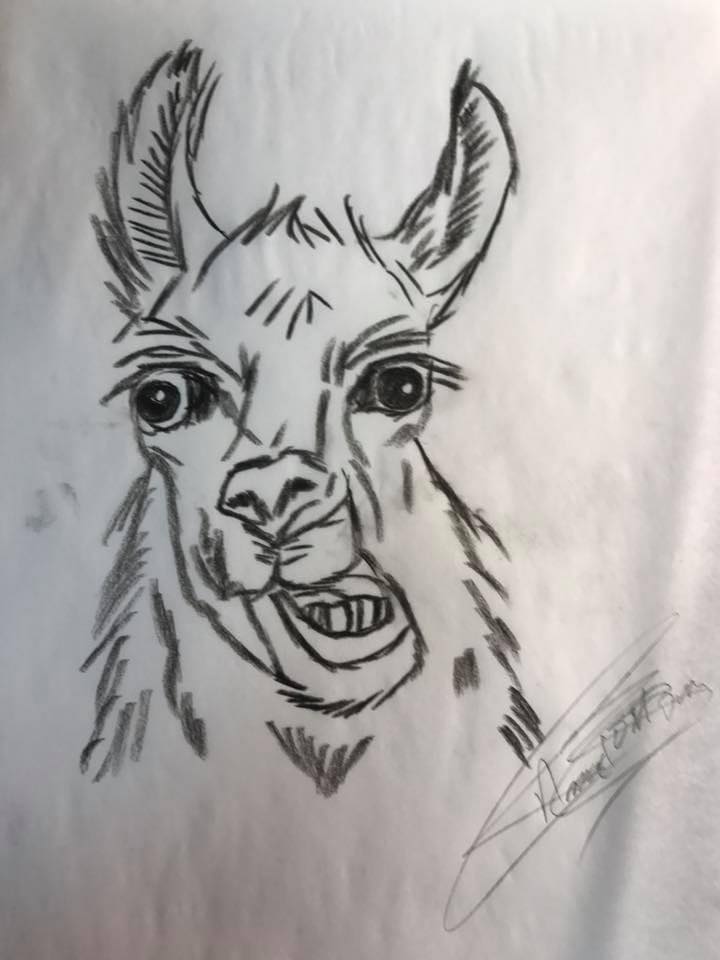
My Take Tuesday: The Llama Que Se Llama Lloyd
It was a quiet Sunday afternoon, and I had just settled onto the couch, ready to enjoy the best part of one of my favorite movies. The peace was short-lived. My phone rang, jolting me from the comfort of cinematic escapism.
“Hello, this is Dr. Bott,” I answered, slipping into my professional tone.
“Hey Doc! I need you to come check on my llama. He’s gone absolutely berserk!”
There was panic in her voice. “He just ate my blouse off the clothesline. Yesterday, he spit right in my eye. He keeps biting Susie and Dolly—those are my other llamas—and he’s been attacking anyone who dares step into his pen!”
If I’ve learned one thing in veterinary medicine, it’s that calls involving llamas often come with a unique flavor of urgency. Perhaps it’s the temperament of the animals, or perhaps it’s the humans who choose them—but either way, the stories tend to be unforgettable.
“And I even tried calming him with lavender oil!” she added, “but he bit my finger!”
“Oh my,” I replied, masking the mix of concern and curiosity already brewing in my mind.
The term berserk has been applied rather liberally over the years to llamas or alpacas that behave outside the norm. But from her description, I sensed this wasn’t just a dramatic overstatement—this was a legitimate call for help.
“Is your llama male?” I asked, shifting gears to triage.
“Ya’ darn tootin’ he is.”
“Is he castrated?”
“No, we ain’t got around to it yet.”
Aha. In my experience, few things will settle down a wild-eyed macho llama like timely castration—especially if performed before puberty. Intact males, particularly those imprinted on humans, can become dangerously aggressive. This condition is often referred to as berserk male syndrome—a misdirected dominance behavior rooted in confusion about whether their handlers are rivals… or fellow llamas.
As I headed south on I-15, I reviewed the condition in my head. True berserk male syndrome is rare but serious. It often arises when young male llamas are bottle-fed or raised without appropriate interaction with their own species. They grow up believing humans are part of their herd.
As I turned down the gravel road leading to the client’s farm, I saw him.
Lloyd.
A tall, fiber-covered llama with a fierce expression and a gait that seemed to challenge the earth beneath him. His screeching alarm call—a high-pitched shrill overlaid with a guttural rumble—echoed through the stillness. He bolted along the fence line, wild-eyed and furious.
Lloyd had the long banana-shaped ears of a llama, but with his thick facial fiber, he could’ve passed for an alpaca in disguise. As I stepped out of the truck to greet Mrs. Jones, I was promptly baptized with a full-face projectile of regurgitated cud.
Veterinary medicine keeps you humble.
Between coughs and wipes, I explained our plan: “We need to sedate Lloyd. I’d like to examine his teeth, and—as you’ve requested—castrate him while he’s under.”
Mrs. Jones didn’t hesitate. “Maybe he’ll calm down if we chop his balls off!”
No matter how many years I’ve been doing this, that line always makes me chuckle—especially coming from a straight-faced rancher.
Administering the tranquilizer took some teamwork—and endurance. We were both doused in more spit and absorbed a few solid kicks before the sedative finally took hold. Lloyd laid down and drifted off to sleep.
Upon examining his mouth, I found the culprit: his fighting teeth—sharp premolars used for dominance displays—had grown into the soft tissue of his cheek. Every chew, every bite, had been laced with pain.
With the offending teeth safely removed and the castration complete, Lloyd awoke a new man—or rather, a calmer camelid.
He walked gently beside Mrs. Jones as she led him back to the pen. She beamed as Lloyd nuzzled her cheek for the first time in weeks.
“That’s my boy,” she whispered, wiping a tear with her free hand.
It wasn’t berserk male syndrome. It wasn’t bad behavior. It was pain—pure and simple.
If only animals could tell us where it hurts. But they can’t, not in words. Instead, they rely on behaviors, however bizarre or “berserk,” to speak for them. And it’s our job—whether as veterinarians, caretakers, or pet owners—to listen.
Lloyd reminded me of that.
And that is my take.
N. Isaac Bott, DVM
 DocBott