
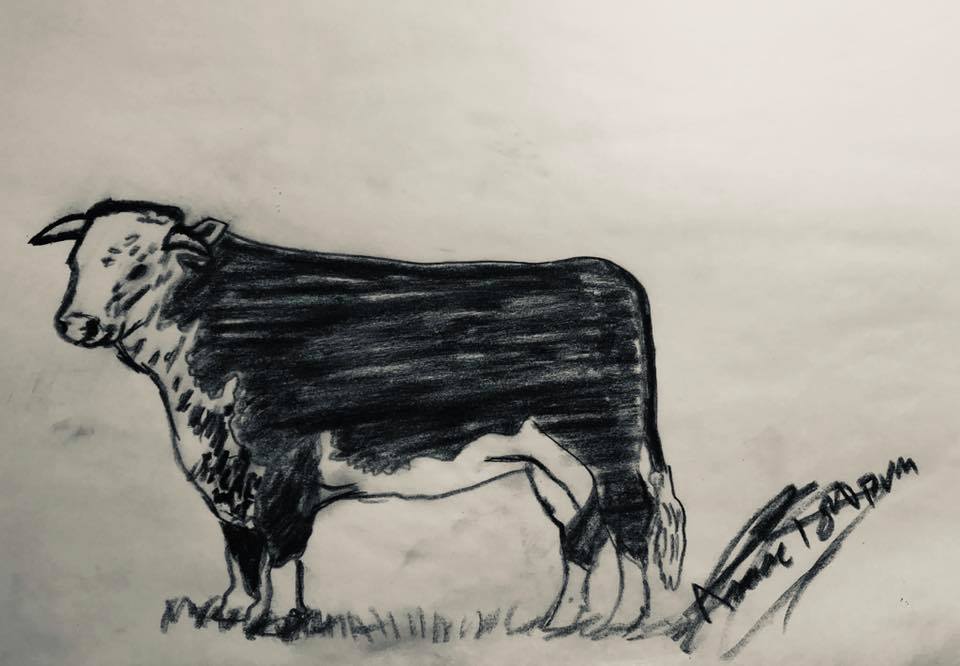
My Take Tuesday: The Belligerent Bovine
January in Utah is a striking season. The landscape is blanketed in white—snow-covered peaks, rooftops, and fields blending into a serene, colorless canvas. A profound stillness settles over the land, as if the world itself is at rest. But then, without warning, winter reclaims her dominion with biting blizzards, disrupting the peace and tightening her icy grip.
It was on one such frigid morning that I stepped out my front door into air so cold it burned my face. At twenty below zero, each breath stung my nostrils. Yet, amidst the harshness, Utah’s January nights hold a quiet beauty. Driving to emergency calls in the dead of night, with only the hum of the engine and the glow of headlights cutting through the darkness, I find rare moments of solitude. In those brief windows, I can pause, reflect, and cherish the stillness that my busy life seldom allows.
That night’s call was for a Hereford cow with a laceration. She had somehow tangled herself in a barbed wire fence, leaving a gaping wound that oozed fresh blood. As I approached the squeeze chute, the crimson drops fell onto the snow, creating vivid streaks that steamed faintly in the freezing air.
It was clear she needed sutures.
Few tasks test a veterinarian’s grit quite like suturing in subzero temperatures. It’s an exercise in patience, endurance, and sheer determination.
Opening my supply box, I found most of the drugs frozen solid. Thankfully, the lidocaine was still liquid. Drawing it into a large syringe, I injected the anesthetic around the wound’s edges. The old cow bellowed, her frustration and discomfort evident.
With numb, stiff fingers, I began placing sutures in a simple interrupted pattern. Between each stitch, I paused to flex my hands, hoping to restore some dexterity. Exhaling warm air onto them only worsened the chill. The cold was unrelenting, but I pressed on, determined to finish the job.
As I secured the final suture, the cow lunged forward, slamming her massive belly against the chute and pinning my hand. A sharp pain shot up my arm as I jerked my fingers free, wincing from the sudden jolt.
“Alright,” I said, stepping back, “turn her loose. We’re done.”
The moment the head gate opened, the Hereford burst out of the chute, bellowing and swinging her head in wild protest. She charged forward about twenty yards before stopping abruptly. Then, to my dismay, she turned and locked eyes on me.
Trouble.
Quickly grabbing my tools, I ran for the fence. Behind me, 1,800 pounds of furious bovine thundered in pursuit. Her bellows filled the frozen air, and I could feel the vibration of her hooves pounding the ground.
I didn’t dare look back as I scrambled over the lodgepole pine fence surrounding the corral. Just as I swung my leg over, she skidded to a stop on the other side, her head low and nostrils flaring. She stared at me, bewildered, as if questioning how I had escaped her wrath.
My heart hammered in my chest, adrenaline coursing through me as I caught my breath. That was one angry cow.
Once I was safely back in my truck, the throbbing in my squished hand returned with a vengeance. Still, I was grateful—grateful to leave the belligerent bovine far behind. As I drove away on the frozen highway, I couldn’t help but think back to my days at Washington State University’s veterinary school. In the large animal section of the teaching hospital, there was a magnetic sign that read:
“Fractious cow can make it to the gate in 2.5 seconds. Can you?”
It would’ve been the perfect sign for that squeeze chute on that Utah County farm.
And that’s my take.
N. Isaac Bott, DVM
 DocBott