
My Take Tuesday: The Red Handkerchief
As a veterinarian, I all too often find myself in precarious situations.
Upon graduating from veterinary school in 2009, I moved back home here to Utah. My first job out of school was right here in Utah County.
It was not unusual for me to be called to attend a dozen or more lame and injured cows on a particular day. You might arrive to find them in a paddock with no sorting pen and therefore no means of restraining them for treatment. What are you going to do? Unfortunately, farmers often have the attitude that you’re the vet, they’ve called you out to do the job, so they expect you just to get to it. Often these cattle facilities left much to be desired. A few broken palates, some bent powder river panels and a welded together squeeze chute constitute pretty decent working conditions.
Usually, some unsatisfactory compromise could be sorted out which would reinforce the fact that you were not half as good as their old vets.
Max was no exception. He stood 6’1″ and was as skinny as a bean pole. He always had a runny, drizzly nose, and he kept a red handkerchief in the front pocket of his bib overalls. Max didn’t want a new young vet working on his cows. He was used to the old school way and had no reason to change.
I was greeted on one of these farm visits by this familiar refrain: “We used to use old Doc SoandSo. Have you heard of him? Best dairy vet in the county. Of course, you’re new and not used to dealing with dairy cows down here are you?”
Perhaps I am unduly sensitive but being told you’re second best before you’ve even begun is either irritating or depressing—depending on how your day has been. This day tipped more toward the irritating side.
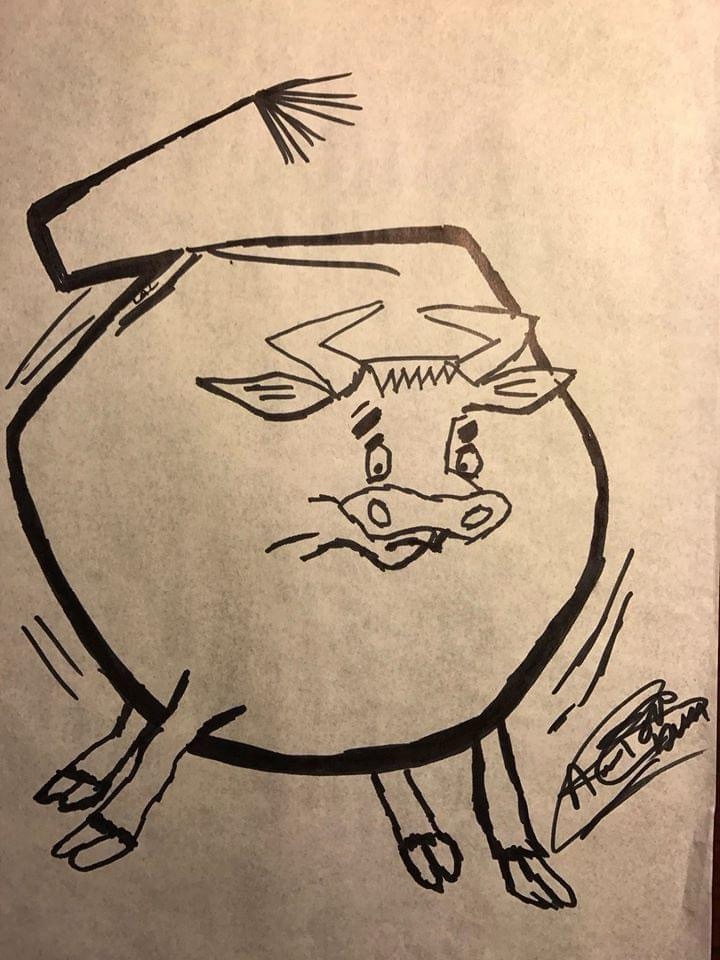
Suzy was the name of his milk cow. She was a tall Holstein crossbreed cow. On this particular day, Miss Suzy stood in the knee-deep pasture staring at us as we entered the field. She was swollen up like an engorged wood tick. On her left side, her stomach was protruding so far that she was as wide as she was long. The diagnosis, even from afar was obvious.
She was bloated.
Bloat is a digestive disorder characterized by an accumulation of gas in the first two compartments of a ruminant’s stomach (the rumen and reticulum). Production of gas (primarily carbon dioxide and methane) is a normal result of fermentation processes. The gas is usually discharged by belching (eructation) but, if the animal is unable to remove the excess gas, pressure builds up in the rumen-reticulum exerting pressure on the diaphragm which prevents the animal from inhaling, and bloat occurs. The most common type of bloat is frothy bloat where gas builds up in a foam or froth above the rumen contents and the normal belching is inhibited.
Imagine a 40-gallon tub of partially digested green stomach contents. The pressure of this stomach is such that when it is alleviated, it is similar to popping a balloon, this disgusting smelly concoction will spew in a fashion similar to the Old Faithful Geyser.
Before we could even isolate her in the corner to begin treatment, Max decided he needed to blow his nose. As he pulled out his bright red handkerchief, he flipped it with his wrist and positioned it to evacuate his proboscis. Suzy caught sight of this red temptation and came charging full speed – like a freight train – straight for us. She was bellowing and blowing snot in a fit of rage.
In a situation like this, it doesn’t matter how quick you are. The only relevant assessment of speed is how fast you are in relation to the other person in the pasture. I figured I could beat Max to the gate but would feel guilty in so doing.
I braced myself for the impact. Max yelled, “Hey Now!”
Suzy collapsed just steps before she reached us. The massive pressure caused by the bloat had cut off her air supply. She lay in a heap in front of us.
The treatment for bloat in a case like this is to relieve the pressure as fast as possible. An incision in made through the left side of the abdomen and the rumen is decompressed. In a situation like this, you only have a few seconds to act. My surgical instruments were in my toolbox over by the gate. I knew there wasn’t time to retrieve them.
I reached in my pocket and pulled out my Old Timer pocketknife. I made a quick incision with the sharp point.
Immediately, air began spewing out. It sounded like removing a valve stem from a car tire. It whistled as the massive stomach returned to normal size. Shortly thereafter, Miss Suzy was back on her feet and back to her normal self.
As I prepared to leave, Max commented, “Hey Doc, I guess you are alright after all.”
Max then pulled out the red handkerchief and blew his nose as he inquired, “How much do I owe you?”
And that is my take!
N. Isaac Bott, DVM
 DocBott