
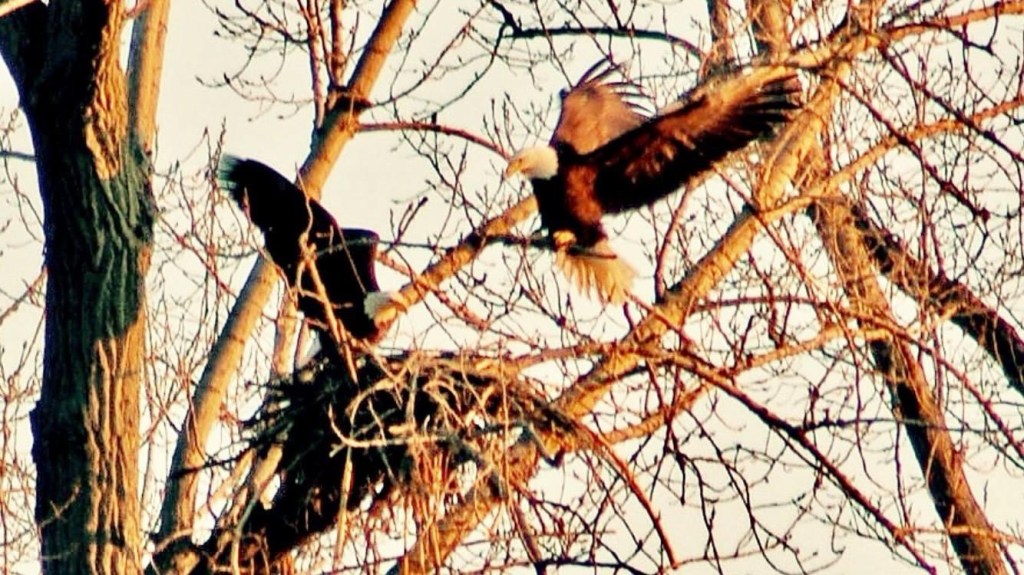
My Take Tuesday: Where the Eagles Fly
Above the timberline, soaring over the lofty mountains of the Manti Lasal National Forest fly two bald eagles. The eagle flies higher than other birds, and its vantage point must exceed that of any other creature. An eagle’s eye is almost as large as a human’s but its sharpness is at least four times that of a person with perfect vision. The eagle can identify prey moving almost a mile away. That means that an eagle flying at an altitude of 1000 feet over open country could spot prey over an area of almost 3 square miles from a fixed position.
To glimpse the soaring splendor of a pair of majestic bald eagles is a rare and wonderful sight. These beautiful birds fly through the deep blue skies that surround Castle Valley.
For some unknown reason, this pair of eagles chose an unusual spot to call home and build their nest. Leaving behind the towering mountain cliffs and desolate desert that closely surround Castle Dale, they instead selected a small clump of Cottonwood trees located in the corner of an open dry land alfalfa patch.
I recall my father purchasing this land in the late 1980’s. We plowed the blue clay soil and planted alfalfa on the areas that were fertile enough to support crop production.
The very next year, while we were feeding cows, we noticed two bald eagles perched in the clump of Cottonwood trees at the bottom of the field. I recall thinking how unusual it was to see two bald eagles in the same tree.
During the next few months, these eagles built a massive nest. We watched as they carried sticks and bark from miles away. The nest was an engineering marvel, built high in the tree below the crown supported by large solid branch extending straight east. The nest was constructed of interwoven sticks. The interior was lined with grass, corn stalks, branches, and other material. The bowl was filled with soft materials and their own downy feathers.
I recall the first eaglets born on the farm. In a rare event, 3 offspring were hatched and successfully raised. I remember seeing the newborn eaglets. They are covered with gray down, and so light they almost appear white. It isn’t until years later that their characteristic white head feathers develop as they reach adulthood. The babies grow rapidly, adding about a half pound to a pound of body weight every week until they are about 9-10 weeks old.
Every spring, I watched as these birds hatched, learned to fly and left the nest. Year after year, decade after decade, this process repeated itself producing many successful offspring.
Each breeding season, material was added to the nest and it’s size increased by up to a foot in height and diameter each year. The nest became visible from great distances as its size increased.
The bald eagles were a welcome sight. Each year they would appear right before Christmas. I remember seeing them consistently every year while growing up. They stood perched, looking down on my every move. A feeling of safety and security ensued as these majestic guardians stood watch. Their presence inspired insight, bravery, and wisdom.
Although we all recognize the Bald Eagle as the national symbol of the United States, and as a proud icon of patriotism. I feel they could serve just as well or better as symbols of faithful monogamy. When one of these birds of prey finds his or her mate, the pair stays together for life. They are strong and independent; they are survivors. They are majestic and bold. They are a symbol of strength and determination.
The third week in February each year coincided each year with the return of the magnificent birds to the nest in the cottonwood trees south of town.
There is safety in constancy, and measured security in consistency. I am glad that high in the blue skies above Castle Dale, there is a welcoming place, where the eagles fly.
And that is my take.
N. Isaac Bott, DVM
 DocBott