
My Take Tuesday: The Deluxe Fish Hotel
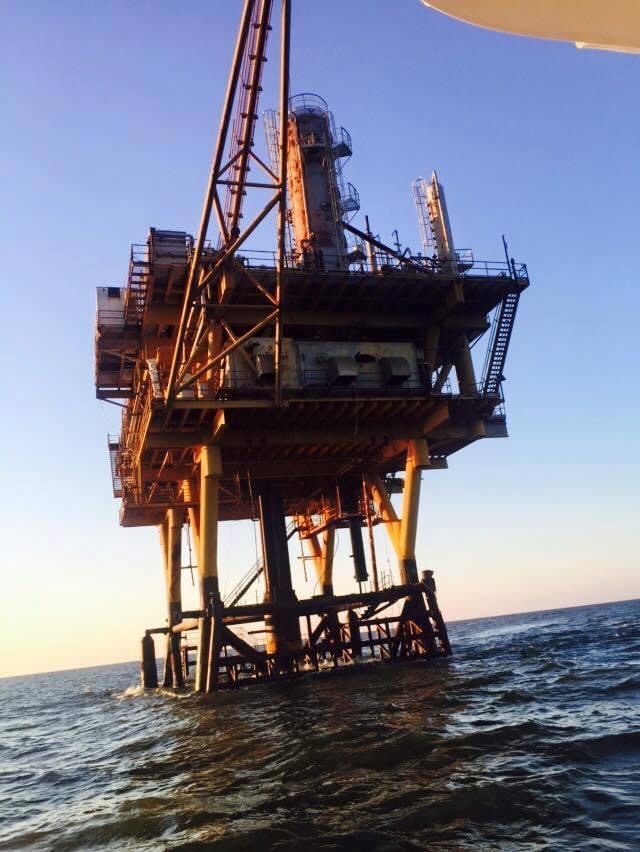
A few years back, I spent a day deep sea fishing with some of my best friends in the Gulf of Mexico. We traveled nearly 80 miles from Venice, Louisiana, out into the deep ocean. We were fishing for Yellowfin Tuna.
I found it interesting that our fishing guide knew right where to go. Instead of fishing in the deep open ocean, we spent the day fishing near a number of large man made oil rigs. Fish, it turns out, are turning the underwater portions of the rigs into the equivalent of apartment towers. They congregate in the masses near these huge man made structures. Smaller fish seek these rigs out for protection, while larger predator species stay close by to consume these large quantities of smaller fish that hide near the base of the structure.
The main reason, apparently, is the rig superstructures stretch all the way from the surface to the sea floor and thus provide a huge area that becomes the undersea equivalent of a tall building. The platform structures support a diverse community of invertebrates that, along with floating resources such as plankton, provide the base of the food web supporting fish associated with the platform.
For decades, scientists have studied why life is so abundant near these abandoned oil rigs. One researcher surveyed 16 rigs annually over a 15-year period, and found that they hosted 10 times the amount of fish as other natural marine environments around the world, such as reefs and estuaries. The California rigs even had seven times the aquatic population of the rich ecosystems around reefs in the south Pacific.
Even the natural habitat with the greatest fish density — a coral reef in French Polynesia — was nowhere near as populated as the oil rigs that were studied.
This study shows that man-made structures actually can enhance natural habitats.
The 2010 Deepwater Horizon oil spill disaster in the Gulf of Mexico made us all a lot more wary of the environmental impacts of offshore oil exploration. This study gives us another perspective on how man made structures can benefit certain ecosystems and enhance natural habitats.
This insight is adding momentum to efforts to convert some of these rigs into artificial reefs once they are decommissioned. Blue Latitudes, an organization founded in 2014 by two young scientists, is trying to increase awareness of the value of rigs as permanent homes for sea life.
I am not advocating an increase in deep sea drilling, but it would certainly be a good idea to figure out what specific features of these structures help fish to flourish, and then use this information to help enhance these endangered ecosystems.
And that is my take.
N. Isaac Bott, DVM
 DocBott