
My Take Tuesday: Don’t worry Doc, She’s a Tame Cow
“Is the cow where you can catch her?,” was my first question.
Preston was a longtime client and on this particular day he had a cow that was having difficulty calving.
Responses to this question can vary. On this particular occasion the gentleman stated, “Don’t worry Doc, she is a tame cow. I raised her on a bucket.” He then gave a caveat, “Besides, she is too sick to run.”
“I really do not like trying to pull a calf without restraining the cow. I don’t want to get hurt,” I replied.
“We could even tie her up to one of the pillars in the barn,” he continued.
Now clearly, this should have raised a red flag. A 1800 pound snorting bovine is not to be taken lightly. The thought of working on her without a squeeze chute was ludicrous. Just think of the danger I would be subjecting myself to. A well placed kick could easily end my career.
“Can you please help me out, Doc?”, he begged.
Veterinarians all have a soft spot. We like to help people, and often we do so placing our own health and wellbeing on the back burner.
“I guess I could stop by,” I replied, “But please be sure to have a good rope handy.”
“You got it Doc!,” He promised.
When I arrived, Preston had the cow tied up to the center pillar of the barn. The massive beam was actually an old telephone pole.
The cow stood, chewing her cud as if nothing was amiss. A foot was clearly sticking out from the back end of the cow. From the appearance and position of the foot, I could immediately tell it was a back leg.
Delivering a breached calf is no easy feat. The size of the calf would make it impossible to turn around, and the best option was to attempt to pull the calf as it presented. The test for delivery of a calf in the backwards presentation but normal position and posture differ because the fetus should be first rotated 45-90 degrees by crossing the legs before attempting delivery to take advantage of the widest diameter of the cow’s pelvis.
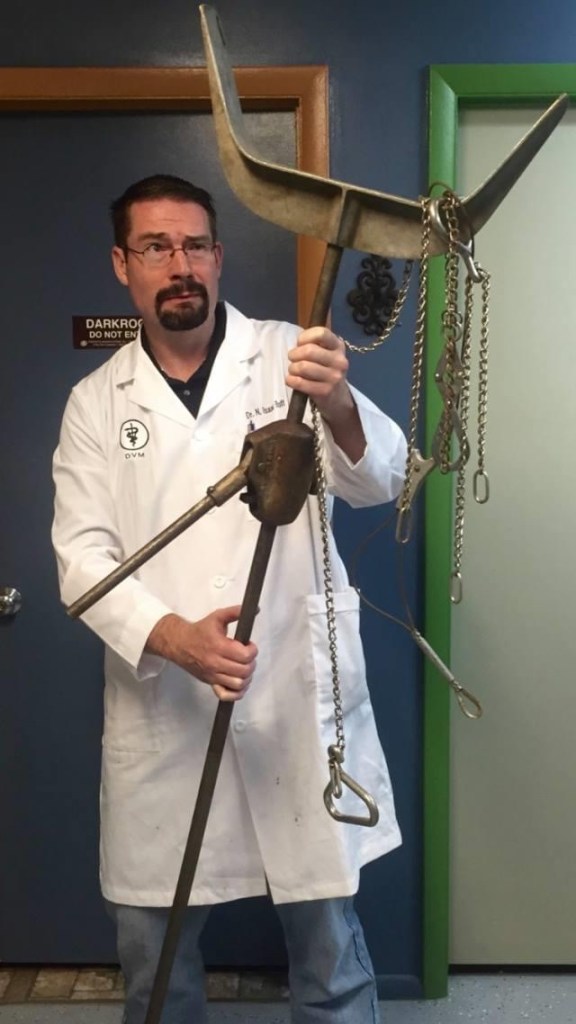
Most experts say you should not apply more force than that of two strong men pulling by hand. But, if you’re alone in assisting a difficult birth, a calf jack can help generate the necessary force. Luckily I had my calf jack with me.
A calf jack is a long pole with a adapter that sits against the backside of the cow, just below the birth canal. There is a handle and jack that move along the entire length of the pole. OB chains are attached to the calve’s legs and then are attached to the jack. Extreme care must be taken to not apply too much pressure while using a calf jack. The health of the calf and mother could easily be compromised if the instrument is used improperly.
I attached the chains to the jack and gently began to tighten the slack. As I applied traction, the cow went crazy! She began to jump and kick and swing her head. I jumped back as fast as I could. She bellowed and began kicking her back legs in the air as if she were a rodeo bull.
The calf jack was firmly attached and stuck out straight nearly 6 feet from her rear end. This device became a formidable weapon and this cow knew exactly what to do. She was able swing it with extreme accuracy.
And boy did she ever swing it!
My OB bag was the first victim. It went flying through the air spreading instruments all over the barn. My water bucket next was launched vertically, covering all of us with fetal fluid and blood tinged warm water.
In a swift motion, the cow pivoted on her front feet, swinging her back end in an abrupt 180 turn. My back was turned to her when this happened and it caught me completely off guard. The calf jack, still sticking straight out from her backside, struck me about 2” below the back of my knees. This caused me to do a partial backflip. I landed on the soft bed of straw head-first.
“Preston!,” I shouted, “I thought you said she was tame!”
“Well, Doc, I ain’t never hooked one of those on her before!” he replied, with a look of bewilderment in his eyes.
Together we grabbed a large panel and placed it along side the raging bovine. She immediately calmed down and I returned to my job.
The calf was born alive! It was a precocious solid black bull calf with a stripe of white extending down his forehead. It weighed nearly 120 pounds!
“Good job Doc!” Preston exclaimed, “I was a little worried there for a minute!”
“So was I,” I replied, “So was I.”
The pain in my calves finally set in as I walked back to my truck. I had a battle wound that took weeks to heal – a linear bruise left by the unforgiving calf jack stuck to the backside of a most formidable and sinister cow.
And that is My Take!
N. Isaac Bott, DVM
 DocBott