
Gratitude – Is it uniquely human?
Anthropomorphism is the attribution of human characteristics, such as emotion, to animals. While such comparisons are often inaccurate, there is some evidence that gives some merit to these comparisons.
Impala are large antelopes native to Africa that have been observed grooming each other. These grooming exchanges among African impala are usually unsolicited: one individual grooms the neck of a second individual, and then the second individual returns the favor, and grooms the first individual for an equivalent amount of time. It is thought that this mutual grooming behavior serves to remove ticks from parts of the body that an individual can’t reach itself.
Vampire bats, as you might expect, survive only on blood, and most feed at least once every three days. And while adult vampire bats regularly miss meals, they need not worry, as other individuals will regurgitate blood to feed them.
While the impala and vampire bat examples are interesting, they can be explained by much a simpler mechanism than gratitude: researchers call it symmetry-based reciprocity. That is, if members of a species preferentially direct favors to close associates, the distribution of favors will automatically be reciprocal due to the symmetrical nature of association. In other words, the mutual back-scratching of the impala and blood-vomiting of the vampire bat could simply be correlational: individuals who hang out together will tend to engage in reciprocal interactions, but only because they tend to hang out together.
In other species, the behavior extends beyond what is described above. For example, the common exchange of food for grooming among chimpanzees. To look at this further, researchers placed bundles of leaves and branches in the chimpanzee enclosures after the they had identified the patterns of grooming on a specific day. The adult chimps were more likely to share food with individuals who had groomed them earlier that same day.
In another experiment, primatologists Seyfarth and Cheney played recordings of vervet monkey calls and measured the reaction of recently groomed individuals. The type of vocalization that they used was a call used to threaten enemies and to solicit the support of friends, in anticipation of a conflict. When the recording was of a previous grooming partner, vervet monkeys paid more attention than when the recordings were of other individuals.
Taken together, these studies indicate that some non-human primates have the long-term memory abilities required for gratitude, as well as the ability to distinguish among individuals.
Another experience was described by a separate researcher. He tells a story about how two chimps had been shut out of their shelter by mistake during a cold rain storm. They were standing dejected, water streaming down their shivering bodies, when the researcher chanced to pass. Upon opening the door for the two chimps, Dr. James Leuba recounts, “instead of scampering in without more ado, as many a child would have done, each of them delayed entering the warm shelter long enough to throw its arms around his benefactor in a frenzy of satisfaction.”
Do animals have gratitude? It is still a much debated question. However, it is clear that some animals, such as chimpanzees and other non-human primates, seem to possess at least a more basic form of proto-gratitude, based on their ability to keep track of favors given to and received from different individuals.
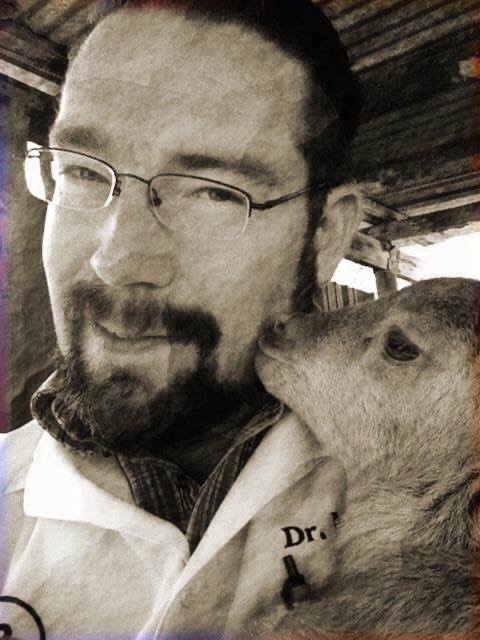
When pets are rescued and adopted, they seem to display a greater-than-average appreciation (e.g. tail wagging, purring) of our care and for the food we give them. I have witnessed this time and time again.
I believe gratitude is a shared emotion.
Happy Thanksgiving!
N. Isaac Bott, DVM
What are your thoughts?
 DocBott