
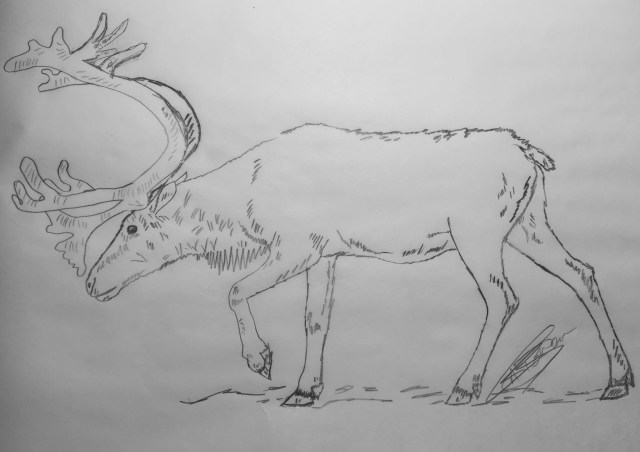
The Human-Reindeer Connection
Humans have been interacting with reindeer for at least 40,000 years.
A reindeer engraved on the wall of a cave in south Wales has been confirmed as the oldest known rock art in Western Europe. It is believed to have been created at least 14,000 years ago!
A recent study on reindeer mtDNA identified at least two separate and apparently independent reindeer domestication events, in eastern Russia and Fenno-Scandia (Norway, Sweden and Finland). Substantial interbreeding of wild and domestic animals in the past obscures DNA differentiation, but even so, the data continue to support at least two or three independent domestication events, probably within the past two or three thousand years.
When people think of reindeer, they often visualize Rudolf and his friends pulling Santa’s sleigh. As cute as this image may be, there is so much more to these fascinating creatures.
Their ecology, physiology, and anatomy are very unique. They have been domesticated for thousands of years, yet we know very little about them from a veterinary standpoint. Attempts at artificial insemination, embryo transfer and other reproductive technologies have been met with considerable challenges and mixed results.
Although many sources erroneously claim that caribou and reindeer are the same – Caribou and Reindeer are different subspecies. Reindeer are classified as Rangifer tarandus tarandus and the alaskan caribou are classified as Rangifer tarandus granti. Even National Geographic and many prominent zoos in the United States are wrongly classifying these animals. A recent genetic mapping published in Nature shows the migration pattern of these mammals over the last 21,000 years, and shows that they are actually different animals — but closely related cousins.
I never considered working on reindeer while in veterinary school, yet they have become an important species to me as a practicing veterinarian. I have traveled all over North America and Asia working on this species.
Reindeer have a long history in culture and myth. That history has given way to further study to learn about how unique they are. I have been privileged to be a part of some of these scientific advancements.
 DocBott