
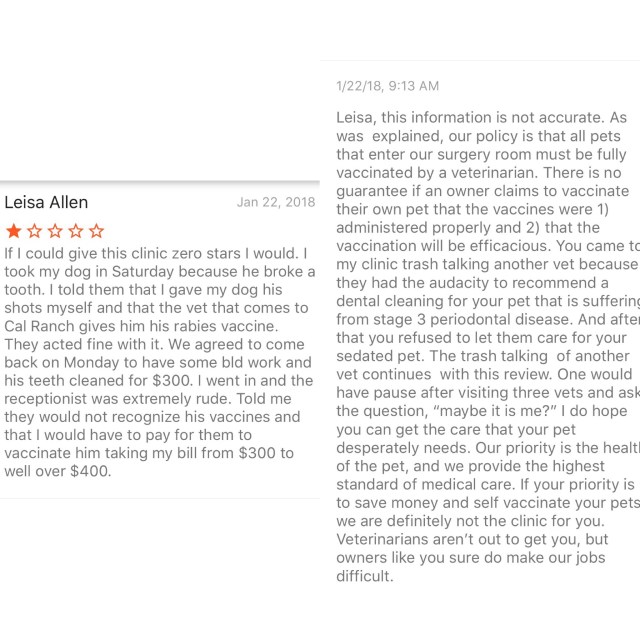
My Take Tuesday: The Negative Review
When was the last time you heard of someone phone shopping for the price of their hysterectomy? Imagine being on the receiving end of such a phone call. As strange as it may sound, this is something that veterinary clinics deal with every single day.
Our policy at Mountain West Animal Hospital is not to give estimates for surgical procedures without first seeing a pet. Prices vary greatly with most medical care, especially surgery. Every animal is unique and individual. Prices vary on the need of each animal. Depending on health and condition some patients require different anesthesia, more care, different treatments to go home and so forth. There are myriads of variables that must be considered when providing an estimate for a surgical procedure and a thorough physical examination is required to provide such an estimate accurately.
Despite the misinformed general public perception, a “spay” is not a simple surgery. The ovaries are held in place, in close proximity to the kidneys, by a ligament. Arteries that branch from the aorta supply the blood to each ovary. Two additional arteries provide the blood supply to the uterus. Each of these 4 major arteries are ligated during a “routine” spay. This is a very invasive procedure. Despite this, the total cost to spay a 100 pound dog is still only around $300. In contrast, the total cost to perform an ovariohysterectomy (“spay”) on a 100 pound woman is about $40,000 – over one-hundred times as much!
As a veterinarian, I have always been interested in parallels between my profession and the human health care profession. While veterinarians, on some levels, seem to try to model what we do after “how it’s done in human medicine”, there are some things that I hope we will always do differently.
We have been able to keep our fees for most procedures relatively low compared to the same procedures in human medicine. The reasons for this difference are numerous, but in my opinion come down to mostly two things. The first is that we, as human patients, have become so dependent on insurance to cover our medical bills that we have removed competition from the equation.
Another major difference between veterinary medicine and human health care is the degree of specialization. Yes we do have a growing number of specialties in veterinary medicine, including surgeons, cardiologists, neurologists, dermatologists etc., etc., but for the most part, we as general practitioners, are still able to do what we feel we are capable and qualified to do. Therefore, we are able to treat most problems that arise in pets very efficiently and without having to refer our patients to a specialist for everything more severe than a laceration or an ear infection.
All to often in human medicine, many different specialty practitioners share in the care of a patient. As Dr. Bob Encinosa has observed, “One doctor takes care of Mary’s diabetes, while another takes care of her heart condition and yet another handles her dementia or her arthritis. It becomes very easy to overlook the question, “How is Mary?”
At Mountain West Animal Hospital, we provide individualized care. We strive to provide the best possible veterinary care for our patients by maintaining and utilizing state of the art facilities and equipment, and by employing and developing a well-trained competent and caring staff. We are dedicated to providing friendly, compassionate service to our clients in an atmosphere of professionalism, respect and concern. We advocate community and client responsibility in improving the welfare of animals. We seek to be a positive, contributing influence within the community we serve.
Unfortunately, occasional negative reviews are posted that reflect a lack of respect for our high standard of care and commitment to pets. If you appreciate our individualized care, I encourage you to provide a positive google review.
I feel that we have the best clients and patients out there. I consider myself blessed to work with such extraordinary people and to be able to help their beloved four-legged family members.
And that is my take!
N. Isaac Bott, DVM
 DocBott